

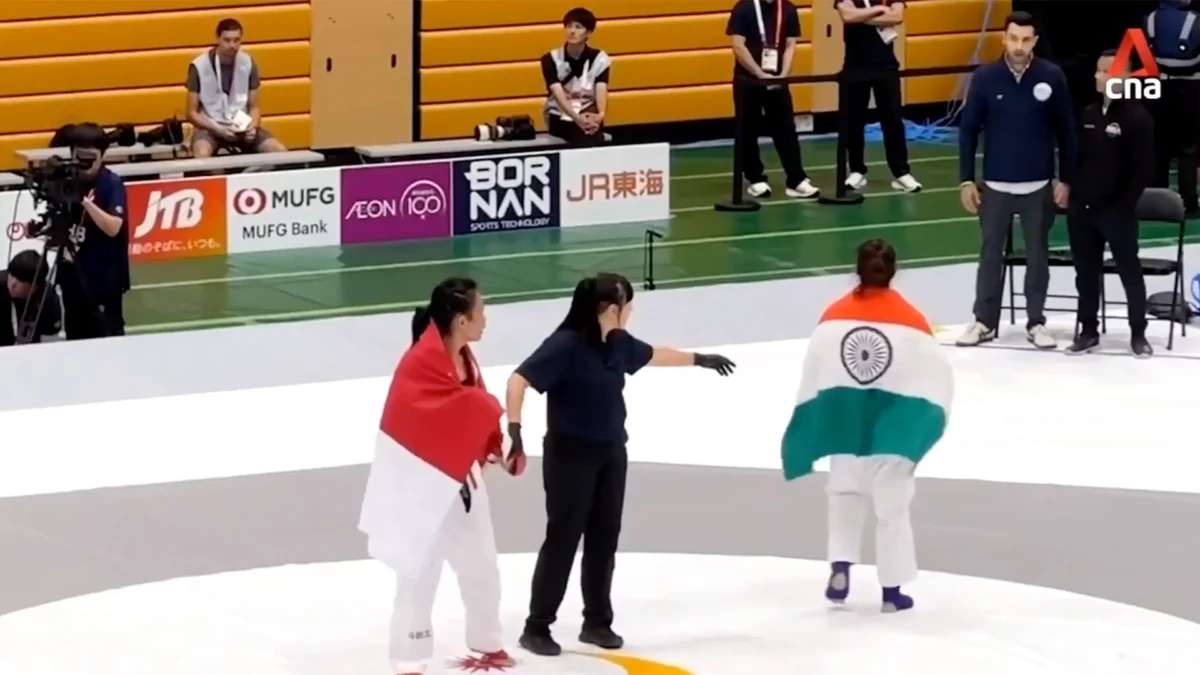
India’s debut medal in Mixed Martial Arts (MMA) at the Asian Games has been significantly overshadowed by a contentious semi-final bout involving Suchika Tariyal, who controversially refused to shake hands with her Singaporean opponent following a defeat and subsequently accused the Asian MMA Association (AMMA) of favoritism towards Singapore. The incident, which occurred during the highly anticipated women’s bantamweight semi-final on September 22, 2026, has ignited a fierce debate about sportsmanship, officiating integrity, and the pressures faced by athletes on an international stage, casting a shadow over what was otherwise a historic moment for Indian combat sports.
Chronology of a Contentious Bout
The lead-up to the women’s bantamweight semi-final at the Asian Games was marked by considerable anticipation, particularly for Suchika Tariyal, who had demonstrated formidable skill in her previous matches. Tariyal, a seasoned fighter from Haryana, India, was seen as a strong contender for gold, representing a nation increasingly investing in and excelling at combat sports. Her journey to the semi-finals had been dominant, characterized by decisive victories and showcasing a blend of striking prowess and grappling acumen. The semi-final bout pitted her against Singapore’s rising star, Sarah Lim, who had also impressed spectators with her strategic fighting style.
The match itself, held at the Hangzhou Sports Park Gymnasium, was a closely contested affair from the outset. Both fighters exhibited high levels of technical skill and physical endurance across three intense rounds. According to initial reports and eyewitness accounts, the first round saw Tariyal establish an aggressive rhythm, landing several significant strikes and briefly securing a takedown. Lim, however, responded effectively in the second round, employing clever footwork and counter-striking to mitigate Tariyal’s offense and land her own impactful combinations. The third and final round was arguably the most critical, with both athletes pushing their limits in pursuit of a decisive advantage. The judges’ decision, when announced, awarded the victory to Sarah Lim via split decision, a verdict that immediately drew a strong reaction from the Indian contingent and a visible look of disbelief from Tariyal.
It was in the immediate aftermath of this announcement that the controversy erupted. As is customary in combat sports, the referee motioned for both fighters to approach the center of the octagon for the traditional post-fight handshake. While Lim extended her hand, Tariyal, visibly distraught and shaking her head, declined the gesture, turning away from her opponent and the official. Her subsequent comments to the media further inflamed the situation, where she explicitly stated her belief that the decision was unjust and that the Asian MMA Association had shown favoritism towards her Singaporean rival, without specifying the exact nature of the perceived bias. This unprecedented refusal and direct accusation instantly became the focal point of discussion, overshadowing Lim’s victory and India’s guaranteed first-ever MMA medal (a bronze for Tariyal as a semi-finalist).
Background: MMA’s Emergence and India’s Ambitions
Mixed Martial Arts has witnessed an explosive global surge in popularity over the past two decades, transitioning from a niche sport to a mainstream phenomenon. Its inclusion in multi-sport events like the Asian Games marks a significant milestone, signifying its growing recognition and legitimacy in the broader athletic landscape. For nations like India, with a rich history in traditional wrestling and combat disciplines, MMA represents a new frontier for sporting excellence and international acclaim. The Indian Olympic Association (IOA) and the national MMA federations have increasingly channeled resources into developing talent, establishing academies, and providing international exposure to promising fighters.
The Asian Games, often dubbed the second-largest multi-sport event after the Olympics, serves as a crucial platform for athletes to showcase their skills and for their respective countries to demonstrate sporting prowess. For India, a nation of over a billion people, every medal carries immense national pride and can inspire a new generation of athletes. Suchika Tariyal, having navigated the demanding qualifiers and early rounds, carried the hopes of millions. Her presence in the semi-finals guaranteed India its first MMA medal, a historical achievement that was meant to be a moment of unbridled celebration. The controversy, however, quickly diverted attention from this landmark accomplishment, shifting the narrative from triumph to perceived injustice. The Asian MMA Association (AMMA) is the continental governing body responsible for regulating and promoting MMA in Asia, including sanctioning events and overseeing officiating standards. Its integrity is paramount to the fair conduct of the sport in the region.
Disputed Decisions and the Perception of Bias
The core of Tariyal’s accusation lies in the subjective nature of judging in combat sports, particularly when a bout goes the distance and is decided by points. Unlike a knockout or submission, which provides a clear outcome, a judges’ decision relies on their interpretation of effective striking, grappling, control, aggression, and defense over the course of the rounds. In a split decision, where not all judges agree on the winner, the perception of a contentious outcome is naturally heightened.
While Tariyal did not provide specific details regarding the alleged favoritism, her statement implied a systemic bias within the AMMA’s officiating structure. This could encompass several areas:
- Refereeing Decisions: Any perceived inconsistencies in breaking up clinches, standing up fighters, or issuing warnings for fouls.
- Judging Criteria Application: Questions over how judges weighed various aspects of the fight. For instance, did they overvalue Lim’s counter-striking compared to Tariyal’s aggressive forward pressure and takedown attempts?
- Scorecard Transparency: The opacity of individual judge scorecards immediately after a decision can fuel speculation, especially in high-stakes bouts.
Sports analysts who reviewed the fight footage noted the extreme closeness of the contest, with arguments to be made for both fighters winning. Some pundits pointed to Tariyal’s higher volume of significant strikes in the first and third rounds, while others highlighted Lim’s defensive prowess and effective counter-attacks in the second. The divergence in expert opinions underscores the inherent difficulty in judging such finely balanced matches. However, Tariyal’s direct accusation of "favoritism" goes beyond mere disagreement with a subjective decision, suggesting an underlying prejudice that she believes influenced the outcome. This claim, if substantiated, would have severe ramifications for the AMMA and the integrity of MMA as an Olympic-recognized sport.
Statements and Official Responses
The aftermath of the controversial bout triggered a cascade of reactions from various stakeholders:
Suchika Tariyal (India): In an emotional post-fight interview, Tariyal stated, "I gave my everything, I felt I won that fight. This decision, it’s not fair. I believe the Asian MMA Association has a bias, especially when it comes to certain countries. I felt it during the fight, and the decision confirmed it. I cannot shake the hand of someone who won unjustly." Her statements, delivered with raw emotion, resonated deeply with Indian fans and the wider sporting community.
Indian Olympic Association (IOA) / Indian MMA Federation: The IOA, through its chef de mission, issued a statement expressing "deep disappointment" over the outcome and Tariyal’s allegations. "We stand firmly behind Suchika Tariyal," the statement read. "We believe our athlete fought valiantly and deserved a fair assessment. We are currently reviewing the fight footage meticulously and are exploring all available avenues to formally appeal the decision to the Asian MMA Association, in accordance with the established rules and regulations of the Games. We demand complete transparency in the judging process."
Asian MMA Association (AMMA): In response to the growing controversy, an AMMA spokesperson released a formal statement acknowledging the appeal process. "The Asian MMA Association maintains the highest standards of integrity and impartiality in all its officiating and judging," the statement affirmed. "All judges and referees undergo rigorous training and certification. We understand the intense emotions involved in high-stakes competitions, and we respect every athlete’s right to appeal. We will initiate a thorough review of the bout, including detailed analysis of the judges’ scorecards and the referee’s conduct, as per our established protocols. We are committed to upholding fair play and ensuring justice for all competitors." The AMMA did not, however, directly address the specific accusation of "favoritism" beyond its general assertion of impartiality.
Sarah Lim (Singapore): The Singaporean victor, while accepting the bronze medal (as per rules, semi-final losers both get bronze), expressed regret over the handshake refusal but refrained from engaging with the bias claims directly. "I fought my best, and the judges made their decision," Lim commented. "It’s a tough sport, and emotions run high. I respect Suchika as a fighter, and I was ready to show that respect. I hope she finds peace with the result." Her comments were measured and focused on her own performance and the competitive nature of MMA.
Singapore National Olympic Council (SNOC): The SNOC congratulated Sarah Lim on her historic medal for Singapore. "We are immensely proud of Sarah Lim’s performance and her dedication," an SNOC representative stated. "We trust in the integrity of the Asian Games’ officiating bodies and believe that all decisions are made with fairness and adherence to rules. We hope for continued sportsmanship from all participating nations."
Independent Sports Analysts: Combat sports analysts, such as Dr. Rohan Sharma, a sports ethics lecturer, offered a broader perspective. "Judging combat sports, especially MMA with its complex scoring criteria, is inherently challenging and often subjective," Dr. Sharma explained. "While athletes are always advised to respect decisions, the emotional toll of a perceived unjust loss in a major event can lead to such outbursts. The AMMA’s transparency in the appeal process will be crucial here, not just for this case, but for reinforcing trust in the sport’s officiating."
Rules and Regulations: The Appeal Process
The rules governing multi-sport events like the Asian Games, and specific federations like the AMMA, include provisions for disputing official results. Typically, an appeal must be filed within a strict timeframe (e.g., 24-48 hours) following the contested event, accompanied by a formal protest letter and often a video analysis of the disputed decisions. The grounds for appeal are usually limited to clear errors in rule application, judging procedure, or blatant refereeing mistakes that demonstrably altered the outcome, rather than simply disagreeing with a subjective score.
The appeal would likely be heard by an independent review panel appointed by the AMMA, possibly with oversight from the Asian Games organizing committee’s appeals tribunal. This panel would scrutinize the fight footage, judges’ scorecards, and any relevant reports from officials. The potential outcomes of such an appeal are varied:
- Appeal Denied: The original decision stands, which is the most common outcome due to the high bar for overturning subjective judging calls.
- Decision Overturned: A rare outcome, usually reserved for clear and undisputed errors.
- No Contest: The fight result is nullified, though this is even rarer in professional sports and typically applies to instances of rule violations or external interference.
- Review and Recommendation for Future Improvement: While the result might not change, the review could lead to recommendations for improving judging protocols or official training.
Given the high-profile nature of the event and the explicit accusation, the AMMA’s handling of the appeal process will be under intense scrutiny, not just from India but from the entire MMA community.
Broader Implications and Future Outlook
The controversy surrounding Suchika Tariyal’s semi-final bout carries significant implications across several dimensions:
- Sportsmanship and Etiquette: The refusal of a handshake, while emotionally understandable from Tariyal’s perspective, is widely seen as a breach of sporting etiquette. Such actions, particularly on a global stage like the Asian Games, can negatively impact the perception of the athlete and their nation’s sporting conduct. It raises questions about the balance between expressing frustration and upholding the spirit of competition.
- Integrity of the Asian MMA Association: Tariyal’s direct accusation of favoritism poses a serious challenge to the AMMA’s reputation and credibility. In a rapidly growing sport that strives for Olympic inclusion, maintaining absolute impartiality in officiating is paramount. Any hint of bias, whether real or perceived, can undermine trust among athletes, federations, and fans. The outcome of the appeal and the transparency of the AMMA’s investigation will be critical in either validating or dispelling these concerns.
- India-Singapore Sporting Relations: While unlikely to cause a major diplomatic incident, such controversies can create minor friction in sporting relations between countries. It adds an unwanted layer of tension to otherwise friendly rivalries.
- Impact on Suchika Tariyal’s Career: While the incident guarantees her a bronze medal and national recognition, the controversy could also define her narrative for some time. Her refusal to shake hands might draw criticism from some quarters, even as others laud her for standing up for what she believes is right. Her mental fortitude and ability to rebound from this experience will be crucial for her future in the sport.
- Future of MMA Officiating: The incident may prompt a broader discussion within AMMA and other MMA governing bodies about enhancing judging transparency, standardizing criteria, and potentially exploring technology to assist officials, similar to VAR in football. The need for clear, unambiguous explanations for contentious decisions is more apparent than ever.
- Call for Enhanced Transparency: The incident highlights the ongoing demand from athletes and the public for greater transparency in judging processes, especially in subjective sports. Open scorecards, detailed explanations of criteria application, and robust, independent appeal mechanisms are often cited as ways to mitigate such controversies.
As the Asian Games continue, the spotlight will remain on the AMMA’s response to the appeal and the broader dialogue sparked by Tariyal’s actions. What began as a historic moment for Indian MMA has evolved into a significant test for the integrity of Asian combat sports, underscoring the delicate balance between competitive zeal, fair play, and the objective application of rules. The resolution of this controversy will undoubtedly shape the future trajectory of MMA at major international sporting events.
