

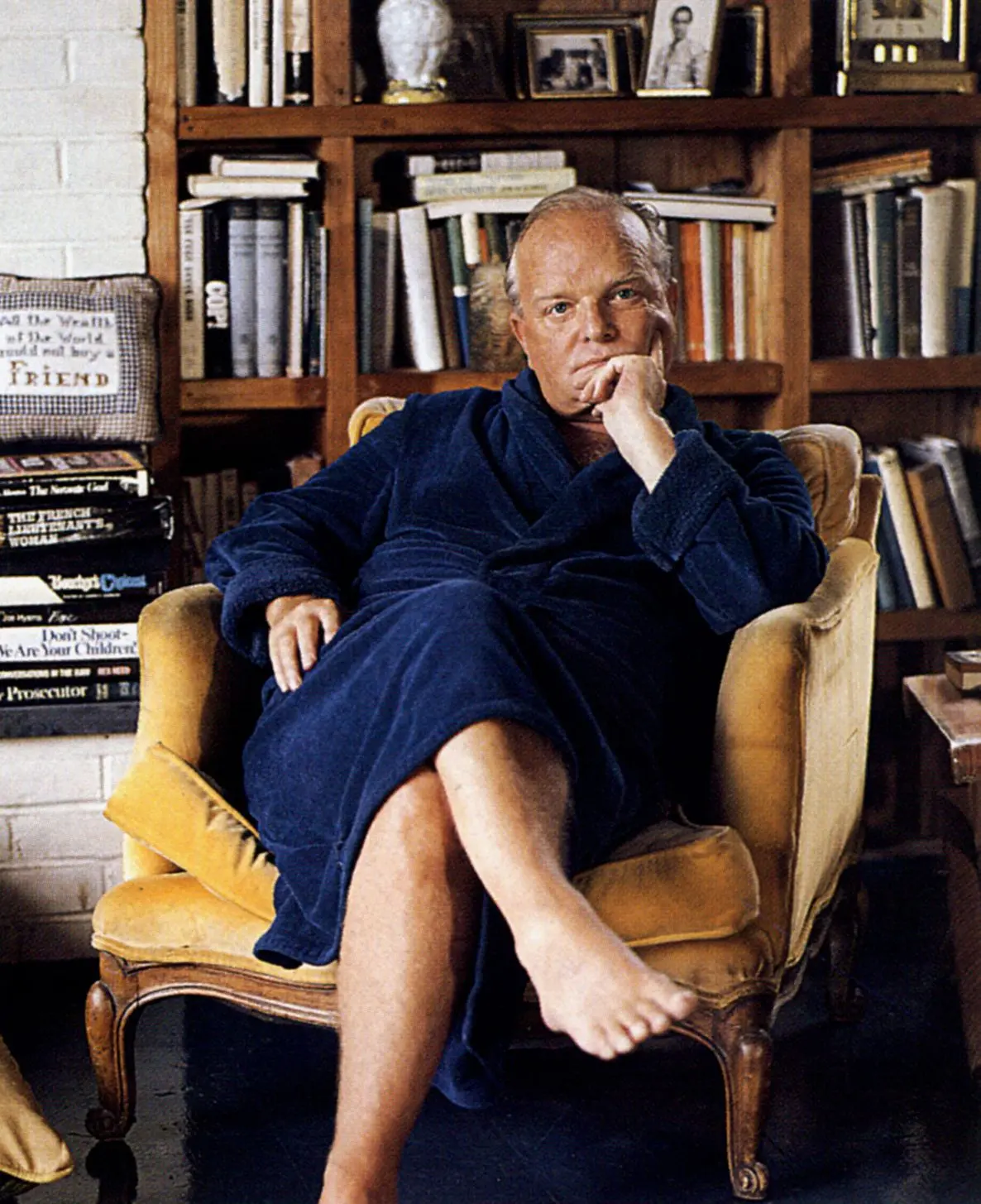
The tangible remnants of one of the twentieth century’s most enigmatic literary figures are set to transition from private hands to the public marketplace. Nearly 400 items belonging to Truman Capote, the celebrated author of In Cold Blood and Breakfast at Tiffany’s, will be offered at auction this November. The sale, organized by the Bellport-based Cornell Auction house in New York, represents a significant moment for literary historians and collectors alike, offering an intimate glimpse into the private life of a man who was as famous for his social maneuverings as he was for his prose.
The collection comes to market via Gerald Clarke, the 89-year-old biographer and close confidant of Capote. Clarke, who published the definitive biography of the author in 1988, inherited a vast majority of Capote’s personal effects following the writer’s death in 1984. After four decades of stewardship, Clarke is downsizing his own holdings, providing the public with a rare opportunity to acquire objects that Capote once touched, used, and curated within his various residences.

The Auction Schedule and Provenance
The Cornell Auction sale is officially scheduled for November 21, with an online preview and bidding period beginning on October 26. While the full catalog remains under final preparation, early revelations suggest a collection that mirrors Capote’s eclectic and often contradictory personality. The provenance of the items is bolstered by their historical documentation; many of the objects slated for sale were photographed exactly 50 years ago for a 1976 Architectural Digest feature on Capote’s Sagaponack home.
The significance of this auction lies not only in the items themselves but in their survival. Following Capote’s death at the age of 59, his estate was handled with care by Clarke, ensuring that the "personal stage" Capote built for himself remained largely intact. The upcoming sale is expected to draw international interest, following a recent trend of high-profile literary estate auctions, such as those of Joan Didion and Sylvia Plath, which saw mundane objects fetch prices far exceeding their utilitarian value.
Highlights of the 400-Lot Collection
Among the most anticipated items in the auction is Capote’s extensive collection of paperweights. Gerald Clarke noted in recent interviews that Capote became "addicted" to these glass and resin spheres, viewing them as small, contained universes. The collection includes high-end antique pieces as well as those crafted by Capote himself, who experimented with preserving flowers in resin. Perhaps the most poignant of these is a paperweight containing rocks gathered from the Kansas farm where the Clutter family murders occurred—the central subject of Capote’s 1966 masterpiece, In Cold Blood.

Beyond the paperweights, the auction includes items that speak to Capote’s deep-seated literary and social connections. A signed copy of To Kill a Mockingbird by Harper Lee is among the premier lots. Lee and Capote were childhood friends in Monroeville, Alabama; Lee famously assisted Capote with the research for In Cold Blood, and she modeled the character of Dill Harris in her own novel after him.
Other items range from the whimsical to the utilitarian:
- A bronze frog-shaped inkwell, reflecting Capote’s penchant for animal-themed decor.
- The original house keys to his Sagaponack residence.
- Needlepoint pillows, some of which were gifted by his "Swans," the circle of high-society women—including Babe Paley and C.Z. Guest—whom he famously befriended and later betrayed.
- Personal photographs and signed books that document a life spent at the intersection of the literary avant-garde and the New York elite.
The Sagaponack Sanctuary: "Kansas with a Sea Breeze"
A substantial portion of the items originated from Capote’s home in Sagaponack, New York. Built in 1962, the residence served as a vital retreat for the author during his most productive and, later, his most turbulent years. Capote described the then-quiet farming community of the South Fork as "Kansas with a sea breeze," a nod to the rolling potato fields that reminded him of the Midwestern landscapes he traversed while writing In Cold Blood.

The house itself was an architectural reflection of Capote’s desire for "run-down comfort." Designed to his specific directions, the two-story wooden structure featured an unconventional "raincoat" construction, where the exterior walls were exposed to reveal vertical studs and horizontal bracings. This gave the home a rustic, unfinished aesthetic that contrasted sharply with the sleek, polished interiors of his United Nations Plaza apartment in Manhattan.
In the 1970s, Sagaponack was not the billionaire’s row it is today; it was a "rural Montparnasse" populated by artists and writers such as Willem de Kooning, James Jones, and Joseph Heller. Capote’s life there was defined by a deliberate reclusion. He famously claimed that in fourteen years of residence, he had gone out for dinner only six times, preferring the company of his English bulldog, Maggie, and a small circle of trusted friends.
Chronology of a Literary Life
To understand the weight of the items up for auction, one must look at the timeline of Capote’s career and the role these possessions played in his creative process:

- 1948: Publication of Other Voices, Other Rooms catapults a young Capote to fame.
- 1958: Breakfast at Tiffany’s is published, cementing his status as a chronicler of New York life.
- 1959–1965: Capote spends years researching and writing In Cold Blood. During this period, he begins accumulating many of the items found in the Sagaponack house.
- 1966: The Black and White Ball at the Plaza Hotel marks the pinnacle of his social standing.
- 1975–1976: The publication of "La Côte Basque, 1965" in Esquire leads to his social ostracization by the "Swans." This era coincides with the Architectural Digest spread that documented his home.
- 1984: Capote dies in Los Angeles. Gerald Clarke begins the task of cataloging his legacy.
- 2024: The television series Feud: Capote vs. The Swans reignites public interest in his personal life, setting the stage for the November auction.
Analysis: The Market for Literary Legacies
The upcoming sale at Cornell Auction is part of a broader cultural phenomenon where the personal effects of authors are treated as secular relics. In the world of high-end auctions, items owned by iconic writers often carry a "celebrity premium" that transcends their material worth. When Joan Didion’s estate was sold in 2022, a pair of her Celine sunglasses sold for $27,000, while a plain marble paperweight fetched $13,000.
Capote’s estate is expected to follow a similar trajectory. The items are not merely furniture or trinkets; they are the stage props of a meticulously crafted public persona. For collectors, owning Capote’s house keys or a paperweight he made by hand is a way to bridge the gap between the myth of the author and the reality of the man.
Furthermore, the timing of the auction is strategically aligned with a resurgence of Capote in the cultural zeitgeist. The 2024 miniseries Feud: Capote vs. The Swans has introduced a new generation to the writer’s complicated legacy, likely driving up demand among younger collectors and institutions.

Official Responses and Implications
While the full impact of the sale won’t be known until the hammer falls on November 21, representatives from the Cornell Auction house have expressed a commitment to preserving the narrative context of the items. By referencing the 1976 Architectural Digest photography, the auction house is providing a "visual map" of how these objects functioned in Capote’s daily life.
Gerald Clarke’s decision to sell these items marks the end of an era. For forty years, these objects were part of a private archive used to document and understand Capote’s life. Their dispersal into various private and public collections means that while the "shrine" to Capote’s Sagaponack life will be dismantled, his physical legacy will be shared among a wider audience of enthusiasts.
As the literary world looks toward the November sale, the auction stands as a final chapter in the story of a man who once said, "I am always drawn back to places where I have lived, the houses and the neighborhoods." Through these 400 lots, the public is finally invited into those houses, offering a closing look at the private world of Truman Capote.
