

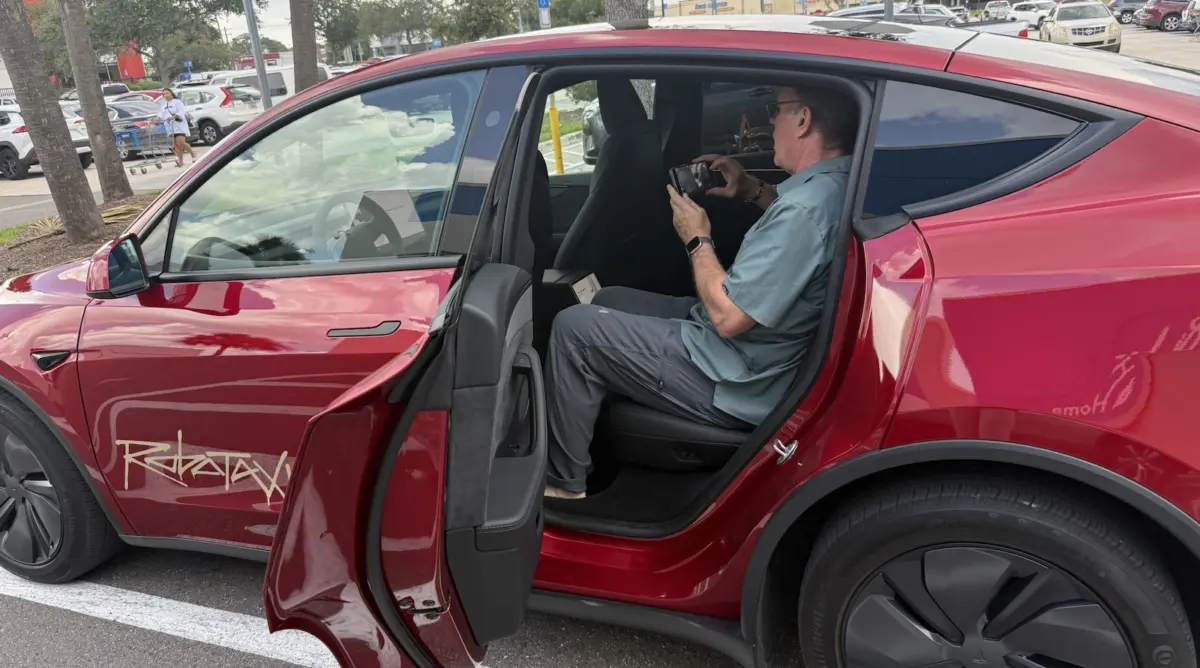
Tesla’s autonomous driving division has achieved a significant milestone in the competitive landscape of robotaxis, officially surpassing Waymo in weekly driverless miles within the Austin, Texas, metropolitan area. According to recent performance metrics and fleet data, Tesla’s unsupervised miles have surged from 250,000 in the previous quarter to a current rate of approximately 3.3 million miles. If the company maintains its current 20% weekly growth trajectory, projections indicate that Tesla will overtake Waymo’s national mileage totals within 11 weeks. Furthermore, by mid-February 2027, Tesla is positioned to match the combined ride-hailing volume of industry giants Uber and Lyft across three major Texas hubs: Austin, Dallas, and Houston.
This rapid expansion signals a shift in the autonomous vehicle (AV) sector, where the debate between hardware-heavy systems and vision-based software is reaching a critical inflection point. As Tesla accumulates unsupervised miles at an exponential rate, the resulting data pool is becoming sufficiently large to provide statistically significant answers regarding safety comparisons between human drivers, Waymo’s LiDAR-equipped fleet, and Tesla’s vision-only approach.
The Mathematical Path to Market Leadership
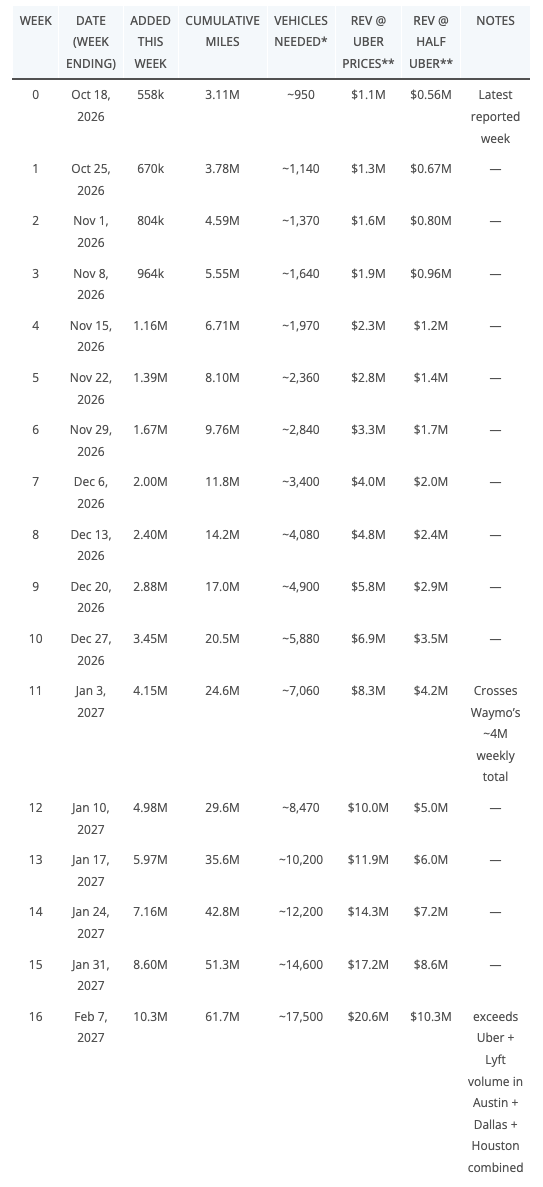
The transition from supervised Full Self-Driving (FSD) to unsupervised robotaxi operations has moved with unexpected velocity. During Tesla’s Q3 2026 earnings summary, the company revealed a jump in unsupervised miles that implies a compound weekly growth rate of 20%. To understand the implications of this growth, analysts have mapped out a "crossover" timeline against established competitors.
Starting from a baseline of approximately 558,000 unsupervised miles per week, a 20% weekly increase would see Tesla crossing Waymo’s current national total of roughly 4 million weekly miles in less than three months. By the 16-week mark, Tesla’s weekly volume could reach 10 million miles. At this scale, the service would account for more than half of the current ride-hailing market share in the Texas "Golden Triangle" of Austin, Dallas, and Houston.
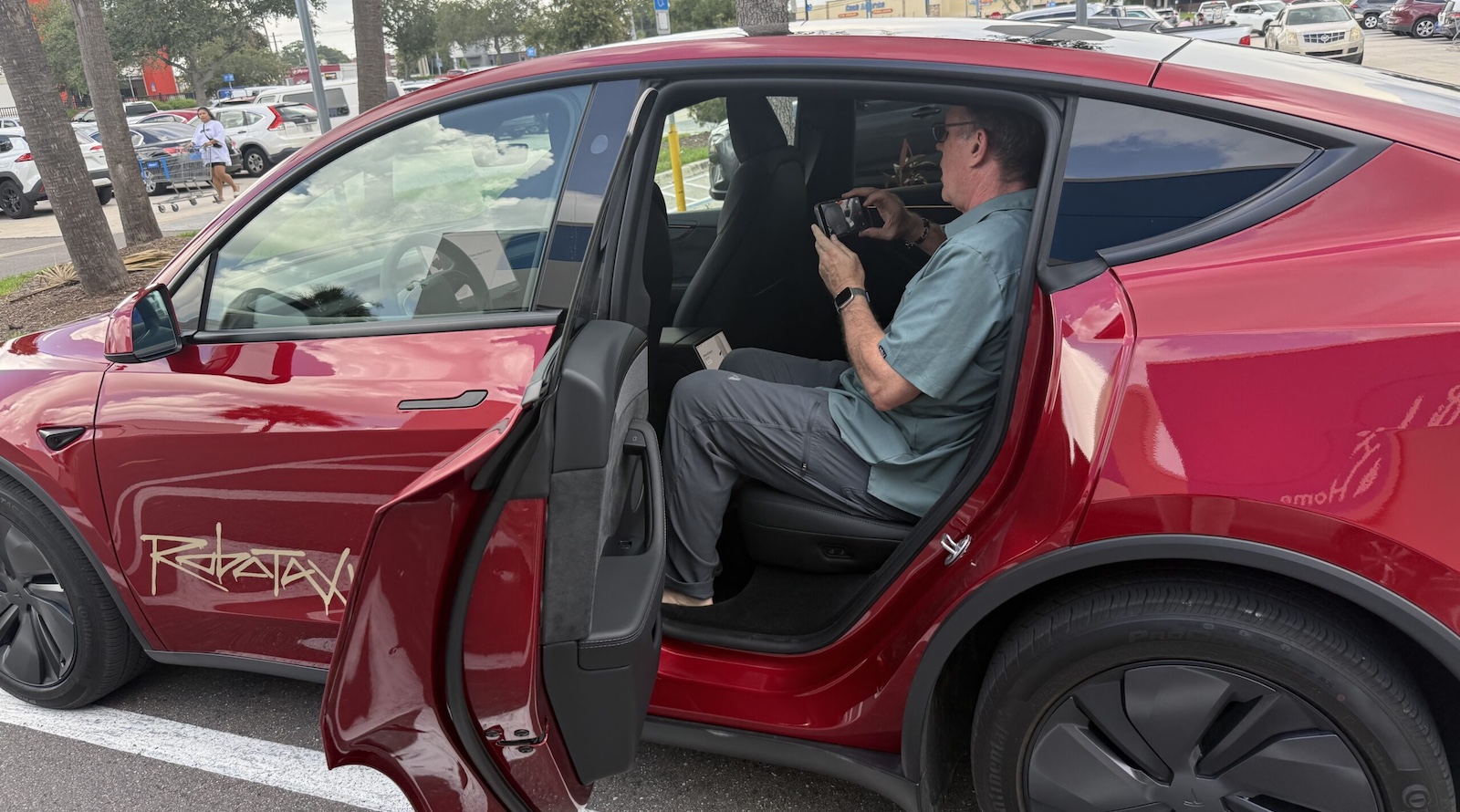
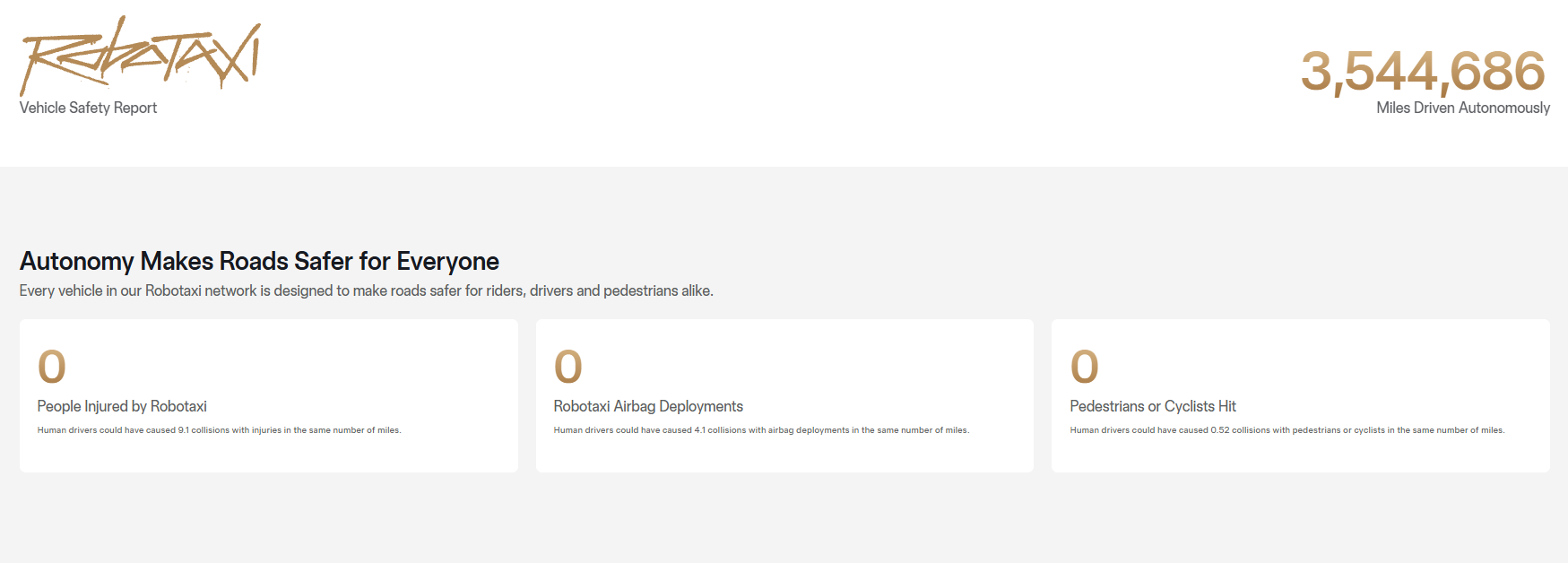
This growth is supported by a rapidly expanding fleet. As of late October 2026, Texas DMV registry data indicates approximately 927 Tesla vehicles—comprising both the purpose-built Cybercab and specifically configured Model Y units—are registered for robotaxi operations across Texas and Florida. The scalability of this fleet depends on maintaining constant utilization rates and the continued deployment of hardware from Tesla’s Gigafactories.
Competitive Divergence: Waymo’s Plateau and Tesla’s Surge
While Tesla’s growth appears to be in its "launch phase" exponential curve, its primary competitor, Waymo, has shown signs of a maturing, and perhaps slowing, deployment model. Through the end of June 2026, Waymo logged a cumulative 271.3 million rider-only miles. However, sequential growth has cooled significantly. In Q2 2026, Waymo added 50.7 million miles, representing a modest 1.6% increase over Q1.
City-level data further illustrates this cooling trend. In Phoenix, Waymo’s longest-running market, the company has posted two consecutive quarterly declines in mileage. In Austin, where Tesla has just taken the lead, Waymo’s quarter-over-quarter growth plummeted from over 100% in early 2025 to just 4% by mid-2026. While Waymo continues to expand into new markets like Atlanta and Los Angeles, the overall percentage growth of its installed base is no longer keeping pace with the aggressive scaling seen in Tesla’s Texas operations. Even if Waymo were to return to its historical 15% quarterly growth rate, it would still be vastly outpaced by the 970% quarterly growth implied by Tesla’s current weekly performance.
Regional Dominance in the Texas Market
The battle for autonomous supremacy is currently focused on three specific Texas metros, each presenting a unique set of challenges and opportunities:

- Austin: With a population of roughly 2.5 million, the metro area sees approximately 315 million vehicle-miles traveled (VMT) per week. Tesla’s most recent tracked week in Austin reached 438,000 miles, edging out Waymo’s 400,000 miles. Despite the milestone, both companies currently represent a tiny fraction of the total driving demand, suggesting a massive ceiling for growth.
- Dallas-Fort Worth: This is a significantly larger market with 5.7 million people and 157 million daily VMT. Tesla’s Dallas operating zone is already larger than its initial Austin footprint, covering 81 square miles and logging over 600,000 cumulative unsupervised miles.
- Houston: Houston remains the smallest of the three for Tesla, with a 25-square-mile geofence and 226,000 cumulative miles. However, the density of Houston’s 5.9 million residents provides a high-utilization environment once the service area expands.
The combined Uber and Lyft market in these three cities represents a "slice" of roughly 5 to 7 million weekly miles. Tesla’s projected path to 10 million weekly miles suggests that the company is not just looking to take market share from existing ride-hailing services, but is aiming to disrupt personal vehicle ownership entirely.
Economic Disruption and Pricing Strategy
The core of Tesla’s strategy lies in the unit economics of the Cybercab. By removing the cost of a human driver and utilizing a vision-only system that avoids the high capital expenditure of LiDAR sensors, Tesla aims to price its service at roughly half the rate of current ride-hailing options.
If Tesla achieves a price point significantly below the fully loaded cost of owning and operating a personal car (which includes insurance, maintenance, and depreciation), the addressable market expands from the 7-million-mile ride-hail slice to the multi-hundred-million-mile personal driving market. Analysts suggest that even a 1% to 2% shift from private car trips to autonomous transport would generate tens of millions of additional weekly miles. This transition would also make autonomous transport competitive with off-peak or transfer-heavy public transit trips, further increasing the service’s utility.
Technical Implications: The LiDAR vs. Vision Debate
The accumulation of millions of unsupervised miles serves a dual purpose: operational growth and technical validation. For years, the consensus among AV developers—including Waymo, Cruise, and Zoox—has been that LiDAR (Light Detection and Ranging) is an essential redundancy for safe autonomous operation.
Tesla’s "Vision" approach, which relies solely on cameras and neural networks, has been criticized by some as insufficient for "Level 5" autonomy. However, if Tesla’s safety data continues to show an incident rate lower than that of human drivers and comparable to or better than Waymo’s LiDAR-based systems, it would fundamentally undermine the argument that expensive sensor suites are a prerequisite for safety. Superior results from Tesla would suggest that the sophistication of the underlying AI and the volume of training data are more critical than the variety of hardware sensors.
Operational Risks and Potential Bottlenecks
Despite the aggressive projections, several factors could temper Tesla’s exponential growth. Maintaining a 20% weekly growth rate becomes exponentially more difficult as the base number increases.

- Infrastructure Scaling: Rapid fleet expansion requires a commensurate increase in charging infrastructure, automated cleaning facilities, and maintenance hubs. Any lag in these physical support systems will cap utilization rates.
- Regulatory Scrutiny: While Texas has been a hospitable environment for autonomous testing, a single high-profile incident could lead to regulatory pauses or "stop-use" orders, as seen previously with other AV companies in California.
- Geofence Expansion: Expanding from 25 square miles in Houston to a city-wide service is not an automatic process. It requires extensive mapping validation and local permitting, which could delay volume absorption into 2027.
- Utilization and Deadhead Miles: As the fleet grows, the percentage of "deadhead" miles (miles driven without a passenger) must be managed. If vehicles spend too much time navigating to chargers or waiting in low-demand areas, the economics of the $0.50-per-mile target could be threatened.
Industry Outlook and Analysis
Tesla is no longer merely a manufacturer of electric vehicles; it is transitioning into a high-margin AI and robotics firm. The recent 20% weekly growth is the clearest indicator to date that the company’s unsupervised software has cleared internal quality benchmarks for public deployment.
While history suggests that most exponential growth curves eventually encounter a constraint that turns them into S-curves, Tesla’s current momentum in Texas has reached a level of "materiality." The arithmetic no longer requires hypothetical scenarios; the fleet is on the ground, and the miles are being logged.
The next four months will be a defining period for the autonomous mobility sector. If Tesla successfully scales Dallas and Houston to match Austin’s coverage and maintains its safety record, the company will have established a blueprint for rapid national deployment. While expansion into other states like Florida remains a secondary priority for the short term, the results in the Texas market will likely serve as the primary evidence Tesla presents to global regulators and shareholders as it moves toward a full commercial launch of the Cybercab network in 2027.
