

The residential real estate industry is currently navigating a complex intersection where the rapid advancement of artificial intelligence, a heightened demand for consumer privacy, and a modernization of appraisal standards are in direct conflict. As technology and specifically Large Language Models (LLMs) have evolved over the past several years, homeowners and real estate professionals have expressed mounting anxiety regarding the security and permanence of property data. This shift has triggered a series of defensive measures, ranging from the removal of interior listing photos post-sale to the rise of private listing networks. While these actions are intended to protect the privacy of homeowners and the intellectual property of brokerages, they are creating a significant "data vacuum" for the appraisal community at a time when federal regulators are demanding more granular, data-driven reports than ever before.
The Growing Push for Data Privacy and the AI Factor
The impetus for the current trend toward data restriction is rooted in both personal privacy concerns and the competitive landscape of the real estate industry. For many homebuyers, the idea that high-resolution interior photos of their bedrooms, bathrooms, and security systems remain accessible on public portals indefinitely is a source of discomfort. Consequently, many buyers now request that listing agents "wipe" these photos from the Multiple Listing Service (MLS) and third-party aggregators immediately after a transaction closes.
Simultaneously, real estate brokerages are increasingly protective of their proprietary data. The emergence of AI has introduced new risks; LLMs can scrape vast amounts of MLS data to train algorithms, potentially disintermediating the agent or providing valuation models that bypass professional expertise. To counter this, some brokerages have advocated for "private exclusives" or off-market listings. These strategies allow properties to be marketed within a closed network, avoiding the "days on market" clock and preventing a public digital footprint of price adjustments or property conditions. However, while these moves protect the seller’s privacy and the brokerage’s data, they significantly impede the transparency of the open market.
The Appraisal Crisis: Flying Blind in a Data-Driven World
Appraisers serve as the independent third party in a real estate transaction, ensuring that the collateral for a mortgage is worth the price being paid. To perform this role accurately, appraisers rely heavily on historical MLS data to verify the condition and quality of "comparable sales"—properties that have recently sold nearby and serve as the benchmark for a subject property’s value.
Desiree Mehbod, a Virginia-based appraiser, highlights the gravity of the situation, noting that when listing agents remove interior photos and floor plans the moment a house sells, appraisers are left "flying blind." The interior condition of a home is one of the most critical variables in valuation. Without visual evidence of whether a kitchen was renovated in 2024 or 1994, an appraiser cannot make an informed adjustment to the value.
The rise of private listing networks further exacerbates this "data scarcity." When a significant portion of a neighborhood’s sales occurs off-market, the public record lacks critical details such as interior condition, seller concessions, or the true exposure time the property had on the market. This creates an environment where appraisals are based on incomplete information, potentially leading to inaccurate valuations that could either overvalue a property or cause a loan to be denied because of a lack of supporting data.
UAD 3.6: A New Era of Granular Reporting
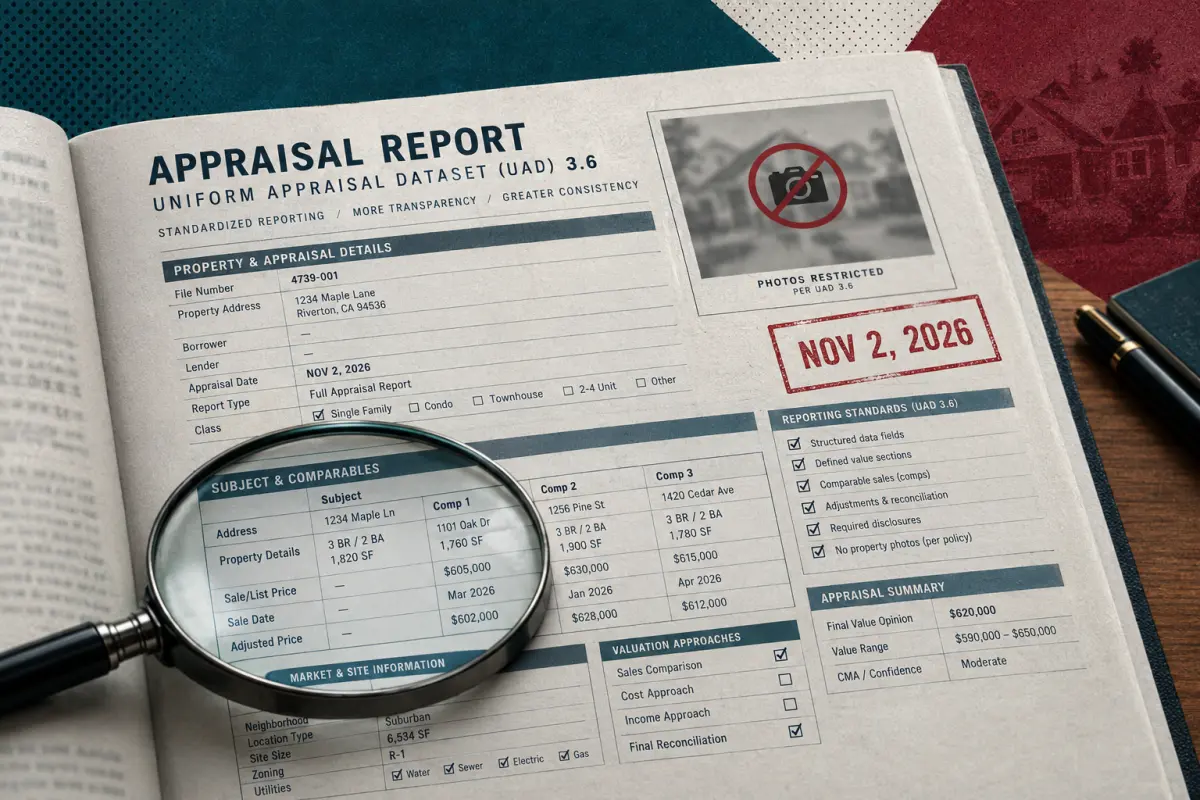
The timing of this data withdrawal is particularly problematic due to the implementation of the Uniform Appraisal Dataset (UAD) 3.6. Effective November 2, this updated standard represents the most significant change to appraisal reporting in over a decade. Under the new guidelines, the traditional method of writing narrative text descriptions of a home’s features is being replaced by a highly structured data-entry system.
Appraisers will now be required to select specific data points from exhaustive dropdown menus for every feature of a property. This transition is designed to create a more "machine-readable" appraisal report that can be easily analyzed by government-sponsored enterprises (GSEs) like Fannie Mae and Freddie Mac. However, as Mehbod points out, this system requires a "staggering amount of high-resolution interior data and structural metrics."
The paradox is stark: while the federal government is demanding that appraisers provide more precise and granular data points, the primary source of that data—the MLS—is being systematically stripped of the very information needed to fill those requirements.
The Economic Consequences: Time, Money, and Affordability
The difficulty in obtaining data does not just affect the appraiser’s workflow; it has a direct impact on the consumer’s wallet. Frank Gregoire, a veteran appraiser based in Florida, emphasizes that the appraisal fee is fundamentally tied to the time required to complete a credible report. In an era of data transparency, an appraiser could verify a comparable sale’s condition in minutes by viewing archived MLS photos. In an era of data scarcity, that same appraiser may have to spend hours tracking down the listing agent, the buyer’s agent, or even visiting the property in person to speak with the new owners.
"If it takes more time because I have to chase down someone for information, I am going to charge more money," Gregoire stated. At a time when homebuyers are already struggling with high interest rates and record-high home prices, the added cost of a more expensive appraisal—or the delay caused by a lack of data—adds another layer of friction to the closing process.
A Chronology of Real Estate Data Accessibility
To understand the current tension, it is helpful to look at the evolution of property data over the last three decades:
- Pre-2000s (The Analog Era): Real estate data was largely contained in physical "MLS books." Appraisers often had to visit local real estate boards to view photos or drive by properties to assess their exterior condition. Data was scarce but controlled.
- 2000s–2015 (The Digital Expansion): The rise of the internet and portals like Zillow and Redfin democratized data. MLS systems moved online, and historical photos became a standard part of the digital record, greatly increasing appraisal efficiency.
- 2016–2021 (The Big Data Boom): AI and automated valuation models (AVMs) began using historical data to predict home prices with increasing accuracy. This period saw the peak of data transparency.
- 2022–Present (The Privacy Pivot): Concerns over AI scraping, cybersecurity, and personal privacy have led to the current "retraction" phase. The introduction of UAD 3.6 in late 2024 marks the point where regulatory requirements and data availability have finally collided.
The MLS Response: Searching for a Middle Ground
Recognizing that consumer privacy and appraisal needs are currently at odds, several Multiple Listing Services have begun implementing "media privacy" controls. The California Regional MLS (CRMLS), Canopy MLS, and Flexmls are among those leading the way in creating tiered access to property information.
These organizations have developed policies that restrict the distribution of interior photos to public-facing real estate portals after a sale is closed, while simultaneously maintaining those images in a secure, internal "historical" database accessible only to licensed professionals. A spokesperson for the Council of MLSs (CMLS) noted that they are currently developing "Best Practices" guidance to help other regions strike this balance. The goal is to ensure that while a homeowner’s interior life is shielded from the general public, the appraiser—who is a necessary participant in the financial ecosystem—retains access to the data required for a credible valuation.
Broader Implications for the Housing Ecosystem
The "push and pull" between privacy and transparency has implications that reach far beyond the immediate transaction. Ryan Lundquist, a Sacramento-based appraiser and market analyst, views the trend toward private listings as a "step backwards" for market health. Transparency is the bedrock of a fair and efficient market; when sales data is hidden, it becomes harder to identify market trends, detect housing discrimination, or ensure that property taxes are assessed fairly.
Furthermore, there is a risk to public trust. If appraisers are forced to become "data collectors" rather than independent analysts, it can create animosity between the professional and the homeowner. As Mehbod warns, if a homeowner wants their loan to close, they will eventually be forced to grant the appraiser access, but doing so under a cloud of data scarcity makes the appraiser appear as an intrusive agent of the bank rather than an expert verifying value.
Analysis of the Path Forward
The real estate industry is at a crossroads. The demand for privacy is a legitimate consumer right, and the protection of data from unauthorized AI scraping is a valid business concern for brokerages. However, these interests cannot exist in a vacuum. The mortgage industry, which provides the liquidity necessary for the housing market to function, requires the certainty that only high-quality data can provide.
As the industry moves past the November 2 implementation of UAD 3.6, the success of the "middle ground" approach adopted by MLSs like CRMLS will be critical. If the industry can successfully bifurcate "public data" and "professional data," it may be able to satisfy both the homeowner’s desire for privacy and the appraiser’s need for precision. If not, the market may see a continued rise in appraisal fees, longer closing times, and a decrease in the overall reliability of property valuations—unintended consequences of a privacy-first world that could ultimately harm the very consumers it seeks to protect.
