

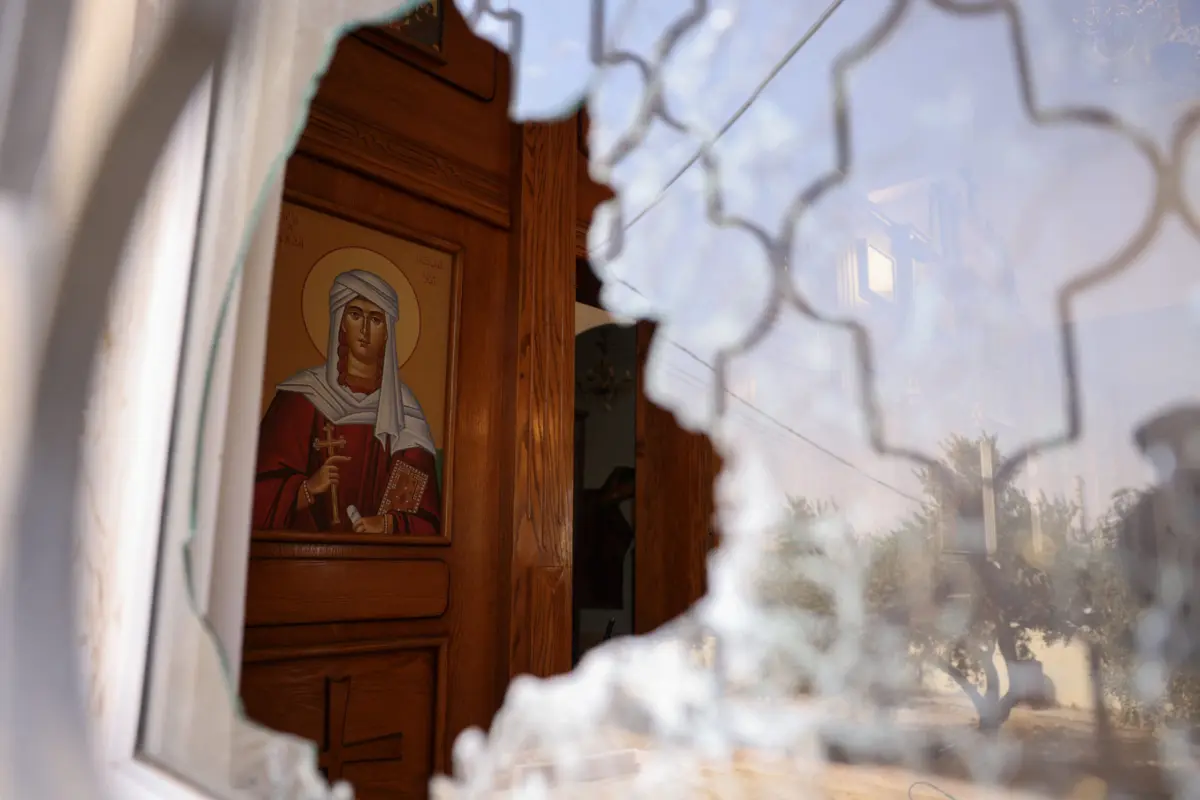
Jordanian security forces have launched an intensive manhunt across the Karak governorate following a devastating terror attack on a Greek Orthodox church in the village of Hamoud on Friday, which claimed the lives of eight people and left dozens more wounded. The audacious assault, described by authorities as a rare act of terror targeting a Christian place of worship, has sent shockwaves through the Kingdom, prompting King Abdullah II to condemn the perpetrators and order an immediate review of the country’s security protocols for responding to such incidents. The monarch, who later visited the injured in hospital, vowed that those responsible would face the “harshest penalties,” underscoring the gravity with which the Hashemite Kingdom views this assault on its interfaith harmony and national stability. As the nation grapples with the aftermath, questions persist regarding the identity and motives of the three gunmen, whose actions have ignited a national outpouring of grief and a resolute international condemnation.
A Violent Friday: The Unfolding Attack in Hamoud
The tranquility of Friday afternoon in Hamoud, a village nestled within the historically rich Karak governorate, was shattered by an act of cold-blooded violence. Congregants had gathered at the local Greek Orthodox church for a funeral service, a solemn occasion that quickly devolved into a scene of unimaginable horror. According to eyewitness accounts and initial reports, the attack commenced abruptly, just moments after the service began. Survivors recounted hearing a powerful explosion that ripped through the air, immediately followed by the chilling sound of gunfire.
The coordinated nature of the assault suggested a premeditated plan. Two of the masked gunmen arrived at the church in a vehicle, their faces concealed, while a third assailant, brandishing a semi-automatic rifle, joined them on foot. Without warning, they stormed the sacred premises, unleashing a barrage of bullets upon the unsuspecting mourners. The attack unfolded rapidly, lasting several minutes as panic and chaos engulfed the church. Nasser al-Burqan, a lawyer and survivor of the ordeal, recounted his terrifying encounter with one of the attackers. He described how, from a mere two metres (approximately 6.5 feet) away, an assailant pointed a handgun directly at him and opened fire. Miraculously, al-Burqan survived the initial onslaught, but the terror was palpable. “When everything finally quietened down, I looked out the window behind me, and I saw two [assailants] – one was masked, the other was not; he was carrying a handgun,” he later told Reuters, painting a vivid picture of the attackers’ brazen presence. The horror deepened when al-Burqan’s son, also present at the funeral, later contacted him from the hospital, having sustained a gunshot wound to the leg.
Another individual, Tarek Ammarin, visiting a relative injured in the attack, struggled to articulate the devastation, simply stating, “A massacre, a massacre in every sense of the word.” His words encapsulated the collective shock and grief pervading the community. Local officials, including Bahjat al-Rushda, mayor of Shihan village in Karak, joined a chorus of condemnation, denouncing the incident as a “wicked” attack and expressing prayers for the country’s continued safety. As the gunmen fled, security forces, alerted to the unfolding tragedy, swiftly deployed to the church, initiating a relentless pursuit of the suspects. State news channel Al-Mamlaka reported on the immediate deployment, highlighting the urgency of apprehending those responsible.
The Grim Toll: Casualties and Community Grief
The human cost of the attack was devastating. The Ministry of Health confirmed that eight individuals lost their lives, turning a funeral into a mass tragedy. Jordan’s Petra news agency later clarified that seven victims perished at the scene of the shooting, their lives cruelly cut short amidst the chaos. An eighth victim tragically succumbed to her injuries hours after the attack, underscoring the severity of the wounds inflicted. Beyond the fatalities, an additional 40 people sustained injuries, ranging from critical to less severe. As of the latest reports, 27 of the injured remain hospitalized, with medical teams at Prince Ali Military Hospital in Karak working tirelessly to save lives and alleviate suffering. The Director of the hospital confirmed that at least one person is in critical condition following extensive surgery, a stark reminder of the long-term physical and psychological scars this attack will leave.
The sheer number of casualties reflects the indiscriminate nature of the violence, which targeted innocent civilians gathered for a religious ceremony. The community of Hamoud, and indeed the entire Karak governorate, has been plunged into profound mourning, grappling with the sudden and senseless loss of loved ones. Funerals for the victims are expected to draw large crowds, symbolizing not only grief but also a defiant show of unity against the forces of extremism. The images of distraught families, blood-stained pews, and the visible anguish of survivors paint a grim picture of the terror inflicted, a poignant testament to the suffering endured by a community that prides itself on its peaceful coexistence.
The Manhunt and the Elusive Perpetrators

In the immediate aftermath of the attack, the focus of Jordan’s security apparatus shifted decisively towards identifying and apprehending the three perpetrators. Official government statements have consistently referred to them as “unknown assailants,” emphasizing the ongoing nature of the investigation and the lack of a definitive identification or claim of responsibility from any group. However, crucial evidence has emerged, including security camera footage that has been widely circulated online and broadcast by channels such as Al-Mamlaka. This footage reportedly shows three individuals actively engaged in shooting outside the church before running towards its entrance. Other segments of the video also depict the attackers opening fire on a group of men attempting to flee the building, providing vital visual evidence of their methods and movements.
Jordan’s Interior Minister, Mazin Al-Farrayeh, condemned the attackers in the strongest possible terms, referring to them as a group of “extremists” who have “no relationship to humanity.” While no specific organization was named, this language strongly suggests authorities believe the attack was ideologically motivated and carried out by radical elements. The challenge for security forces now lies in translating these visual clues and intelligence into concrete identifications and arrests. The pursuit is complex, involving forensic analysis, intelligence gathering, and extensive ground operations to track down the fugitives. Given Jordan’s robust security infrastructure and its track record in counter-terrorism operations, there is a strong national expectation that the perpetrators will be brought to justice swiftly. The King’s personal involvement and demand for "harshest penalties" further underline the government’s resolve to hold the attackers accountable and send a clear message against such acts of terror.
Unanswered Questions: The Motive Behind the Terror
As the manhunt intensifies, a critical question remains unanswered: what was the specific motive behind this brutal attack on a Christian church in Karak? While Prime Minister Jafar Hassan quickly attributed the assault to “terrorist ideology” and “blind extremism,” he refrained from offering specific details about the attackers or their precise motivations. The absence of an immediate claim of responsibility from any known terrorist group has further complicated efforts to ascertain the underlying reasons.
Several possibilities, though speculative in the absence of definitive information, could be considered within the broader context of regional extremism. One potential motive could be an attempt to sow sectarian division within Jordan, a country celebrated for its interfaith harmony and Muslim-Christian coexistence. By targeting a Christian place of worship during a funeral, the perpetrators might have aimed to ignite religious tensions and destabilize the social fabric. Another possibility is that the attack was a form of retaliation or a message from extremist groups against the Jordanian government’s firm stance against terrorism and its active participation in regional and international counter-terrorism efforts. Jordan has long been a frontline state in the fight against radical ideologies, often targeted by groups like ISIL for its moderate policies and alliances. The choice of Karak, a governorate that has previously experienced ISIL-linked violence, could also indicate a strategic targeting of areas perceived to be vulnerable or historically significant. Until the identities of the attackers are revealed and further intelligence gathered, the precise motive behind this heinous act will remain a subject of intense investigation and analysis.
Karak and Jordan’s Legacy of Coexistence
The Karak governorate, situated approximately 120km (75 miles) south of the capital Amman, is a region steeped in history, renowned for its ancient crusader castle and its vibrant, diverse communities. It is also home to a significant portion of Jordan’s Christian minority. Christians constitute roughly 2.6% of Jordan’s total population of 11.5 million people, numbering around 300,000. This community, while a minority, holds a deeply entrenched and respected position within Jordanian society, with a history in the land that predates Islam. They are not merely tolerated but are integral components of the national identity, participating actively in all facets of public life, from politics to business and academia.
Jordan prides itself on its unique model of interfaith solidarity and coexistence. Taylor Luck, senior Middle East correspondent at the Christian Science Monitor, highlighted this aspect to Al Jazeera, emphasizing that Jordan’s Christians “pride themselves on [their] interfaith solidarity and coexistence.” Indeed, Muslims and Christians in Karak, as in other parts of Jordan, have lived side-by-side for generations, sharing customs, traditions, and a common national identity. Churches and mosques often stand in close proximity, symbolizing a shared heritage and mutual respect. This deep-rooted harmony is a defining characteristic of Jordanian society, often lauded as a beacon of stability and moderation in a turbulent region.
The targeting of a church, therefore, is not merely an attack on a religious community but a direct assault on the very foundations of Jordanian national unity. However, as Luck suggested, if the attack was an attempt to divide the community, it is more likely that the “community come[s] back even stronger.” History has shown that such acts of terror often galvanize the population, reinforcing their commitment to shared values and strengthening communal bonds against external threats. Beyond its vibrant communities, Jordan is also home to numerous biblical sites that attract visitors and pilgrims from around the world, further cementing its role as a land of spiritual significance for diverse faiths.
A Unified Condemnation: National and Global Responses

The attack in Karak elicited an immediate and powerful wave of condemnation, both domestically and internationally, underscoring the global outrage at such acts of terror. King Abdullah II, known for his steadfast commitment to protecting all Jordanians, regardless of their faith, wasted no time in responding. He not only visited the injured at Prince Ali Military Hospital but also publicly condemned the perpetrators, vowing the "harshest penalties" and ordering a comprehensive review of the country’s security procedures to prevent future attacks. This swift and decisive leadership was mirrored by Prime Minister Jafar Hassan, who declared three days of national mourning, with flags across government and public buildings to be flown at half-mast—a solemn gesture reflecting the nation’s profound sorrow and solidarity with the victims.
The international community was equally vocal in its denunciation. Countries including Azerbaijan, Iraq, Poland, Palestine, and Qatar issued strong statements condemning the attack and expressing their unwavering solidarity with Jordan. These expressions of support highlighted Jordan’s crucial role as a stable partner in the region and a leading voice for moderation. Perhaps one of the most significant condemnations came from Ahmed al-Tayeb, the Grand Imam of Al-Azhar in Cairo, one of the foremost Sunni religious institutions globally. Al-Tayeb offered his heartfelt condolences to the victims’ families, unequivocally labeling the shooting a "heinous terrorist attack." In a powerful social media post, he asserted that "This crime contradicts the teachings of the Abrahamic religions and reveals that its perpetrators are devoid of all compassion, humanity and morality," thereby refuting any religious justification for such violence and positioning it outside the bounds of legitimate faith.
The United States embassy in Jordan also released a statement on X, extending "most heartfelt condolences to the victims and survivors of the terror attack today at a church in Karak, Jordan," reaffirming its alliance and support for the Kingdom in its fight against terrorism. The unified global response served as a strong message to the perpetrators and their sympathizers that such acts of terror would not succeed in dividing communities or destabilizing nations.
Jordan’s Resilience: A History of Countering Extremism
While rare, the attack in Karak is not an isolated incident in Jordan’s history of confronting extremism. The Kingdom has, on several occasions, faced the brutal realities of terrorism, demonstrating remarkable resilience and resolve in its aftermath. The most significant precedent for the recent church attack occurred in 2016, when the ISIL (ISIS) group launched a series of coordinated attacks across Karak. That year, a deadly siege on a Crusader-era castle in the heart of Karak claimed the lives of 10 people, including a Canadian tourist and seven Jordanian police officers. Dozens more were injured in the prolonged standoff, which saw Jordanian security forces engage in a fierce battle with the militants. Ultimately, four attackers were killed by security forces, bringing an end to the siege.
This historical context underscores Jordan’s persistent struggle against radical ideologies, particularly those propagated by groups like ISIL. Jordan’s strategic location, its moderate policies, and its robust alliances with Western nations have often made it a target for extremist organizations seeking to destabilize the region. The Kingdom has been a proactive participant in the global coalition against ISIL and other terror groups, engaging in intelligence sharing, border security enhancements, and counter-narrative campaigns. Its security forces are highly trained and experienced in counter-terrorism operations, and the country maintains a vigilant stance against both internal and external threats. The 2016 Karak attack, like the recent church shooting, was a stark reminder of the continuous challenges Jordan faces in safeguarding its security and stability amidst regional turmoil. However, each incident has also served to reinforce the national unity and the government’s unwavering commitment to combating terrorism in all its forms.
Broader Implications: Security, Society, and Stability
The terror attack on the Greek Orthodox church in Karak carries significant implications for Jordan, touching upon its national security, social fabric, and regional standing. From a security perspective, King Abdullah II’s immediate order for a review of security procedures signifies a renewed commitment to enhancing protective measures, particularly around sensitive sites like places of worship. This will likely lead to heightened intelligence gathering, increased surveillance, and the reinforcement of security protocols, not just in Karak but nationwide. The ongoing manhunt for the three gunmen also highlights the operational challenges faced by security forces in tracking down elusive perpetrators who may be operating within clandestine networks.
Socially, the attack was a direct assault on Jordan’s cherished interfaith harmony. Extremist groups often aim to sow discord and division along religious lines. However, the unified condemnation from both Muslim and Christian leaders, including the Grand Imam of Al-Azhar, and the outpouring of national solidarity, strongly suggest that this attack will, paradoxically, reinforce Jordan’s social cohesion. The resilience of the Jordanian people, often tested by regional instability, is expected to prevail, strengthening the bonds between communities against a common enemy. The message from civil society and religious institutions is clear: such acts will not succeed in breaking the unity of the Jordanian people.
Economically, while Jordan’s tourism sector is generally robust, especially given its wealth of historical and biblical sites, isolated acts of terror can temporarily deter visitors. However, the government’s swift response, coupled with Jordan’s established reputation as a safe and stable destination in a volatile region, is likely to mitigate any prolonged negative impact. Finally, on a regional and international stage, the attack reinforces Jordan’s critical role as a bulwark against extremism. The global expressions of solidarity underscore the international community’s recognition of Jordan’s unwavering commitment to fighting terrorism and its importance as a pillar of stability in the Middle East. As Jordan mourns its dead and heals its wounded, its resolve to combat the forces of terror remains undimmed, a testament to its enduring strength and unity.
