


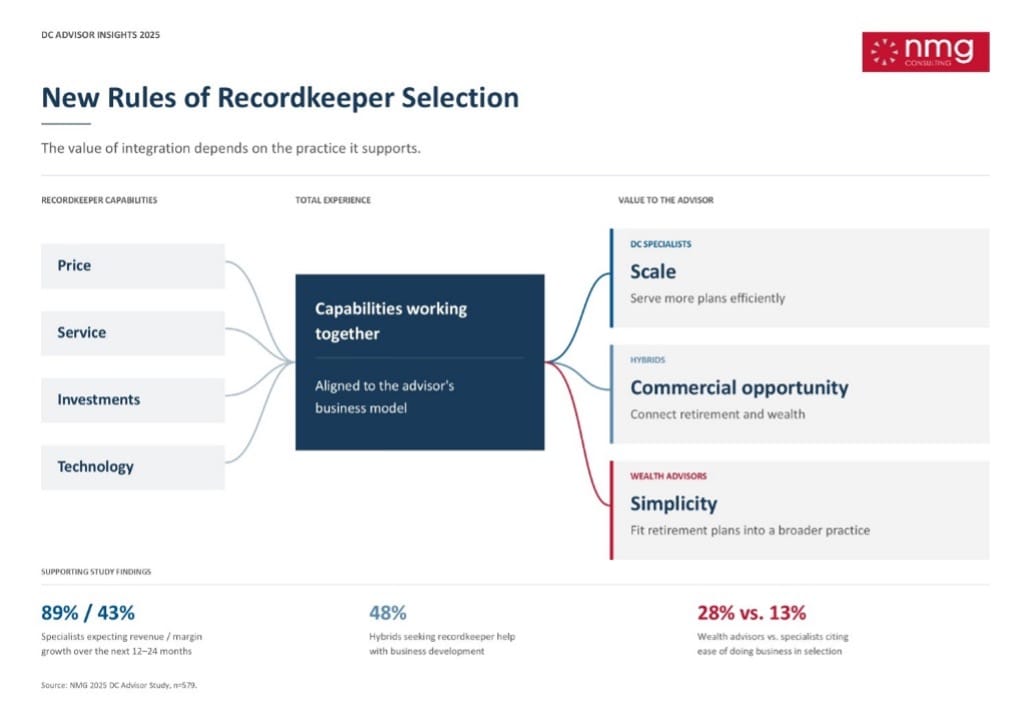
The landscape of retirement plan recordkeeping is undergoing a significant transformation, moving beyond the traditional metrics of price, service, investments, and technology as the sole determinants of success. A recent analysis by NMG Consulting, based on a study of nearly 600 financial advisors, reveals a critical shift: record keepers must now deeply understand and cater to the diverse business models of the advisors they serve to win and retain business. The era of a one-size-fits-all approach is rapidly fading, replaced by a demand for tailored solutions that demonstrably enhance an advisor’s practice.
For years, the industry’s playbook for attracting advisors and securing new business has remained remarkably consistent. The prevailing wisdom dictated that excelling in core areas like competitive pricing, responsive customer service, robust investment options, and cutting-edge technology would invariably lead to market share gains. However, this foundational approach, while still relevant, is proving insufficient in an increasingly sophisticated and specialized advisory market. As NMG’s research indicates, a proposition designed for the "average" advisor often fails to resonate strongly with any specific segment, leading to a dilution of appeal and ultimately hindering growth. To thrive in today’s competitive environment, record keepers are compelled to make strategic decisions about whom they aim to serve and meticulously craft their offerings to align with the unique operational and strategic priorities of those advisors.
The Shifting Sands of Advisor Preference
NMG’s annual DC Advisor Study, a comprehensive survey of the retirement plan advisory community, underscores the continued importance of these fundamental criteria. However, it also highlights a crucial nuance: possessing strong capabilities alone is no longer a guaranteed pathway to securing a top position in an advisor’s vendor selection. The study’s findings suggest that a record keeper’s true value proposition is increasingly measured by how effectively they support and enable the diverse business models that advisors are actively building.
This distinction is not merely theoretical. Consider a hypothetical scenario involving two record keepers, both achieving an impressive 77% advocacy score among advisors. One record keeper boasts leading service ratings, while the other is recognized for its superior digital experience. Despite their equal advocacy scores, their trajectories in securing top-three advisor relationships between 2024 and 2025 diverged significantly. The record keeper with leading service saw its share of these coveted relationships decline from approximately 30% to 22%. Conversely, the record keeper excelling in digital experience witnessed an increase, rising from around 25% to 28%. This divergence illustrates a critical point: while advocacy measures regard and respect, it does not solely guarantee the acquisition of an advisor’s next plan. The underlying operational support and alignment with an advisor’s workflow are becoming paramount.
Beyond Functional Excellence: The Integrated Experience
Advisors experience their record keepers not in isolation, but through the daily, granular operations of their businesses. The journey from prospecting a new client to implementing a plan and providing ongoing service is a continuous flow. A participant’s simple question can either become a valuable opportunity for deeper engagement and financial planning or devolve into a frustrating administrative headache. Record keepers may perform exceptionally well within each individual function – prospecting, sales, implementation, and ongoing service – yet still leave advisors to bridge the gaps and manage the inefficiencies that arise from fragmented systems or processes.
Therefore, evaluating recordkeeping capabilities in isolation misses an essential element of their true value. Service quality, for instance, is inextricably linked to the ease of access to critical information. Technology, in turn, serves as the connective tissue for the entire relationship, fostering efficiency, delivering actionable insights, and empowering advisors to act decisively. What truly matters, according to the NMG study, is not the individual strength of these components, but how seamlessly and effectively they work together to create a cohesive and supportive ecosystem for the advisor.

The Economic Imperative: A Changing Compensation Landscape
The increased emphasis on integrated support and business model alignment is further amplified by recent economic shifts within the advisory industry. Historically, a significant portion of an advisor’s compensation, particularly for those focused on retirement plans, was often derived directly from the record keeper. This created a direct financial incentive for advisors to maintain strong relationships with their chosen recordkeeping partners. However, this dynamic has evolved considerably. Today, particularly for specialist and hybrid advisors who offer a broader range of financial services, compensation is more frequently sourced directly from the plan sponsor or through fee-based arrangements.
This shift has repositioned the record keeper’s influence. Instead of being a direct source of revenue, record keepers increasingly impact the operational costs and efficiencies of an advisor’s practice. Service failures, such as delays in information retrieval or administrative errors, can consume valuable staff time, diverting resources from client-facing activities. Poor integration between a record keeper’s platform and an advisor’s own systems can create significant manual work and introduce inefficiencies. Conversely, a record keeper that enhances efficiency can create valuable capacity for an advisor, allowing them to take on more clients or deepen their service offering without a commensurate increase in staffing costs.
Price Remains a Factor, but Service Gaps Prove Costlier
While the narrative is shifting, price undeniably remains a significant consideration in the advisor’s decision-making process. The NMG study confirms this, with 80% of advisors citing pricing as a key selection criterion. Client service also ranks high, with 68% of advisors deeming it important. However, the research also reveals a stark hierarchy of importance when it comes to disqualifiers. Poor advisor service emerges as the leading reason for advisors choosing not to engage with a record keeper, accounting for an average of 28% of disqualifications across all record keepers. This stands in sharp contrast to fees, which account for only about 8% of disqualifications.
This data suggests a critical insight: while competitive pricing might get a record keeper onto an advisor’s initial shortlist of potential partners, it is poor service – or more broadly, a failure to integrate seamlessly into the advisor’s workflow – that ultimately removes them from consideration. A low fee structure for the plan sponsor, while attractive on the surface, can still result in a costly relationship for the advisor to manage if the record keeper’s operational shortcomings create significant burdens. This underscores the need for record keepers to understand the advisor’s perspective on cost, which extends beyond the direct fee to encompass the indirect costs of inefficiency and administrative burden.
Facilitating Growth: Unlocking New Opportunities
Beyond simply supporting existing operations, record keepers have a significant opportunity to act as catalysts for practice growth. Enhanced connectivity between the record keeper, the advisor, the Third-Party Administrator (TPA), and the client can unlock valuable insights into participant needs and identify untapped plan opportunities. In fact, 43% of advisors surveyed by NMG identified business development as an area where record keepers could provide more substantial support.
The nature of this support, however, is not uniform. It must be tailored to the specific business model of the advisor.
Tailoring Support for Diverse Advisor Models
DC Specialists: The Imperative of Scalable Capacity
For advisors who specialize exclusively in Defined Contribution (DC) plans, the paramount concern is the capacity to scale their operations efficiently. The NMG study indicates that 89% of DC specialists anticipate revenue growth over the next 12 to 24 months. However, a significant challenge looms: only 43% expect their gross margins to improve during the same period. This gap highlights a critical need for record keepers to enable these specialists to serve a larger volume of plans without a proportional increase in staffing. At the scale at which DC specialists operate, even minor service failures or inefficiencies can quickly escalate into substantial capacity problems, hindering their ability to grow profitably. Record keepers that can provide robust, scalable operational support are thus highly valued by this segment.
Hybrid Advisors: Bridging Retirement and Wealth Management
Hybrid advisors, who blend retirement plan services with broader wealth management offerings, face a different set of priorities. Nearly half of these advisors are actively seeking more robust business development support from their recordkeeping partners. For hybrids, the key lies in leveraging participant data and engagement opportunities to identify unmet advice needs among plan participants. This, in turn, can facilitate the expansion of broader client relationships, moving beyond the retirement plan to encompass comprehensive financial planning and wealth accumulation strategies. Record keepers that can provide integrated data platforms and tools that facilitate such cross-selling and deeper client engagement are particularly attractive to this segment.
Wealth Advisors: The Demand for Simplicity and Seamless Integration
Wealth advisors, whose primary focus lies outside of retirement plan administration, prioritize simplicity and ease of doing business. Twenty-eight percent of wealth advisors cite ease of doing business as a critical selection criterion, a significantly higher proportion compared to the 13% of specialists who prioritize this. For these advisors, retirement plans must seamlessly integrate into their existing practice without demanding they become retirement plan experts. Record keepers that offer intuitive platforms, streamlined onboarding processes, and minimal administrative overhead are essential for wealth advisors to effectively serve their clients’ retirement needs without diverting significant resources from their core wealth management activities.
The Human Element in a Digital World
Across all advisor segments, the desire for enhanced human support remains strong, even in an increasingly digital environment. Thirty-seven percent of advisors explicitly stated a preference for greater support through dedicated contacts. While advisors welcome technology that simplifies routine interactions and streamlines processes, they also expect accountability when problems arise. This suggests that the ideal recordkeeping solution involves a harmonious blend of advanced digital capabilities and responsive, knowledgeable human support. Technology should handle the transactional, while dedicated contacts should manage the exceptions, the complex issues, and provide strategic guidance.
The Future of Recordkeeping: Integrated Value Creation
In conclusion, while price, service, investments, and technology remain foundational elements of any recordkeeper’s offering, the competitive battleground is shifting. The new rules of engagement revolve around how effectively record keepers can integrate these core components to create tangible value for the specific advisors they aim to serve. This means understanding and catering to the distinct needs of DC specialists by providing scalable capacity, fostering commercial connections for hybrids to expand their wealth management practices, and delivering unparalleled simplicity for wealth advisors.
Simply checking the traditional boxes may earn a record keeper consideration. However, securing the next plan, and indeed building lasting partnerships, will depend on a record keeper’s ability to demonstrably make an advisor’s business work better. This requires a strategic pivot from a product-centric to a client-centric approach, where deep understanding of advisor business models drives innovation and shapes the entire service delivery ecosystem. The recordkeepers who embrace this evolution will be best positioned to thrive in the dynamic future of retirement plan services.
About the Author:
Joshua Dietch, Partner at NMG Consulting, leads the U.S. Insights practice. With over 25 years of experience in consulting and corporate roles, including his tenure at Chatham Partners (now NMG Consulting), Joshua has advised leading asset managers, retirement service providers, insurers, banks, and wealth managers. His expertise encompasses business strategy, market research, new product development, and marketing and distribution strategies, providing him with deep insights into the evolving dynamics of the financial services industry, particularly within the retirement plan and advisory sectors.
