


For decades, the cornerstone of success in the retirement plan recordkeeping industry has been a seemingly straightforward formula: offer competitive pricing, exceptional service, robust investment options, and cutting-edge technology. This quartet of criteria has long been the industry’s lingua franca for attracting financial advisors and securing new business. However, a recent analysis by NMG Consulting suggests that this traditional approach, while still relevant, is no longer sufficient to guarantee sustained growth. The era of a one-size-fits-all proposition is giving way to a more nuanced reality where recordkeepers must deeply understand and cater to the distinct business models of the advisors they aim to serve.
NMG Consulting’s latest DC Advisor Study, encompassing insights from nearly 600 financial advisors, confirms that while these core criteria remain important, they are increasingly insufficient on their own to secure a recordkeeper’s placement in an advisor’s preferred provider list. The study highlights a significant shift: a recordkeeper’s true value is now being measured by how effectively they integrate their offerings to support and enhance the advisor’s operational workflow and business development strategies.
The implications of this shift are already becoming apparent in the market. Consider a scenario where two recordkeepers achieve an identical advocacy score of 77%. One is lauded for its leading service ratings, while the other stands out for its superior digital experience. According to NMG’s findings, between 2024 and 2025, their respective shares of top-three advisor relationships moved in opposing directions. The recordkeeper with leading service ratings saw its share decline from approximately 30% to 22%, while the one with a leading digital experience witnessed an increase from about 25% to 28%. This stark contrast underscores a critical distinction: while advocacy measures regard and indicate positive sentiment, it does not automatically translate into winning the advisor’s next plan. The operational integration and the tangible benefits to the advisor’s daily practice are proving to be the decisive factors.
The Advisor’s Daily Experience: A Crucial Lens for Recordkeepers
Financial advisors interact with recordkeepers not as abstract entities, but through the tangible realities of their daily business operations. The process of prospecting for new clients, converting leads into successful sales, onboarding new plans, and managing ongoing client service all have a recordkeeper at their core. Similarly, a participant’s inquiry can either be a gateway to a valuable financial planning opportunity or devolve into a frustrating administrative hurdle. A recordkeeper that performs competently in individual functions but fails to bridge the gaps between these touchpoints inevitably leaves the advisor to shoulder the burden of managing these disconnects.
Therefore, evaluating recordkeeping capabilities in isolation misses a fundamental aspect of their value proposition. True service excellence is inextricably linked to seamless access to critical information. Technology, far from being a mere transactional tool, serves as the connective tissue of the advisor-recordkeeper relationship, fostering efficiency, delivering actionable insights, and empowering advisors to act decisively. What truly matters is not the individual strength of each capability, but how harmoniously they function together to create a unified and supportive ecosystem for the advisor.

Economic Realities Driving the Shift
The growing importance of integrated capabilities is rooted in evolving economic realities within the advisory profession. Historically, advisors often received a portion of their compensation directly or indirectly through recordkeepers. However, in today’s landscape, particularly for specialists and hybrid advisors, compensation is increasingly derived directly from plan sponsors. This economic shift means that recordkeepers now exert a more profound influence on the operational costs of an advisor’s practice. Service failures, for instance, can consume valuable staff time, poor technological integration can create redundant work, and a lack of efficiency directly erodes an advisor’s capacity to serve more clients.
While pricing remains a significant consideration, its role has subtly transformed. NMG’s study reveals that 80% of advisors still cite pricing as a selection criterion, and 68% emphasize client service. However, the data also indicates a critical distinction: poor advisor service is the leading reason for not engaging with a recordkeeper, accounting for an average of 28% across surveyed recordkeepers, significantly higher than the 8% attributed to fees. In essence, competitive pricing might secure a place on an advisor’s initial shortlist, but subpar service is a swift disqualifier. Furthermore, a low fee for the plan sponsor can mask a costly and burdensome relationship for the advisor.
Enabling Growth: The Evolving Role of Recordkeepers
Beyond operational support, recordkeepers have a burgeoning opportunity to actively contribute to the growth of advisor practices. Enhanced connectivity between the recordkeeper, the advisor, Third-Party Administrators (TPAs), and the end client can uncover unmet participant needs and reveal new plan opportunities. The study found that 43% of advisors identify business development as a key area where recordkeepers could provide more robust support.
The nature of this support, however, is not uniform. It must be tailored to the specific business model of the advisor:
Tailored Support for Diverse Advisor Models
DC Specialists: The Imperative of Scalable Capacity
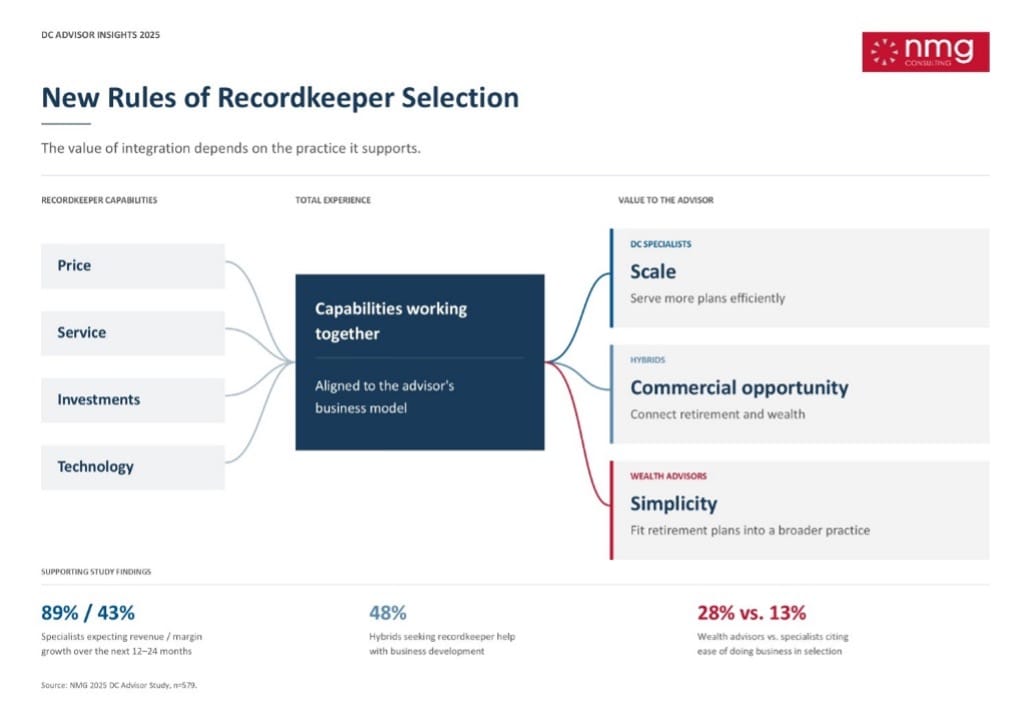
For advisors who specialize exclusively in defined contribution plans, the paramount concern is the capacity to scale their operations efficiently. The NMG study projects that 89% of DC specialists anticipate revenue growth over the next 12 to 24 months. However, a significant challenge looms: only 43% expect their gross margins to improve concurrently. Recordkeepers that can enable these specialists to serve a larger volume of plans without a commensurate increase in staffing are crucial for closing this margin gap. At the scale these advisors operate, even minor service failures can rapidly escalate into significant capacity bottlenecks, hindering their ability to capitalize on growth opportunities.
Hybrid Advisors: Bridging Retirement and Wealth Management
Hybrid advisors, who often manage both retirement plans and broader wealth management portfolios, see a significant opportunity in connecting these two distinct yet complementary areas. Nearly half of these advisors expressed a desire for more comprehensive business development support. Recordkeepers that can provide integrated participant data and facilitate proactive engagement can empower hybrid advisors to identify unmet advice needs among plan participants. This, in turn, can foster deeper client relationships and lead to the expansion of their wealth management services.
Wealth Advisors: The Pursuit of Simplicity and Seamless Integration
For wealth advisors whose primary focus lies outside of retirement plan administration, the key differentiator is simplicity and ease of doing business. Twenty-eight percent of these advisors cite ease of doing business as a selection criterion, a figure notably higher than the 13% reported by specialists. Retirement plans must integrate seamlessly into practices that are already heavily focused on other areas, without requiring the advisor to become a deep retirement plan expert. This necessitates recordkeeping solutions that are intuitive, require minimal administrative overhead, and offer a frictionless user experience.
The Human Element in a Digital Age
While technology plays an indispensable role, the NMG study also revealed a consistent demand for human interaction. Across all advisor segments, 37% expressed a desire for greater support through dedicated contacts. Advisors are not simply seeking digital interfaces; they want technology to streamline routine tasks while ensuring there is a clear point of accountability when issues arise. This highlights a crucial balance: leveraging technology for efficiency must be complemented by accessible, responsive human support to navigate complex situations and build enduring partnerships.
Charting the Path Forward: A New Paradigm for Recordkeepers
The enduring importance of price, service, investments, and technology in the recordkeeping landscape is undeniable. However, the competitive advantage is increasingly shifting to how effectively recordkeepers can orchestrate these elements to serve specific advisor segments. The traditional approach of checking boxes may earn a recordkeeper consideration, but securing the next plan hinges on their ability to demonstrably enhance the advisor’s business operations and foster their growth.
The implications for the retirement plan industry are far-reaching. Recordkeepers that fail to adapt to this evolving paradigm risk becoming increasingly marginalized. Conversely, those that invest in understanding the nuanced needs of different advisor business models, and then tailor their technology, service, and support accordingly, are poised to capture significant market share. This shift demands a strategic reorientation, moving beyond generic offerings to embrace a client-centric approach that recognizes and supports the unique journeys of the advisors who are shaping the future of retirement planning.
The convergence of economic pressures, technological advancements, and evolving advisor business models has created a new set of rules for engagement. Success in the modern recordkeeping arena will be defined not merely by the availability of features, but by the tangible impact these features have on an advisor’s profitability, efficiency, and capacity for growth. As the industry navigates this transition, the focus must sharpen on building integrated solutions that empower advisors to thrive, ultimately benefiting the millions of participants whose retirement futures are at stake.
