

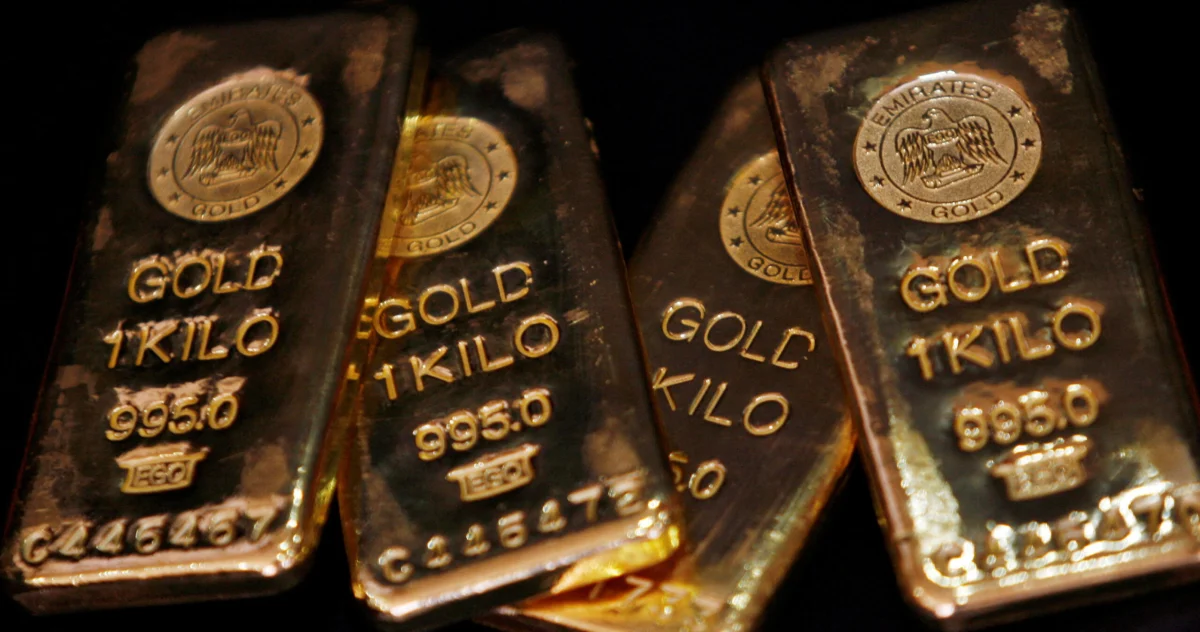
New York, October 28, 2026 – Global precious metal markets experienced a dramatic downturn on Monday, with gold prices plummeting to a more than seven-week low, signaling a significant shift in investor sentiment amidst escalating geopolitical tensions and persistent inflationary pressures. Spot gold registered a substantial 3.3 percent decline, settling at $4,146.51 per ounce, marking its lowest valuation since August 5th. Silver, often seen as gold’s industrial counterpart, mirrored the trend with an even steeper fall, losing nearly 5 percent of its value, dropping to $61.27 per ounce. The broad-based sell-off extended to other precious metals, with platinum shedding 2.9 percent to $1,726.30 and palladium experiencing a sharp 4.4 percent decline to $1,211.45.
This precipitous fall is largely attributed to a confluence of factors, primarily the intensifying military and diplomatic standoff between the United States and Iran, which has sent global oil prices spiraling upwards and reignited fears of entrenched inflation. Compounding these worries are the robust performance of the US dollar and rising Treasury yields, which collectively diminish the appeal of non-yielding assets like gold, even in times of economic uncertainty.
The Market Meltdown: A Detailed Breakdown
The trading day on Monday, October 28, 2026, opened with a bearish tone for precious metals. US gold futures for December delivery also reflected the downturn, falling by 3.3 percent to $4,178.40. This marks a critical juncture for the yellow metal, which historically has been considered a safe haven during periods of economic and geopolitical instability. However, the current economic landscape, characterized by aggressive monetary tightening by the Federal Reserve, has introduced a complex dynamic that challenges gold’s traditional role.
The dramatic drop in gold prices below the psychological $4,200 mark has triggered concerns among investors. The last time gold prices were at this level was in early August, prior to a brief rally fueled by initial fears over the US-Iran situation. However, the sustained hawkish stance of the Federal Reserve and the continued strengthening of the dollar have since overshadowed any safe-haven bids. Analysts are now closely watching the $4,100 support level, with a breach potentially opening the door for further significant declines.
Silver’s performance was particularly stark, with its 4.7 percent drop representing one of its most significant single-day losses in recent memory. This reflects not only its status as a precious metal but also its substantial industrial demand, which can be vulnerable to economic slowdowns or increased production costs driven by energy price hikes. Platinum and palladium, critical components in catalytic converters and other industrial applications, also faced strong selling pressure, underscoring the broader market anxiety surrounding global supply chains and manufacturing output in an inflationary environment.
The Geopolitical Catalyst: US-Iran Conflict Escalation
At the heart of the current market turmoil lies the rapidly deteriorating relationship between the United States and Iran. Tensions, which have been simmering for months, reached a critical point over the weekend when US President Donald Trump unequivocally rejected an Iranian proposal aimed at de-escalating the conflict and reopening the Strait of Hormuz. The Strait, a vital chokepoint for global oil shipments, has been a flashpoint for naval confrontations and threats, leading to severe disruptions in oil supply routes.
The President’s firm stance signaled a prolonged period of geopolitical uncertainty, directly impacting global energy markets. In response, oil prices surged by approximately 3 percent on Monday, with Brent crude futures climbing to $112 a barrel and West Texas Intermediate (WTI) futures touching $107. These elevated oil prices immediately translated into heightened inflation fears across major economies, as the cost of transportation, manufacturing, and energy for consumers began to tick upwards. The prospect of sustained high energy costs threatens to erode consumer purchasing power and corporate profit margins, casting a pall over global economic growth forecasts.
The Strait of Hormuz, through which roughly one-fifth of the world’s total oil consumption passes, remains central to the crisis. Any prolonged disruption or escalation in the region could have catastrophic implications for global energy supplies and, by extension, the world economy. The market’s reaction reflects deep concern that the current geopolitical impasse will not be easily resolved, ensuring a sustained period of high energy prices and inflationary pressures.
Monetary Policy and Persistent Inflationary Pressures
The current economic environment is further complicated by the Federal Reserve’s aggressive monetary policy aimed at curbing inflation. Despite gold’s traditional role as an inflation hedge, the current regime of rising interest rates has paradoxically dulled its appeal. As Sherif Othman, CEO of the Maryland-based Poise Investment Advisors, explained to Al Jazeera, "Although gold is traditionally considered an inflation hedge, higher interest rates dent its appeal as investors prefer yield-bearing assets. Gold does not yield interest, so when Treasury yields go up, investors turn away from gold, impacting its value."
The Federal Reserve has been steadfast in its commitment to bringing annual inflation, which has been hovering around 6-7% for the past year, back to its target rate of 2 percent. Earlier this month, in September 2026, the Fed lifted its benchmark interest rates by a quarter percentage point, pushing the target range for the federal funds rate to 5.50%-5.75%. This marked the sixth rate hike since early 2025, and policymakers have already signaled that at least one more hike is likely in the coming months, indicating a sustained hawkish stance.
This aggressive tightening cycle has made yield-bearing assets, particularly US Treasury bonds, significantly more attractive. On Monday, the yield on the benchmark 10-year US Treasury note surged to 4.8%, its highest level in over a decade, offering investors a compelling alternative to non-yielding gold. Concurrently, the US dollar maintained its strength, holding steady near a two-month high against a basket of major currencies, with the Dollar Index (DXY) maintaining levels above 108. A stronger dollar makes dollar-denominated assets, including gold, more expensive for holders of other currencies, further contributing to the downward pressure on gold prices.
Cleveland Fed President Beth Hammack was among several policymakers who reiterated concerns about elevated inflation risks on Monday, reinforcing the market’s expectation that interest rates may need to rise further. This collective warning from central bank officials underscores the Fed’s commitment to prioritizing inflation control, even at the risk of impacting growth or asset prices.
Expert Insights and Market Sentiment
Market analysts are largely in agreement regarding the forces driving the current precious metals downturn. Jim Wyckoff, a market analyst at American Gold Exchange, succinctly described the situation, stating that "Higher Treasury yields and the US dollar are creating a perfect storm to push the metals prices sharply lower." This sentiment is echoed across financial institutions, where strategists are advising clients to brace for continued volatility.
Analysts at major investment banks, such as Goldman Sachs and JPMorgan, have revised their short-term outlooks for gold downwards. A recent report from Goldman Sachs highlighted that "the current macro environment, characterized by sticky inflation, aggressive central bank tightening, and a strong dollar, is particularly challenging for gold despite geopolitical risks." JPMorgan, in a client note, suggested that "investors are increasingly prioritizing real yields over safe-haven plays, a trend that could persist as long as central banks remain hawkish."
Sherif Othman of Poise Investment Advisors further elaborated on the implications for everyday investors: "There might be no notable direct impact on regular people due to that. However, investors who had turned to gold will see a hit, especially under the current high inflation rates." This highlights the nuanced relationship between inflation and gold in a high-interest-rate environment; while inflation erodes purchasing power, the availability of higher-yielding alternatives makes gold less appealing as a hedge.
Chronology of Recent Events (2026)
To provide context to the current market dynamics, a brief chronology of key events in 2026 is essential:
- Early 2026 (January-March): Global economic data indicates persistent inflation, with annual rates consistently above 6%. Central banks, including the Federal Reserve, signal a commitment to continued monetary tightening. Initial skirmishes and diplomatic tensions between the US and Iran begin to emerge, primarily concerning naval activities in the Persian Gulf.
- April-July 2026: The Federal Reserve implements two additional quarter-point rate hikes, bringing the federal funds rate above 5%. Oil prices begin to show upward pressure as shipping disruptions in the Strait of Hormuz become more frequent, though not yet critical. Gold prices experience some volatility, trading between $4,250 and $4,350.
- August 5, 2026: Gold prices briefly touch a low point, similar to current levels, amid a broader market correction, before finding some support as initial fears of a more serious US-Iran confrontation begin to materialize.
- September 2026: The Federal Reserve conducts its latest quarter-point rate hike, pushing rates to 5.50%-5.75%. Policymakers indicate that more hikes are probable. US-Iran rhetoric escalates significantly, with President Trump issuing stronger warnings regarding Iranian activities.
- Early October 2026: Oil prices surge past $100 a barrel as further threats and military maneuvers occur near the Strait of Hormuz. The US dollar strengthens significantly against major currencies. Gold holds relatively steady, with some investors still clinging to its safe-haven appeal.
- Weekend, October 26-27, 2026: President Trump publicly rejects Iran’s offer to resolve the conflict and reopen the Strait of Hormuz, cementing market expectations of prolonged tensions.
- Monday, October 28, 2026: Global precious metal markets react sharply to the weekend’s geopolitical developments and renewed inflation fears. Gold plummets to $4,146.51, its lowest since August 5th, while silver records a near 5 percent loss.
Broader Economic Implications and Outlook
The decline in precious metals prices has far-reaching implications for various stakeholders. For investors, particularly those who diversified into gold and silver as a hedge against inflation or geopolitical risk, the current downturn represents a significant challenge. Retail investors holding exchange-traded funds (ETFs) backed by physical gold or futures contracts are likely to see their portfolios take a hit. Institutional investors, including sovereign wealth funds and central banks that hold substantial gold reserves, will also be monitoring the situation closely, though their long-term strategies are typically less impacted by short-term fluctuations.
The broader economy faces potential ripple effects. While a fall in gold prices itself doesn’t directly harm consumers, the underlying causes—namely surging oil prices and persistent inflation—do. Higher fuel costs translate into more expensive goods and services, squeezing household budgets already strained by elevated living costs. Businesses, particularly those reliant on transportation and energy-intensive manufacturing, will grapple with increased operational expenses, potentially leading to reduced profit margins, curtailed investment, or even job cuts.
The current environment challenges the very definition of a "safe-haven asset." In previous crises, when interest rates were low or falling, gold’s non-yielding nature was less of a disadvantage. However, with central banks aggressively raising rates to combat inflation, the opportunity cost of holding gold has dramatically increased. Investors now have compelling alternatives in high-yielding government bonds and even certain equities that offer dividends or strong earnings growth. This shift in investor preference underscores a fundamental re-evaluation of risk and return in a high-interest-rate world.
Looking ahead, the trajectory of precious metals will heavily depend on two critical factors: the resolution, or lack thereof, of the US-Iran conflict, and the future course of the Federal Reserve’s monetary policy. A de-escalation of geopolitical tensions and a subsequent moderation in oil prices could alleviate some inflationary pressures, potentially allowing the Fed to pause its rate hikes or even consider cuts in the distant future. Such a scenario could revive gold’s appeal. Conversely, a further escalation of the conflict, coupled with sustained hawkishness from the Fed, would likely continue to exert downward pressure on precious metals, pushing investors further towards yield-bearing assets.
The long-term appeal of gold as a store of value and a hedge against extreme economic instability may endure, but the short-term outlook remains challenging. Investors are now navigating a complex interplay of geopolitics, monetary policy, and inflation, where traditional market correlations are being tested and re-evaluated in real time. The coming weeks will be crucial in determining whether the current downturn is a temporary correction or the beginning of a more prolonged period of weakness for precious metals.
