

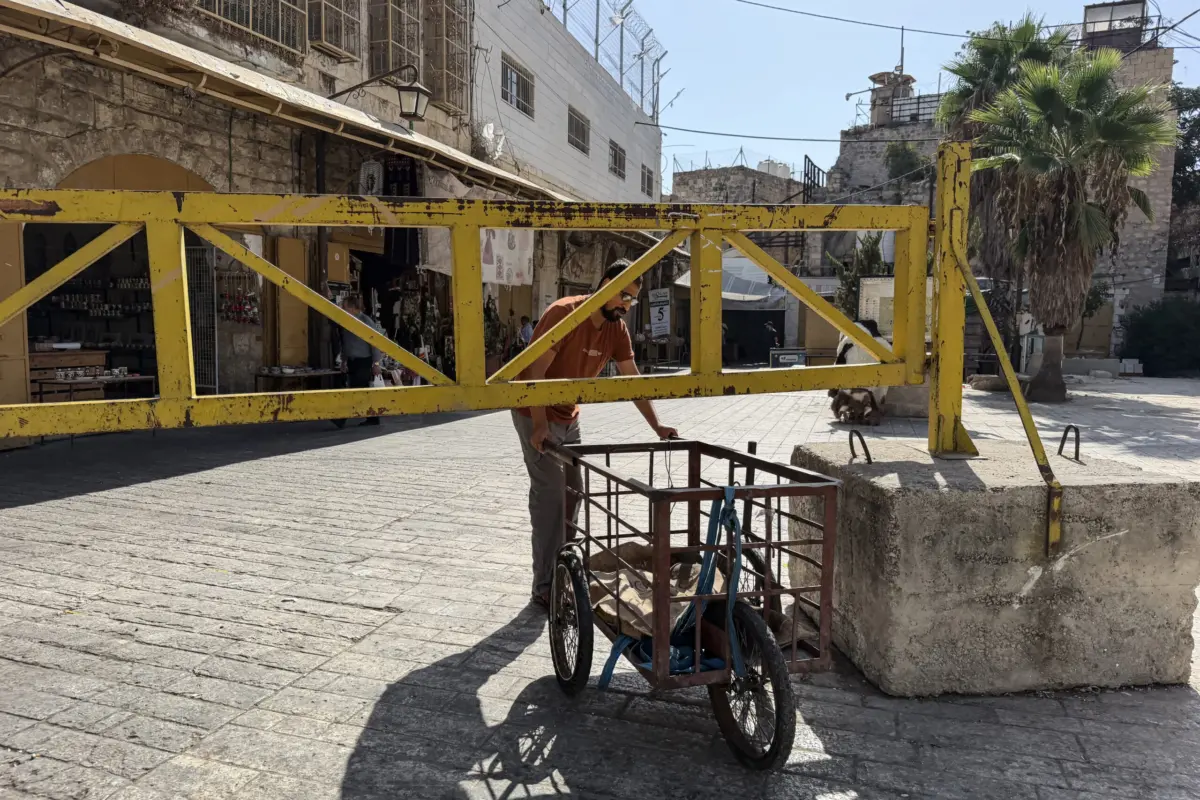
Hebron, occupied West Bank – For Badr al-Tamimi, a 60-year-old resident of Hebron’s Old City, the installation of three new iron gates across a mere 200-meter stretch of his historic neighborhood represents more than a physical barrier; it symbolizes the intensifying daily ordeal faced by Palestinians under Israeli occupation. These recent additions to an already pervasive network of checkpoints and obstacles are transforming parts of Hebron into a “ghost town,” where residents feel systematically driven out, particularly in H2, the sector under complete Israeli military control.
A Life Defined by Obstacles
Badr al-Tamimi’s life in the al-Sheikh neighborhood, adjacent to the revered Ibrahimi Mosque, has long been characterized by the arbitrary nature of Israeli military control. Owning a shop in the Old City, he navigates a labyrinth of restrictions that turn simple tasks into dispiriting tests of patience and resilience. "Our presence in the Old City is a matter of steadfastness, not the availability of the elements needed for economic life," al-Tamimi states, underscoring a grim reality where survival often overshadows prosperity.
The latest restrictions, implemented just days ago, saw Israeli authorities erect three new iron gates within a small area of 0.2 dunams (200 square meters) in the Old City. Hebron Mayor Yousef al-Jabari informed Al Jazeera that one gate now blocks al-Zahid Road, the sole vehicle access route into the Old City. A second restricts entry to al-Shalala Street, a vital artery leading to shops connected to the Bab al-Zawiya area in the city center. The third gate looms over another section of al-Shalala Street, a pedestrian thoroughfare essential for accessing the main shopping district. These gates are not isolated incidents but are integrated into a broader, suffocating web of movement restrictions that permeate the entire occupied West Bank, with Hebron, due to its significant and often volatile settler presence, bearing a disproportionate burden.
According to the United Nations Office for the Coordination of Humanitarian Affairs (OCHA), approximately 40 percent of the 89 checkpoints in the West Bank, and 11 percent of all 925 movement obstacles, are located specifically within the H2 area of Hebron. This concentration of control mechanisms profoundly impacts the estimated 7,000 Palestinians residing in the H2 zone, an area where several hundred Israeli settlers also live. Since the escalation of hostilities in Gaza in October 2023, these restrictions have tightened further, with only Palestinians possessing specific identification numbers permitted to enter this sensitive area, and checkpoints typically operating only between 7 am and 8 pm.
A History of Division and Dispossession
Hebron’s unique and complex reality is deeply rooted in its history following the 1967 Israeli occupation. Once a vibrant commercial hub, the city’s Old City bustled with activity, and residents moved relatively freely between its neighborhoods, fostering a lively economic environment. This began to change dramatically after the 1994 Ibrahimi Mosque massacre, when a US-born Israeli settler murdered 29 Palestinian worshippers inside the mosque.
"They committed the crime, yet they continue to punish us for it," al-Tamimi laments, reflecting a widespread sentiment that the massacre served as a pretext for an intensified regime of control. From that point, the Old City’s geography was irrevocably altered, becoming increasingly isolated from its surroundings. Shuhada Street, once a vital artery for transport and commerce, now stands largely deserted and closed to Palestinians, its storefronts shuttered, its vibrant life extinguished by road closures and restrictions.

The formalization of this division came with the 1997 Hebron Protocol, signed between the Palestine Liberation Organization (PLO) and Israel. This agreement partitioned the city into two distinct zones: H1, placed under relative Palestinian civil jurisdiction, and H2, which encompasses the Old City, the Ibrahimi Mosque, and several illegal Israeli settlements, remaining under full Israeli security and administrative control. This division cemented a reality of two separate legal systems and vastly different daily experiences for Palestinians and Israeli settlers living within the same city.
The outbreak of the Second Intifada in 2000 marked another period of intense escalation. Issa Amro, coordinator of the Youth Against Settlements group, recalls how Israeli prohibitions intensified, transforming Hebron into a focal point of the uprising and, consequently, a target for extensive closures. During this period, vast areas of the city were sealed off, shops were forcibly closed, and residents frequently found themselves confined to their homes or neighborhoods for extended periods.
Escalation and Economic Paralysis Since October 2023
The ongoing conflict in Gaza since October 7, 2023, has brought an unprecedented tightening of Israeli control across the West Bank, and particularly in Hebron. The number of Israeli checkpoints in the city has reportedly surged to 32, with other obstacles impeding Palestinian movement now exceeding 130. "Closed zones," designated by Israeli authorities as areas of military activity with restricted Palestinian access, have expanded significantly around the Ibrahimi Mosque and the illegal settlements embedded within the city’s heart.
"The movement restrictions are effectively holding residents as hostages," Amro asserts, highlighting the punitive nature of these measures. Mayor al-Jabari estimates that approximately 10,000 Palestinians living in the Old City and surrounding closed zones are directly impacted. Parts of Hebron have become entirely inaccessible to vehicles, and Palestinian residents are now subjected to curfews two or three days a week, typically over weekends, further crippling any semblance of normal life.
This relentless tightening of control has paralyzed economic activity, making it nearly impossible for shops and businesses to operate sustainably. Tourism, once a significant source of income, has vanished. Local trade, vital for livelihoods, is choked by the inability of goods and people to move freely. The shuttering of over 500 shops, a legacy of previous closures on streets like Shuhada, is now compounded by the deepening isolation.
Education Under Siege: A Teacher’s Daily Ordeal
The impact extends deeply into fundamental aspects of life, including education. Ayat al-Jabari, a 40-year-old science teacher, exemplifies the daily struggles. Her previous position at Qurtuba School, near the closed Shuhada Street, presented a commute that should have taken five minutes but often stretched to an hour. Lacking a special identification card number, she was frequently forced to take a circuitous and often dangerous route through a nearby cemetery, even in the darkness of winter mornings, to avoid checkpoints. Along this path, settlers and soldiers would often appear, blocking access or subjecting Palestinians to harassment and abuse. "Even those who do hold numbers are sometimes forced to take this path to escape the soldiers’ moods," she explains, illustrating the arbitrary nature of the restrictions.
Her move to Al-Fayha School, closer to the Ibrahimi Mosque, brought no relief. "Whenever Jewish holidays arrive, these schools are closed because all the students live in areas subjected to a total lockdown, to the point where residents are even forbidden from opening their front doors," al-Jabari recounts. This constant disruption to education underscores the systematic erosion of normalcy and the profound psychological toll on both students and teachers.

Official Justifications and Political Motivations
Israeli authorities consistently cite "security concerns" as the primary justification for erecting checkpoints, gates, and imposing movement restrictions. However, Palestinian residents and human rights organizations argue that these measures amount to collective punishment and are designed to facilitate settler expansion and ultimately displace Palestinians. Notably, settlers face no such restrictions on their movement within the same areas, highlighting a stark disparity in treatment.
Hebron Mayor Yousef al-Jabari firmly believes these restrictions are calculated to hinder Palestinians’ ability to return home and stifle life in parts of the city, aligning with a broader strategy of demographic engineering. He points to the confluence of these intensified measures with efforts by Israeli authorities to cement the settler presence in and around Hebron. Control over Hebron, its Old City, and the Ibrahimi Mosque is a central ideological tenet for many Israeli settlers, whose political representatives often hold key positions within the Israeli government. Al-Jabari suggests that the current Israeli government may be using these measures to curry favor with the settler community, especially ahead of upcoming elections.
The seizure of Palestinian buildings and land, coupled with the installation of new gates, is seen by al-Jabari as a continuation of long-standing Israeli policies. These policies include the initial closure of Shuhada Street, the forced shutdown of businesses, and the establishment of settlement outposts and military positions deep within the Old City. The Hebron municipality has responded by filing lawsuits in Israeli courts, despite profound skepticism regarding the impartiality of the judiciary in such matters.
Broader Implications and International Concerns
The systematic restrictions on movement, the economic strangulation, and the daily harassment in Hebron raise significant concerns under international humanitarian law, which prohibits collective punishment and mandates the protection of civilian populations under occupation. Human rights organizations such as B’Tselem and Amnesty International have consistently documented the severe impact of these policies on Palestinian lives, often describing them as tools of de facto annexation and displacement.
The "ghost town" effect in parts of Hebron is not merely an inconvenience; it represents a deliberate strategy to make Palestinian life untenable, thereby encouraging emigration and consolidating Israeli control. This "creeping annexation" through administrative and military means undermines the possibility of a viable Palestinian state and exacerbates tensions. The psychological impact on residents, living under constant surveillance and arbitrary control, is profound, fostering despair and a sense of powerlessness.
As the new iron gates solidify Hebron’s fragmented reality, life for Palestinians in the Old City continues to deteriorate. Work, education, and even basic social interactions become a daily struggle, reinforcing the deep sense of injustice and the ongoing plight of a population living under a pervasive and ever-tightening grip of occupation. The story of Badr al-Tamimi and Ayat al-Jabari is a testament to the enduring human cost of a conflict played out in the daily lives of ordinary people, their freedoms incrementally eroded by each new barrier.
