

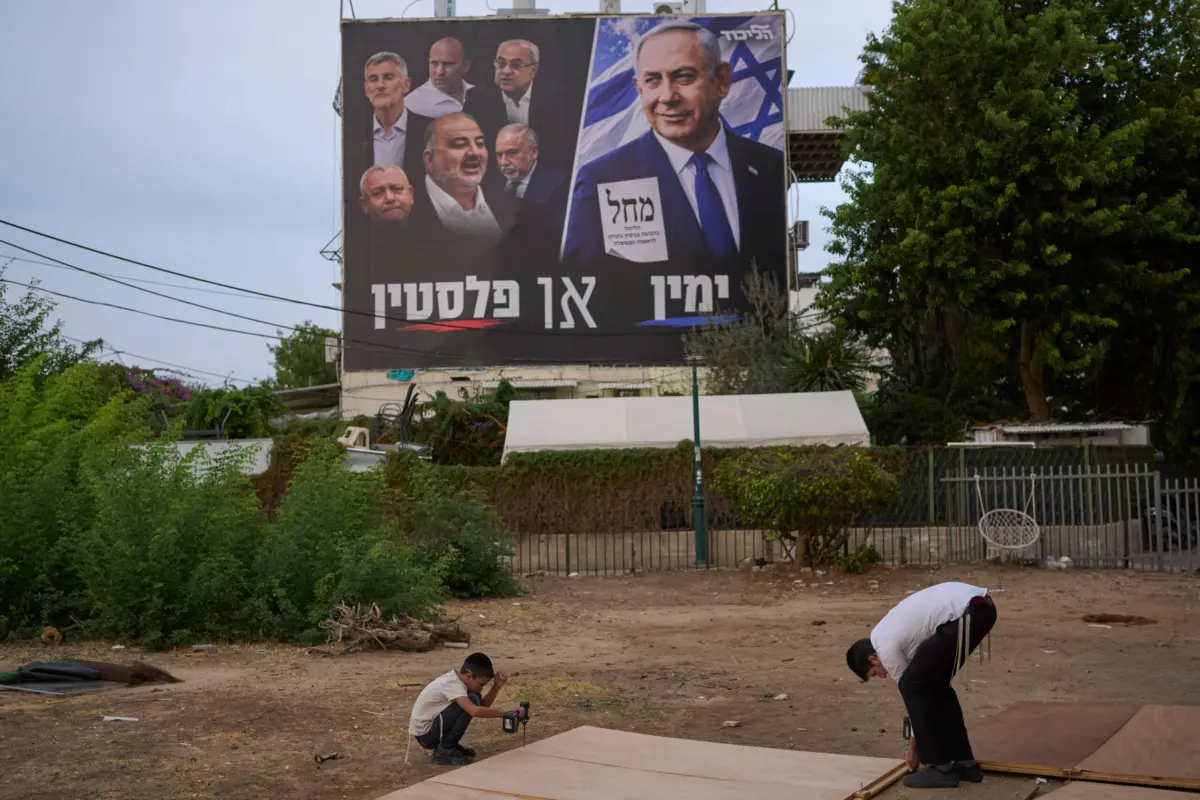
As Israel braced for its October 27 election, the political landscape was profoundly shaped by the shadow of conflict and a discernible shift towards the right. Prime Minister Benjamin Netanyahu, seeking re-election, initiated the final month of campaigning with a stark warning on September 29: Israel’s adversaries were allegedly plotting an attack before the vote. This declaration, made without immediate corroborating evidence, was swiftly followed by a reference to ongoing military operations in the Gaza Strip, where he claimed over 100 "terrorists" had been neutralized in recent weeks. Analysts quickly identified this linkage—between the devastating war on Gaza, which commenced after the Hamas-led October 7, 2023 attacks, the impending elections, and Israel’s national security—as a deliberate strategic move.
Netanyahu’s re-election strategy, observers contend, hinges on his long-standing assertion that he alone possesses the capacity to safeguard Israelis from a myriad of cross-border threats. This narrative persists despite significant criticisms regarding his alleged failures surrounding the October 7, 2023 attacks and the prolonged captivity of hostages. The gravity of this security-centric campaign was underscored just a day after his warning, when a Flydubai flight carrying Israeli passengers from Dubai to Tel Aviv experienced a near-catastrophe after a co-pilot reportedly assaulted his pilot with an axe. Netanyahu was quick to capitalize on the incident, leveraging it to reinforce his image as the indispensable leader for the nation’s top office.
A Nation Under Strain: The Aftermath of October 7 and Political Realignment
The October 7, 2023 attacks, which resulted in the deaths of 1,139 people in Israel and involved the taking of hundreds of hostages, precipitated a profound national trauma and ignited a large-scale military offensive in the Gaza Strip. This conflict has, according to Palestinian authorities, claimed the lives of over 74,000 Palestinians and caused widespread devastation to infrastructure and civilian life, displacing a significant portion of Gaza’s population. Three years later, the war remains inextricably woven into Israel’s domestic political discourse, accelerating an already evident shift towards the right. What were once considered fringe positions concerning Palestinians have now, alarmingly, entered the mainstream.
Polling ahead of the October 27 vote suggests that Netanyahu faces a formidable challenge, marking the first general election since the 2023 attacks. The attacks not only shattered Israel’s sense of invulnerability but also intensified public debate over the nation’s future direction and its approach to regional security. The pervasive fear and insecurity following October 7 have created fertile ground for hardline rhetoric, pushing the political center further to the right and reshaping electoral priorities.
The Ascendance of the Far-Right: Voices of Extremism
Few figures embody this transformation more starkly than Israel’s far-right Finance Minister, Bezalel Smotrich. Known for his incendiary and often racist rhetoric and policies towards Palestinians, Smotrich has faced sanctions from several Western countries due to his controversial stances and actions. In a characteristically provocative statement to the Israeli outlet Ynet late last month, he advocated for the Israeli army to "go to war" in the occupied West Bank and "do there what we did in Gaza." This sentiment reflects a growing demand within segments of Israeli society for more aggressive military action and territorial control, echoing a desire for decisive, often brutal, solutions.
Adding to this increasingly charged atmosphere, Smotrich’s electoral ally, Moshe Feiglin, explicitly stated to the Jerusalem Post less than two weeks later, "The enemy is Gaza, not Hamas." He further called for the annexation of the besieged territory post-election, asserting, "The baby that will be born tomorrow in Gaza will do exactly the same," in a chilling reference to the 2023 attacks. This statement suggests a generational view of the conflict, implying an inherent and immutable enmity.
Palestinian political analyst Ahmed Najar dismisses these as mere "stray comments" from marginal figures. Instead, he views them as a deliberate electoral strategy by power-seeking politicians aimed at depicting Palestinians not as "a people with rights, but a demographic and security problem to be expelled, conquered or destroyed." Najar warns of a "frightening reality" where the election risks becoming "a competition not over whether Palestinian life should be protected, but over who can promise to erase it most aggressively."
Historical Context of a Deepening Divide
The roots of Israel’s rightward trajectory run deeper than the recent conflict. Ahron Bregman, an Israeli security analyst and senior teaching fellow at King’s College London, notes that while forces driving Israel to the right have been gathering for decades, the trend dramatically intensified after October 7. He traces the initial shift to the Yom Kippur War in 1973, a bloody 19-day conflict between Israel and a coalition of Arab states led by Egypt and Syria, which profoundly impacted Israeli strategic thinking and national psyche, fostering a greater emphasis on military might and security at all costs. The rise of the Likud party and the settlement movement in the decades that followed further solidified this conservative shift.
More recently, the far-right has been significantly emboldened through electoral politics, particularly since its integration into Netanyahu’s government in 2022. This coalition is widely regarded as the most right-wing in Israeli history. Alongside Smotrich, Minister of National Security Itamar Ben-Gvir, a far-right provocateur with past convictions for inciting racism and supporting a terrorist organization, holds a prominent cabinet position. Bregman critically views Netanyahu’s decision to include figures like Ben-Gvir and Smotrich in his coalition as a "greatest mistake," legitimizing them as influential forces in Israeli politics. Alarmingly, Ben-Gvir’s growing influence has led him to openly aspire to the role of Israeli defence minister, a prospect Bregman describes as "madness," yet indicative of "contemporary Israel."
Electoral Double Standards and Consensus for Force
Analysts further point to a concerning consensus across the Israeli political spectrum, even among parties challenging the current coalition, advocating for the expulsion of Palestinians from Gaza. This stance exemplifies the profound rightward shift in mainstream political thought. Omar Baddar, director of Palthink for Strategic Studies, observes that the messaging from across the Israeli political and military establishment in the lead-up to the election reveals a "consensus" to continue military operations in Gaza, where nearly 1,500 people have reportedly been killed since a "ceasefire" last year. This ongoing violence, even after a supposed cessation of hostilities, indicates a sustained commitment to military solutions. Baddar attributes this to the radicalization of society, noting that "whoever’s more radical is more likely to get more votes" as the election approaches, creating a dangerous race to the bottom in terms of moderate policy.
Ehab Jabareen, a Palestinian political analyst and researcher within Israel, elucidates the evolving definition of "right-wing" in contemporary Israel. He writes that it primarily signifies "to take a harder line on Palestinian national claims, security and territorial control." He adds that "a large part of Jewish Israeli politics already works from assumptions that would have been treated as right-wing a generation ago: Deep suspicion of a sovereign Palestinian state, a high tolerance for prolonged military control, and a stronger insistence on Jewish sovereignty as the starting point rather than one value among others." This normalization of extreme positions underscores the depth of the political transformation.

The disparity in the electoral process itself underscores this shift. Sami Abu Shehadeh, a prominent Palestinian citizen of Israel and politician, was reportedly forced to withdraw from the election due to remarks about the Gaza war, while Israeli far-right leaders known for violent rhetoric against Palestinians remain unchallenged. This highlights a perceived double standard in the application of electoral rules and public discourse, suggesting a systemic bias against Palestinian voices.
Netanyahu’s Enduring Security Credentials Amidst Scrutiny
Despite the significant security failures of October 7, which remain a top concern for Israelis, Prime Minister Netanyahu’s security credentials surprisingly endure for a segment of the electorate. Reports surfaced last month indicating that Netanyahu had received two separate warnings about an imminent Hamas attack in 2023, from Egypt’s intelligence chief, Abbas Kamel, and United Arab Emirates President Sheikh Mohamed bin Zayed Al Nahyan. These alleged warnings were swiftly cited by Netanyahu’s two main rivals in the prime ministerial race, who deemed him "unfit" to lead the country. However, Netanyahu has vehemently denied being forewarned, and these reports do not appear to have significantly impacted his standing in opinion polls.
Public trust in the Netanyahu government had already been severely eroded by its controversial judicial overhaul, introduced when the current coalition first took power in 2022. Mairav Zonszein, an Israel-Palestine analyst at the International Crisis Group, notes that despite these breaches of trust, the Israeli leader retains considerable support. "Israelis in general still see Netanyahu as kind of the guy on security. And more to the point, they don’t really see an alternative," Zonszein told Al Jazeera, suggesting a lack of viable centrist or left-leaning options perceived as capable of managing security.
A June survey by Mitvim, the Israeli Institute for Regional Foreign Policies, revealed that the Israeli public largely supports its government’s military and security solutions, while simultaneously rejecting efforts to resolve the Palestinian issue and end the occupation of Palestinian territory. This is despite growing concerns about international isolation and a decline in Israel’s global standing since the commencement of the war in Gaza, indicating a prioritization of perceived security over diplomatic engagement or international reputation.
War Fatigue and Societal Strain
Yet, beneath this facade of unwavering support for military solutions, Israelis are also increasingly grappling with war-weariness. The nation’s troops, stretched across six fronts of war in recent years, are bearing the brunt of this societal fatigue. The Ministry of Defence reported recently that nearly 30,000 soldiers and security personnel are experiencing psychological trauma since the war began. In response, the ministry’s rehabilitation department budget has seen an 88 percent increase over the past three years, reaching 10 billion shekels ($3.3 million), primarily allocated to treating mental health conditions and post-traumatic stress disorder. This highlights the profound human cost of prolonged conflict, even as the political discourse pushes for further military engagement, creating a complex societal tension between security demands and the welfare of its service members.
The Expansionist Vision and the Fading Hope of a Two-State Solution
In recent months, Israel has become increasingly vocal about an expansionist vision, with officials openly articulating the goal of "Greater Israel," a claim rooted in biblical verses (Genesis 15:18-21). This vision, advocating for Israeli sovereignty over all historical Judea and Samaria (the West Bank), and potentially parts of surrounding territories, represents a significant shift from previous, more ambiguous stances. For decades, Israel has systematically disregarded international law through its continuous occupation of Palestinian and Syrian land, and has shown little respect for its neighbours’ sovereignty, expanding its presence in Syria and, more recently, in Lebanon.
According to Ahmed Najar, the political economist, the "complete dehumanisation" of Palestinians evident during the election campaign suggests that Gaza is being presented to Israeli voters "not as a catastrophe or a crime for which there must be accountability, but as a blueprint to be repeated elsewhere." This alarming framing indicates a potential for further regional destabilization and conflict, as it implies a willingness to apply the same destructive tactics in other contested areas.
In southern Lebanon, where Israel has conducted near-daily attacks and occupied significant swathes of land, residents have expressed to Al Jazeera their expectation of little change, regardless of the election’s outcome. This sentiment is reinforced by the hawkish stance of Netanyahu’s main political challenger, Gadi Eisenkot, head of the Yashar party and a former army chief of staff. Eisenkot is the architect of the so-called Dahiyeh Doctrine, which emerged from Israel’s 2006 war with Hezbollah. This doctrine advocates for the use of overwhelming force, even against civilian infrastructure, as a deterrent against enemies, a strategy deployed in Israel’s recent conflicts, particularly in Beirut’s southern suburbs. Eisenkot has even criticized Netanyahu for bowing to US pressure to scale down operations in Beirut, insisting the military should retain the freedom to attack Hezbollah anywhere in Lebanon.
For Israelis still reeling from the trauma of October 7, Eisenkot’s tough stance could appeal to a populace seeking to fill a perceived security void. Zonszein observes that many Israelis "see the world as kind of very hostile towards them, the world not understanding what they went through on October 7, and [therefore why] the need to have these security buffer zones in Lebanon, in Syria, and Gaza." This perception of isolation and threat reinforces the demand for aggressive defensive postures.
Consequently, the prospect of a two-state solution to the Israeli-Palestinian conflict has, according to analysts, faded into irrelevance. It has not even registered as a point of discussion in the current election campaign. The concept, which first gained prominence during the Oslo Accords more than 30 years ago, envisioned the creation of a Palestinian state alongside Israel as imperative for peace. However, since the Oslo process began in 1993, the number of Israeli settlers in the West Bank has surged from approximately 260,000 to over 700,000, deeply entrenching themselves in areas crucial for a contiguous Palestinian state, effectively rendering a two-state solution geographically unviable.
Ahron Bergman states that "The concept of a two-state solution is currently irrelevant and likely will remain so for another decade or two, if not longer." He deems it unlikely to materialize in the foreseeable future, as "no Israeli leader can propose it to the Israeli public after the events of October 7." Its re-emergence, he suggests, would require substantial international pressure, including severe sanctions on Israel, coupled with a non-violent Palestinian uprising. The outright rejection of Palestinian statehood has simply become far more "acceptable," according to Zonszein. She points out that "There’s several parties who advocate these views, whereas there isn’t a single Jewish Zionist Party that puts the need for a two-state solution or a Palestinian political process at the forefront."
Conclusion: An Entrenchment of Jingoism
Taken collectively, the upcoming Israeli election appears to be less a demand for fundamental change and more an entrenchment of the jingoism that surged in the aftermath of October 7, 2023. The prevailing sentiment, fueled by fear and insecurity, drives a continuous "movement towards more military force, more need for pushing the borders," as Zonszein concludes, born out of a profound apprehension that another October 7 could occur. This election, therefore, is poised to solidify a political trajectory that prioritizes aggressive security measures and territorial expansion over diplomatic solutions and human rights, with potentially far-reaching consequences for regional stability and the lives of millions.
