

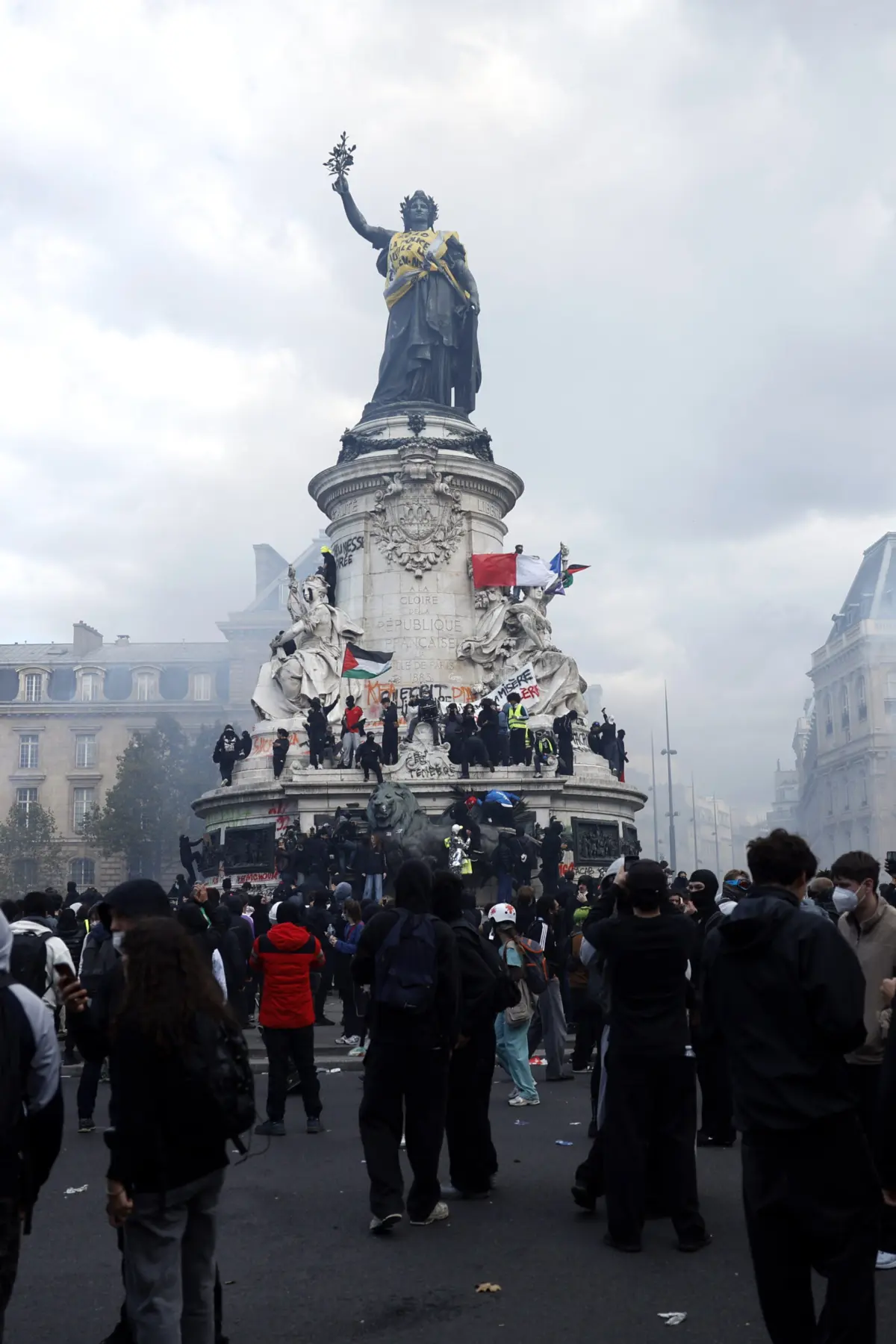
France is currently embroiled in a significant wave of social unrest, with protests sweeping across the nation as deep-seated anger over deteriorating conditions in public schools converges with widespread frustration regarding the soaring cost of living and a government perceived as unresponsive to the needs of its citizens. The movement, which began as localised student grievances, has rapidly escalated into a nationwide phenomenon, drawing in a diverse coalition of students, trade unions, and echoes of the "yellow vest" (gilets jaunes) movement.
On a recent Saturday, an estimated 550,000 individuals participated in demonstrations nationwide, according to figures released by the Interior Ministry. While the vast majority of these marches proceeded peacefully, a discernible minority engaged in destructive acts, targeting public buildings, looting shops, and clashing violently with law enforcement. Police forces responded with tear gas and charges, leading to widespread arrests and injuries. Prime Minister Sebastien Lecornu confirmed the arrest of 1,200 individuals and reported that 150 police officers sustained injuries during the confrontations. Beneath the surface of these street battles lies a profound political crisis, exacerbated by a growing sense that France’s established political institutions offer little viable hope for meaningful change, leaving citizens increasingly disillusioned and their household budgets stretched to breaking point.
This escalating unrest presents a formidable challenge to President Emmanuel Macron, whose administration now faces a critical juncture. The trajectory of these school blockades transforming into a broader national movement speaks volumes about the collective frustration brewing within French society and carries significant implications for Macron’s remaining term and his political legacy.
The Genesis of Discontent: From Classrooms to National Crisis
The current wave of protests initially ignited last month within the high schools (lycées) of Paris’s working-class northern suburbs. Students there voiced immediate and pressing concerns about severe teacher shortages, inadequate facilities, and overcrowded classrooms. These initial grievances quickly resonated beyond the capital, with school blockades and student demonstrations spreading organically to major cities across France, including Bordeaux, Rennes, Nantes, Lyon, Lille, and Marseille.
What began as a focused protest against educational shortcomings swiftly broadened its scope. The Saturday demonstrations, in particular, marked a critical turning point, bringing together not only students but also established trade unions and drawing in supporters of the "yellow vest" movement. The gilets jaunes, which burst onto the scene in 2018, originally mobilised against rising fuel taxes but quickly evolved into a broader protest against economic inequality and the perceived elitism of the Macron government. Their participation underscores the deep historical roots and recurring themes of social unrest in France.
Emile Chabal, a distinguished professor of contemporary history at the University of Edinburgh, contextualised the current demonstrations as "the logical outcome of a series of protests" that have been building since the original gilets jaunes movement. He explained to Al Jazeera that the 2018 movement was primarily driven by acute financial pressures and a deep-seated resentment towards "the French presidential system." This system, often criticised for its centralised power and tendency to favour centrist candidates like President Macron, frequently leaves large segments of the population feeling unrepresented and unheard. The current convergence of these long-standing grievances with students’ anger over the deteriorating state of public education, Chabal noted, represents "the worst possible outcome for the French government."
Demands Reflecting Deep-Seated Societal Ills
The protesters’ demands are multifaceted, reflecting a complex tapestry of immediate concerns and broader societal aspirations. Students’ immediate grievances predominantly revolve around conditions in France’s public high schools, which typically cater to pupils aged 15 to 18. They are calling for smaller class sizes, an adequate number of qualified teachers, significant improvements to dilapidated school buildings, and less demanding timetables. Beyond these specific educational reforms, their complaints also reflect a deeper anxiety about the state’s capacity to provide the foundational education and future opportunities that young people critically need in an increasingly competitive world.
For workers, including school staff and employees across various public sectors, the dispute extends to fundamental issues of wages and the dwindling resources allocated to deliver essential public services. The school protests conveniently coincided with a pre-existing nationwide public sector strike, primarily organised in opposition to the government’s proposed 2027 budget plans. This convergence of grievances has amplified the collective voice of discontent.
The proposed 2027 budget includes a substantial 54 billion euro ($60.8 billion) package of cost-cutting measures and tax adjustments. The government argues these are essential to rein in France’s national deficit. However, among these proposals is a contentious plan to freeze the pay scale used to calculate civil servants’ basic salaries, a move that unions vehemently oppose, highlighting that this would mark the fourth consecutive annual freeze. Such austerity measures, in a climate of persistent inflation, translate directly into a real-terms pay cut for millions of public sector employees, further eroding their purchasing power and exacerbating the cost-of-living crisis.
Donatella della Porta, a renowned sociologist and political scientist, observed that students are playing a pivotal role in inspiring a wider mobilisation around issues of inequality, cuts to public investment, and democratic rights. Their demands, she elaborated, increasingly call for greater social welfare spending rather than increased militarisation. "They do not want to fight wars; they want a different future," she told Al Jazeera, succinctly capturing the aspirations of many young protesters. Della Porta also drew a parallel between the current movement and the broader youth mobilisation over the conflict in Gaza, noting the visible presence of Palestinian flags at demonstrations across several European countries, indicating a growing interconnectedness of global and local injustices in the minds of young activists.
A History of French Social Upheaval: Contextualising the Current Crisis
France has a rich and often turbulent history of social protest, where street demonstrations frequently serve as a vital, if sometimes violent, expression of public dissent. The current unrest cannot be fully understood without acknowledging this historical context.
The "yellow vest" movement of 2018-2019 stands as the most immediate precedent. Triggered by a fuel tax hike, it quickly evolved into a broad-based challenge to Macron’s economic policies, which were perceived as benefiting the wealthy at the expense of ordinary citizens. The gilets jaunes introduced new tactics, including weekly Saturday demonstrations that often led to clashes, and highlighted a deep geographical divide between metropolitan elites and struggling provincial populations. Their legacy includes a heightened awareness of economic inequality and a profound distrust of traditional political institutions.
Further back, the seminal events of May 1968 saw students and workers unite in a massive wave of strikes and protests that brought France to a standstill, nearly toppling Charles de Gaulle’s government. While the context was different—a post-war economic boom and Cold War ideological tensions—the echoes of student-worker solidarity, demands for greater social justice, and a challenge to established authority are palpable. The lycée student protests of 1986 against education reforms, which saw widespread mobilisation and ultimately forced the government to back down, also serve as a reminder of the potent force of youth activism in France.
These historical episodes underscore a recurring pattern: when specific grievances, particularly those related to education or economic hardship, are perceived as symptoms of a broader systemic failure or government indifference, they possess the potential to ignite widespread social movements that challenge the very fabric of French political life. The current confluence of educational neglect, cost-of-living pressures, and a perceived lack of democratic accountability fits squarely within this historical tradition.
Government Response: Prioritising Order Amidst Criticism
The Macron government’s immediate response to the escalating protests has predominantly focused on the maintenance of public order and a firm stance against violence. President Macron himself issued a stern warning, stating that those responsible for acts of violence would be "prosecuted and punished." These comments came in the wake of significant acts of destruction, including a fire that largely destroyed the historic town hall in the city of Limoges, alongside attacks on other public buildings and shops across the country.
However, it is crucial to note that those involved in such acts of violence represent only a small fraction of the much larger and overwhelmingly peaceful mobilisation. The government’s emphasis on law and order has drawn sharp criticism from opposition figures, particularly from the left. Jean-Luc Mélenchon, the leader of the left-wing France Unbowed (La France Insoumise) party, publicly accused the government of repressing school students and allowing the confrontation to needlessly intensify. His argument reflects a broader political debate about whether the government is treating the protests primarily as a security problem, thereby neglecting to address the fundamental grievances that have united disparate groups.
Experts suggest that France’s current problems extend far beyond disagreements over specific budget measures, pointing instead to deeper, systemic discontent. Emile Chabal highlighted the pervasive political paralysis that has gripped France since the 2024 parliamentary elections. These elections resulted in no single political bloc securing an outright majority, creating what Chabal describes as "an environment in which no political party or movement is able to channel social discontent." This fragmentation makes it exceedingly difficult to forge durable agreements on critical issues such as spending, taxation, or the provision of public services. Consequently, protesters are left questioning whether changes in government genuinely lead to meaningful shifts in policy, fostering a sense of futility and despair.
Chabal further noted that the current protests constitute "a tough blow for Macron." The president, who came to power promising youthful energy and a reformed, dynamic France, has seen his promises undermined by "his inability to articulate his political project and his deeply unempathetic persona." This perception of detachment from the daily struggles of ordinary French citizens has been a persistent critique throughout his presidency.
The unrest has also featured violence characteristic of the fringes of French demonstrations, including direct-action tactics often associated with the gilets jaunes. Targets have included shops and, more unusually, public buildings. Chabal described the destruction of Limoges’ town hall as particularly symbolic and significant, given its central place in France’s civic history and republican values.
Other researchers have underscored the critical role of policing tactics in shaping the dynamics of these protests. Guya Accornero, a specialist in social movements at Lisbon’s University Institute, argued that previous confrontations have created lasting tensions between protesters and police. During the current protests, Human Rights Watch reported deeply concerning incidents, including a 15-year-old losing a hand to a police stun grenade and a 14-year-old suffering a shattered jaw after being struck by a tear gas canister fired at close range. The organisation vehemently condemned the excessive force used against children, reiterating that the demonstrations had been overwhelmingly peaceful. "Young people have been violently repressed also when using non-disruptive tactics," Accornero told Al Jazeera, highlighting a pattern of heavy-handed policing that risks further alienating a generation already feeling unheard.
Broader Impact and Political Implications: Who Benefits?
The political implications of this widespread unrest are complex and far-reaching, with no clear consensus among experts regarding potential beneficiaries. Paul Smith, an associate professor in French history and politics at the University of Nottingham, believes that far-right leader Marine Le Pen stands to gain the most. "I see only one beneficiary and that’s Le Pen," he told Al Jazeera, suggesting that the unrest could also damage the presidential prospects of left-wing firebrand Jean-Luc Mélenchon by associating his movement with disorder.
Chabal, while cautioning against automatically assuming a far-right gain, acknowledged that the fear of disorder has historically benefited conservative or centrist parties in France, citing the aftermath of the 1968 protests as a historical precedent. Marine Le Pen herself has strategically navigated the situation, not entirely dismissing the protesters’ grievances. On social media platform X, she described them as "legitimate social demands" while simultaneously attempting to frame them as having been "held hostage by the far left." This tactic allows her to tap into public discontent while simultaneously reinforcing her party’s image as the guarantor of order against perceived radical elements.
While the far-right may indeed seek to capitalise on public discontent, experts suggest that it is more likely to channel this anger towards issues of immigration and the scapegoating of migrants, rather than engaging with the structural critiques of neoliberalism and capitalism that Mélenchon and the far-left often articulate. This divergence in framing highlights the ideological battleground upon which the future of French politics will likely be fought.
With the next presidential election slated for April 2027, political candidates face immense and competing pressures. They must demonstrate their capacity to restore order and ensure stability, while simultaneously convincing a skeptical electorate that they genuinely understand and are prepared to address the underlying conditions that have fuelled this profound mobilisation. The challenge, as Chabal aptly summarises, lies in how to facilitate meaningful change in "an environment in which no political party or movement is able to channel social discontent." This fragmentation not only hinders effective governance but also risks deepening the disillusionment of citizens, potentially leading to further cycles of unrest and political instability. The current crisis, therefore, is not merely a transient wave of protests but a symptom of deeper structural challenges within French democracy and society that demand urgent and comprehensive attention.
