

The Assassination and Immediate Response
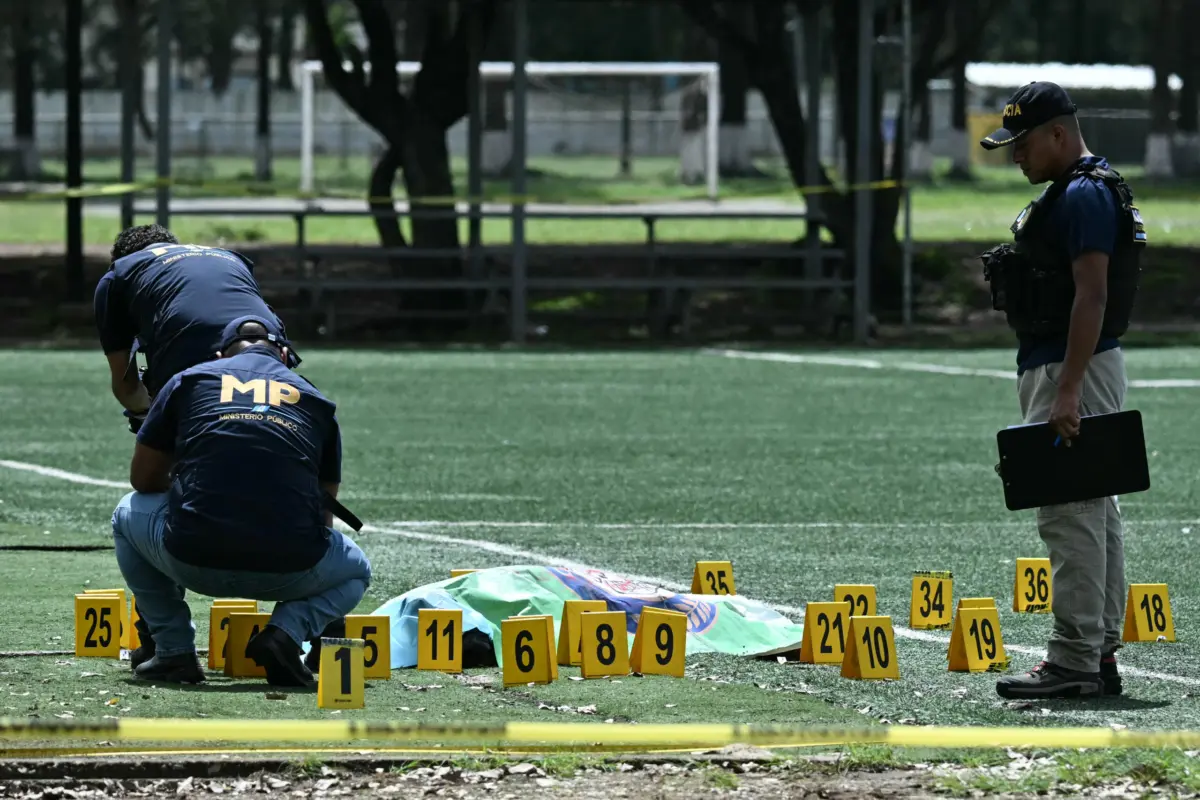
The fatal incident occurred at the Campo Marte sports complex, a public recreational area in the heart of Guatemala City. According to reports from the Public Prosecutor’s Office, Solorzano Foppa, 43, and Aguilar Gamarro were shot by two assailants. The attack was swift and brutal, leaving both men dead at the scene. The precise motives for the attack remain under intense investigation, but the nature of Solorzano Foppa’s work immediately pointed towards a possible connection to his relentless anti-corruption advocacy.
In a remarkably rapid response, Guatemalan police announced the apprehension of two men shortly after the shooting. Authorities confirmed the suspects were taken into custody and that a carbine-style firearm and a motorcycle, believed to have been used in the commission of the crime, were seized. While official identities of the arrested individuals were not immediately released to the public in detail, early reports and images circulating from judicial sources indicated Daniel Choc Toz and Rigoberto Choc Toz were among those detained, subsequently entering holding cells at the Tower of Tribunals. This swift action by law enforcement has been praised by some as a crucial first step, yet many observers underscore the paramount importance of not only apprehending the direct perpetrators but also uncovering the intellectual authors who may have ordered the assassination.
Juan Francisco Solorzano Foppa: A Champion Against Corruption
Juan Francisco Solorzano Foppa was more than just a lawyer; he was a symbol of resistance against the deeply entrenched corruption that has plagued Guatemala for decades. At 43, his career was marked by a series of high-stakes legal battles that targeted some of the nation’s most powerful and politically connected businessmen, politicians, and corporations. His work often placed him in direct opposition to formidable interests, making him a figure both admired and feared.
Foppa’s career trajectory showcased a deep commitment to public service and the rule of law. He previously served as a prosecutor, honing his skills in criminal investigations. A significant chapter in his professional life was his tenure as the head of the Criminal Investigations Directorate within the Public Prosecutor’s Office. This role provided him with invaluable insight into the inner workings of criminal networks and the challenges of pursuing justice in a complex legal landscape.
From 2016 to 2018, Foppa took on an even more impactful role when he led Guatemala’s tax authority, the Superintendencia de Administración Tributaria (SAT). During his leadership, the SAT became a formidable force in combating financial malfeasance. He was instrumental in initiating and prosecuting dozens of cases against powerful Guatemalan business figures who had evaded taxes, recovering substantial amounts of unpaid revenue for the state. His efforts in this position were not merely about fiscal collection; they represented a direct challenge to the culture of impunity that allowed elites to operate above the law, often using their influence to avoid their civic responsibilities. This period cemented his reputation as an uncompromising figure willing to confront systemic corruption head-on, earning him both accolades and powerful adversaries.

A History of Challenging the Status Quo
Foppa’s unwavering commitment to justice frequently led him into controversial and perilous territories. In 2025, he made significant public allegations, asserting connections between the notorious Barrio 18 gang and the National Unity of Hope (UNE) party, a major political force in Guatemala. He also highlighted disturbing links between criminal gangs and the country’s judicial system, suggesting a pervasive infiltration that undermined the very foundations of justice. Such claims, made publicly, carried immense risk and underscored his courage in exposing uncomfortable truths about the nexus of crime, politics, and power in Guatemala.
More recently, in 2023, Solorzano Foppa briefly joined the defense team of prominent Guatemalan journalist Jose Ruben Zamora. Zamora, the founder and president of elPeriódico, had become an international symbol of resistance against the criminalization of journalism and the erosion of judicial independence in Central America. His arrest and subsequent prosecution on charges of money laundering, blackmail, and influence peddling were widely seen by international human rights organizations and press freedom advocates as politically motivated, designed to silence critical reporting. Foppa’s involvement in Zamora’s defense, albeit brief, signaled his solidarity with those fighting for fundamental freedoms and further solidified his image as a defender of democratic principles.
However, Foppa’s participation in the Zamora case was cut short. He was accused by the Public Prosecutor’s Office of obstructing proceedings and destroying or concealing information. While he vehemently denied these charges, he ultimately accepted a plea agreement, explaining that he did not believe he would receive a fair trial given the political climate surrounding the case. This episode highlighted the immense pressures and systemic challenges faced by individuals attempting to uphold justice and defend human rights within Guatemala’s often compromised legal framework. His decision, while pragmatic, spoke volumes about the difficult environment in which he operated.
Guatemala’s Landscape: Corruption, Impunity, and Threats to Justice
The assassination of Juan Francisco Solorzano Foppa occurs against a backdrop of deep-seated corruption and pervasive impunity in Guatemala. The country has long grappled with the corrosive effects of organized crime, drug trafficking, and illicit networks that have infiltrated state institutions at various levels. For years, the fight against these forces was bolstered by the International Commission Against Impunity in Guatemala (CICIG), a UN-backed anti-corruption body that operated from 2007 to 2019. CICIG, in collaboration with the Public Prosecutor’s Office, achieved significant breakthroughs, prosecuting high-ranking officials, including a former president, and exposing vast corruption schemes. However, its success also made it powerful enemies, ultimately leading to its controversial expulsion from the country.
The departure of CICIG created a vacuum, and many feared a resurgence of impunity. Indeed, subsequent years saw a rollback of some anti-corruption gains, with judicial independence coming under increasing pressure and prosecutors and judges who had worked on sensitive cases facing threats, harassment, and even politically motivated prosecutions. The environment for human rights defenders, journalists, and anti-corruption activists has become increasingly perilous, with violence and intimidation used as tools to silence dissent and maintain corrupt systems. Solorzano Foppa’s death tragically underscores these risks, serving as a stark reminder of the dangers faced by those who dare to challenge powerful vested interests.
Official Reactions and International Concern

The murder of Juan Francisco Solorzano Foppa has drawn immediate and strong condemnation from the highest levels of Guatemalan government. President Bernardo Arevalo, who campaigned and won on an anti-corruption platform, expressed his outrage publicly. On his official X account, Arevalo wrote, “I strongly condemn the cowardly murder of former prosecutor Juan Francisco Solorzano Foppa. Both the direct perpetrators and those who ordered the crime must face the full weight of the law.” His statement reflected not only grief but also a firm commitment to pursuing justice.
President Arevalo further stated that he had instructed his government to coordinate with all relevant authorities to ensure the crime is thoroughly investigated and solved. He concluded his remarks with a defiant message: “Those who believe that terror can intimidate the people of Guatemala and the government I lead are mistaken. In honour of Foppa, in honour of our homeland, in honour of justice.” This powerful declaration from the head of state highlights the gravity of the situation and the government’s resolve to push back against attempts to undermine the rule of law through violence.
Beyond official government channels, the assassination is expected to elicit strong reactions from various national and international bodies. Legal associations in Guatemala are likely to mourn the loss of a distinguished colleague and call for robust protections for legal professionals. Human rights organizations, both domestic and international, will undoubtedly express grave concern over the incident, linking it to the broader pattern of threats against those working for justice and accountability in Central America. International bodies, including the United Nations and the Organization of American States, which have historically monitored human rights and rule of law in Guatemala, are also anticipated to issue statements urging a transparent and impartial investigation, emphasizing the need to combat impunity for such egregious acts. The United States, a key partner in anti-corruption efforts in the region, is also expected to weigh in, underscoring the importance of upholding democratic institutions and the rule of law.
Broader Implications and the Path Forward
The assassination of Juan Francisco Solorzano Foppa carries profound implications for Guatemala’s fragile democratic institutions and its ongoing fight against corruption. His death sends a chilling message to other lawyers, prosecutors, judges, journalists, and civil society activists who are engaged in similar high-stakes battles against powerful criminal and corrupt networks. It risks creating a climate of fear that could deter individuals from pursuing justice or exposing wrongdoing, thereby strengthening the grip of impunity.
For President Arevalo’s administration, this incident represents an immediate and critical test of his commitment to his anti-corruption mandate. His ability to ensure a thorough, impartial, and ultimately successful investigation—one that identifies and prosecutes not only the triggermen but also any intellectual authors—will be crucial in demonstrating his government’s resolve. Failure to deliver justice in such a high-profile case could severely undermine public trust in his administration and embolden those who seek to use violence to protect their illicit interests.
Furthermore, Foppa’s murder highlights the persistent challenges to judicial independence and the rule of law in Guatemala. The ease with which a prominent anti-corruption figure could be targeted, despite the swift arrests, underscores the deep-seated nature of the problem. It reinforces concerns among international observers about the protection of justice operators and the need for comprehensive reforms to strengthen legal institutions and safeguard those who work within them.
The loss of Juan Francisco Solorzano Foppa is not just a personal tragedy but a significant blow to the forces of integrity and accountability in Guatemala. His legacy as a fearless advocate will undoubtedly continue to inspire, but his absence leaves a void in a nation that desperately needs champions for justice. The international community, alongside Guatemalan civil society, will be closely watching the unfolding investigation, hopeful that Foppa’s death will not be another statistic in the grim history of impunity, but rather a catalyst for renewed determination to dismantle the structures of corruption and violence that continue to plague the country. The fight for justice in Guatemala has just become even more critical.
