

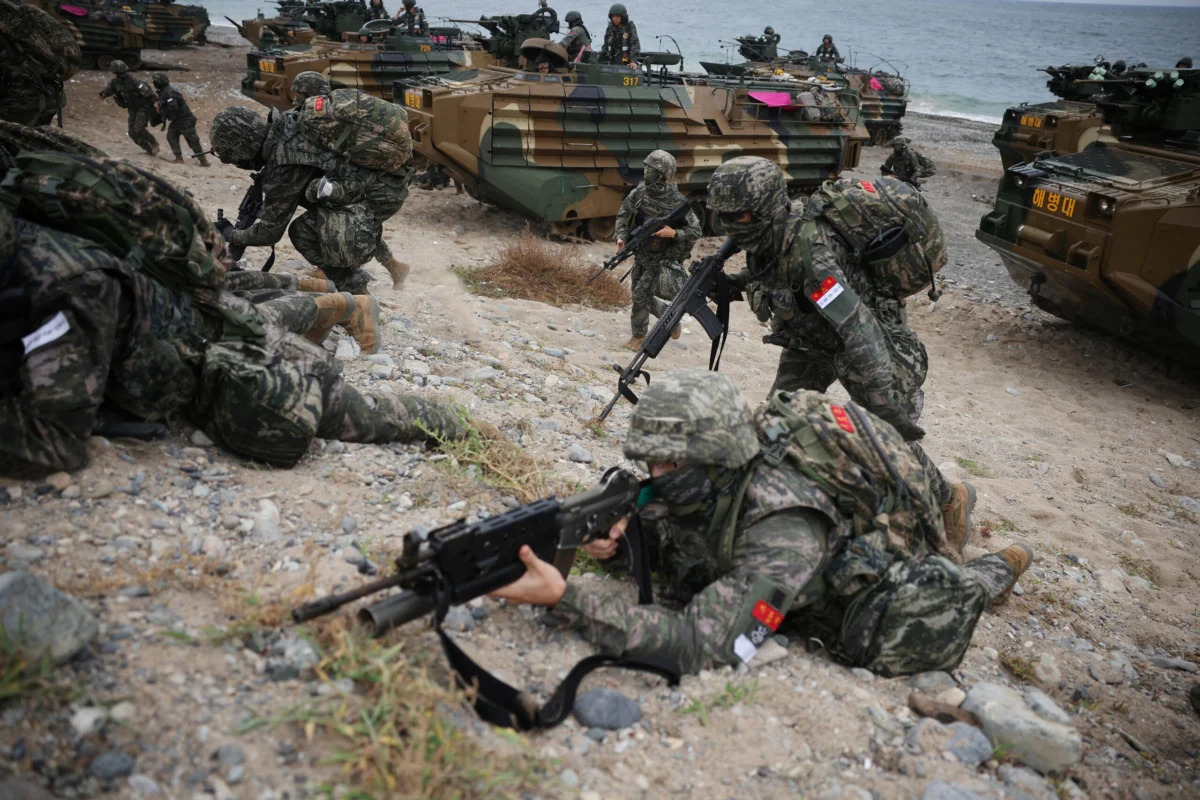
The United States military has officially cancelled the Ssangyong joint amphibious landing exercise, a major biennial military maneuver conducted alongside South Korean forces, citing significant constraints on force availability driven by the ongoing conflict involving the United States, Israel, and Iran. The announcement, made by South Korean military officials on Monday, marks a significant shift in the operational tempo of the ROK-US alliance and follows a series of executive decisions from Washington that have seen the scaling back of long-standing regional security commitments.
Han Seung-jeon, a spokesperson for the South Korean Marine Corps, confirmed during a press briefing in Seoul that the US Marine Corps formally notified South Korean leadership in June regarding the inability to deploy the necessary personnel and assets for this year’s Ssangyong drills. According to the notification, the ongoing war in the Middle East has necessitated the redirection of amphibious ready groups and marine expeditionary units that would typically participate in the Korean Peninsula exercises.
The Ssangyong exercise, which translates to "Twin Dragons," is one of the most visible demonstrations of the combined amphibious capabilities of the two nations. It typically involves thousands of troops, dozens of aircraft, and a fleet of warships practicing "over-the-horizon" landing operations designed to project power onto a coastline. The cancellation comes on the heels of President Donald Trump’s surprise order last week to truncate the Ulchi Freedom Shield (UFS) exercises, citing both the financial burden of the maneuvers and South Korea’s refusal to commit forces to the escalating conflict with Iran.
The Significance of Ssangyong and the Mechanics of Amphibious Readiness
To understand the impact of the cancellation, it is necessary to examine the scale and purpose of the Ssangyong drills. Historically, Ssangyong is intended to sharpen the interoperability between the Republic of Korea (ROK) Marine Corps and the US Marine Corps (USMC). The drills are not merely symbolic; they involve complex logistics, including the coordination of amphibious assault ships, such as the Wasp-class or America-class vessels, and South Korea’s Dokdo-class amphibious transport docks.
In previous iterations, such as in 2023, the exercise involved approximately 30 ships, 70 aircraft, and 50 amphibious assault vehicles. The core of the exercise is the rehearsal of a "vertical and horizontal" landing, where troops are delivered to a target beach via air-cushion landing craft (LCAC) and helicopters simultaneously. Military analysts view these drills as a critical deterrent against North Korean aggression, as they simulate the ability of allied forces to bypass frontline fortifications and strike deep into enemy territory via the sea.
The loss of this training cycle represents a potential degradation in the "fight tonight" readiness that has been the hallmark of the ROK-US alliance for decades. While South Korean officials noted that consultations are ongoing regarding a potential rescheduling or alternative training format, the immediate removal of US assets from the calendar suggests that the operational focus of the Pentagon has shifted toward the Middle East theater.
A Chronology of Scaling Back: From Ulchi Freedom Shield to Ssangyong
The cancellation of Ssangyong is the latest in a rapid succession of events that have redefined the US military footprint in East Asia over the past several weeks.
- Mid-August: The annual Ulchi Freedom Shield (UFS) exercises commence. Originally scheduled as an 11-day intensive simulation involving computer-assisted command post exercises and field training, the drills were intended to test the transition to wartime conditions.
- August 14–18: President Donald Trump issues a directive to scale back UFS. He characterizes the drills as "provocative" and "expensive," echoing sentiments from his first term. He specifically cites Seoul’s reluctance to participate in the "US-Israel war on Iran" as a factor in his decision to reduce the US commitment to South Korean defense exercises.
- August 19: UFS concludes after only five days, less than half its originally planned duration. On the same day, North Korea launches 10 short-range ballistic missiles into the East Sea, an act Pyongyang describes as a "warning" against allied aggression.
- Late August: President Trump takes to Truth Social to praise North Korean leader Kim Jong Un, describing him as "respectful" and "unthreatening" during his current administration.
- Monday Briefing: The South Korean Marine Corps confirms the total cancellation of the Ssangyong exercise scheduled for the following month.
This timeline suggests a deliberate decoupling of military readiness from diplomatic posturing. While the Pentagon has not issued an official statement regarding the Ssangyong cancellation, the South Korean perspective emphasizes a "resource constraint" model, whereas the political rhetoric from the White House suggests a more transactional and diplomatic motivation.
Geopolitical Drivers: The Middle East Conflict and Resource Allocation
The primary reason cited for the Ssangyong cancellation—constraints caused by the war on Iran—highlights a growing tension in US global strategy. The "Pivot to Asia," a policy initiated over a decade ago to focus US resources on the Indo-Pacific to counter a rising China and a nuclear-armed North Korea, is being challenged by the immediate demands of the Middle East.
The conflict involving Israel and Iran has required a surge in US naval and marine presence in the Eastern Mediterranean, the Red Sea, and the Persian Gulf. Amphibious Ready Groups (ARGs), which are the backbone of the Ssangyong exercise, are currently deployed to provide regional stability, protect shipping lanes from Houthi or Iranian interference, and provide a rapid-response capability for potential evacuations or combat operations.
From a logistical standpoint, the US Marine Corps operates on a finite "Global Force Management" schedule. When a crisis erupts in the Middle East, assets are often diverted from the Indo-Pacific Command (INDOPACOM). The cancellation of Ssangyong is a tangible manifestation of this "zero-sum" reality of global force projection.
Furthermore, President Trump’s explicit mention of Seoul’s refusal to participate in the Iran conflict introduces a new level of friction into the ROK-US alliance. South Korea, which relies heavily on Middle Eastern oil, has historically maintained a delicate diplomatic balance in the region. Engaging in a direct kinetic conflict with Iran would not only jeopardize its energy security but also potentially alienate its Middle Eastern trading partners. The US administration’s decision to link Korean Peninsula defense exercises to South Korean participation in a Middle Eastern war represents a significant shift in the traditional "Special Measures Agreement" and alliance expectations.
The Diplomatic Dimension: Trump’s Re-engagement with Pyongyang
Parallel to the military scaling-back is a clear effort by the Trump administration to revive personal diplomacy with Kim Jong Un. The President’s recent comments suggesting that the military drills were "totally inappropriate and hostile" align with North Korea’s long-standing narrative that these exercises are rehearsals for an invasion.
The administration’s current stance appears to be a return to the "Singapore Summit" era of 2018, where Trump unilaterally suspended major exercises (then known as Ulchi Freedom Guardian) as a gesture of goodwill toward Kim. However, the context has changed significantly since the 2019 Hanoi summit collapse. At that time, negotiations stalled over the extent of sanctions relief in exchange for the dismantling of the Yongbyon nuclear facility.
In the years since, North Korea has significantly expanded its arsenal. During recent remarks, President Trump claimed that Pyongyang now possesses 57 "very powerful" nuclear weapons. This figure stands in contrast to estimates from the South Korean Ministry of National Defense and various international intelligence agencies, which suggest the number is likely between 80 and 120 warheads. Regardless of the exact count, the consensus among security experts is that North Korea’s nuclear and missile programs are far more advanced today than they were during the first Trump-Kim summits.
Analysis of Implications for Regional Stability
The cancellation of Ssangyong and the reduction of UFS carry several long-term implications for the security architecture of Northeast Asia:
- Readiness Gap: Amphibious operations are among the most difficult military maneuvers to execute. They require constant practice to ensure that communication, logistics, and tactical execution are seamless between two different national militaries. A multi-year gap in full-scale Ssangyong drills could lead to a "atrophy" of these specialized skills.
- Alliance Cohesion: The perception that the US is willing to cancel major exercises due to disagreements over unrelated conflicts (like Iran) may lead to concerns in Seoul regarding the reliability of the US "nuclear umbrella" and conventional defense commitments. This could fuel domestic calls within South Korea for the development of its own independent nuclear deterrent.
- North Korean Empowerment: Pyongyang has historically used the suspension or reduction of drills as a tactical victory. By firing 10 missiles even as the drills were being scaled back, North Korea has demonstrated that it does not feel compelled to offer reciprocal concessions for the reduction in allied military activity.
- Strategic Ambiguity in the Indo-Pacific: As the US focuses on the Middle East, regional actors—including China and Russia—may view the reduction in US-ROK military activity as a sign of waning American influence or capacity in the Pacific. This could lead to increased assertiveness in the South China Sea or around the Japanese archipelago.
Official Responses and Future Outlook
While the South Korean Marine Corps has expressed a desire to resume the exercises, the path forward remains uncertain. "Seoul and Washington are continuing consultations on resuming the amphibious exercise," Han Seung-jeon stated, though he refrained from providing a specific timeline.
The Pentagon’s silence on the matter suggests a cautious approach as the administration balances its "America First" foreign policy with the operational requirements of its global military commands. For the South Korean government, the challenge lies in navigating a relationship with a US president who views military alliances through a fiscal and transactional lens, while simultaneously managing the escalating threat from a North Korea that continues to modernize its ballistic missile technology.
As the situation in the Middle East remains volatile, the "Twin Dragons" of the ROK-US alliance remain grounded. The coming months will be a critical period for military planners in both nations as they attempt to reconcile the political directives of the White House with the tactical necessity of maintaining a credible defense posture on one of the world’s most militarized borders.
