

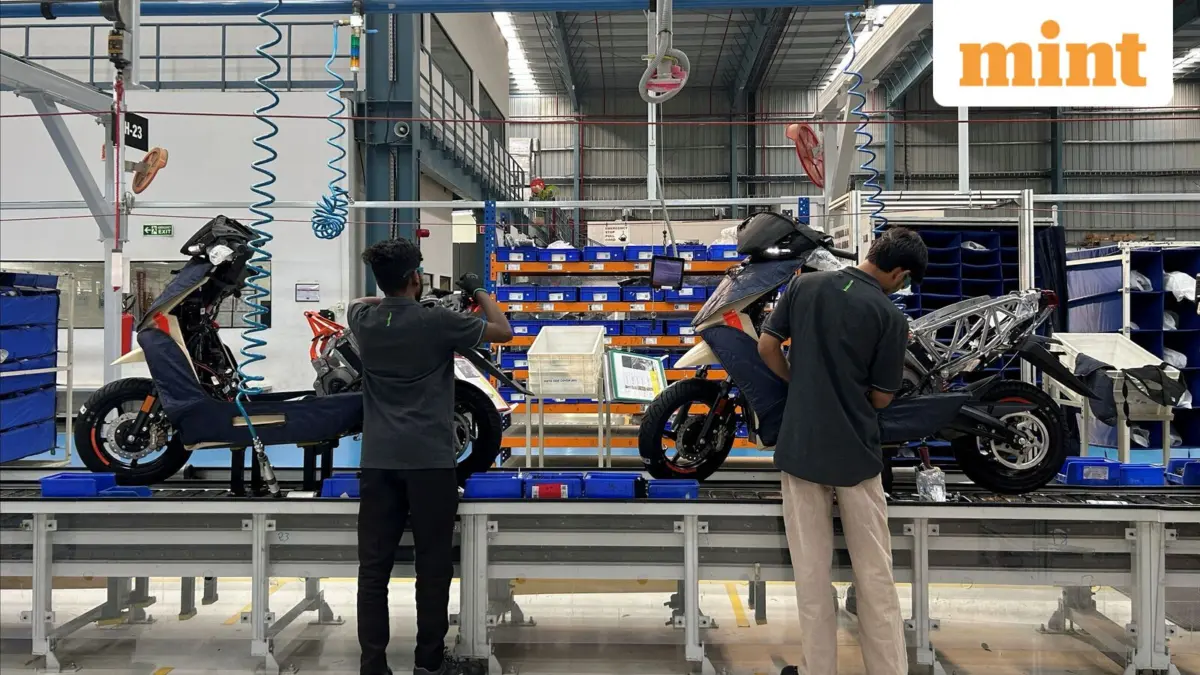
Ather Energy Ltd, a pioneer in the Indian electric two-wheeler sector, has recorded its first-ever quarterly net profit during the second quarter of the 2027 fiscal year (Q2FY27), marking a significant turning point for the Bengaluru-based manufacturer and the broader electric vehicle (EV) industry in India. The company reported a net profit of ₹1.26 crore for the quarter ending September 30, a modest but symbolically vital figure that underscores the brand’s transition from a high-growth startup into a financially viable industrial player. This milestone was fueled by a robust 63% year-on-year increase in operating revenue, which reached ₹1,464 crore, driven by strong consumer appetite for its premium electric scooters and the successful rollout of new models.
The financial markets responded with significant enthusiasm to the news. Investors, buoyed by the company’s ability to eke out a profit despite persistent commodity price pressures and supply chain bottlenecks, drove the stock up by as much as 22% over two trading sessions. This rally brought the share price closer to its all-time high of ₹1,744, which was previously touched in early September. The pivot to profitability is being viewed by analysts as a validation of Ather’s premium pricing strategy and its focus on vertical integration and software-driven revenue streams.
Financial Performance and Margin Expansion
The September quarter results highlight a dramatic improvement in Ather’s operational efficiency. Beyond the headline net profit, the company turned EBITDA-profitable (earnings before interest, taxes, depreciation, and amortization) with a margin of 0.8%, a sharp recovery from the negative 2.7% margin recorded in the preceding quarter (Q1FY27). When including other income, the EBITDA margin stood at a more robust 5.1%, compared to just 0.8% in Q1.
This turnaround was primarily attributed to operating leverage—the ability of a company to increase its operating income by growing revenue at a faster rate than costs. Despite the positive bottom line, Ather faced significant headwinds from commodity inflation. High prices for essential materials such as copper and plastics, exacerbated by global demand for artificial intelligence infrastructure and geopolitical instability in West Asia, weighed on the company’s gross margins.
According to management disclosures, commodity inflation eroded approximately 940 basis points (bps) from the gross margin. However, these losses were partially offset by structural improvements, including strategic price hikes and cost-reduction initiatives that added 530 bps. Furthermore, a favorable product mix, characterized by a shift toward high-range, high-margin models, contributed an additional 270 bps. Consequently, the gross margin, including other income, settled at 24%, representing a slight decline of 140 bps from the levels seen in Q4FY26.
Bridging the Supply-Demand Gap
While the financial metrics were positive, the quarter also revealed the challenges of scaling production in a rapidly evolving market. Ather reported that demand for its vehicles, measured by pre-orders, grew by a staggering 108% year-on-year. However, actual registrations increased by only 60%, totaling 92,600 units. Production figures lagged slightly behind registrations, growing 45% to reach 98,400 units.
The management acknowledged a significant gap in fulfillment, noting that approximately 18,000 to 20,000 units per month of retail demand remains unrealized due to supply constraints. This "unrealized demand" suggests that while the brand’s market appeal remains high, its immediate growth is being capped by its current manufacturing footprint. To address this, Ather has embarked on an aggressive capacity expansion roadmap.
The enhancement of the company’s primary facility in Hosur, Tamil Nadu, is scheduled for completion in the third quarter (Q3FY27). Simultaneously, the first phase of the ambitious AURIC (Aurangabad Industrial City) plant in Maharashtra is slated to come online in Q4FY27. Together, these expansions are expected to more than double Ather’s total annual production capacity from the current 420,000 units to 920,000 units by the end of the fiscal year. Looking further ahead, the company has set a long-term capacity target of 1.64 million units per annum to maintain its competitive edge in the domestic and potentially international markets.
Product Strategy and the Konarc Factor
Central to Ather’s future profitability is its evolving product portfolio. The management has highlighted the "Konarc" model as a key driver of future unit economics. Positioned to capture a broader segment of the market, the Konarc is expected to offer structurally superior margins—roughly 6% to 7% higher than the existing Rizta model over the long term.

In the current quarter, the company’s weighted average ex-showroom price rose to ₹1.64 lakh, up from ₹1.50 lakh in the final quarter of the previous fiscal year. This increase reflects both price adjustments to counter inflation and a consumer preference for higher-spec variants. Ather’s "AtherStack Pro" software package has also emerged as a critical high-margin revenue stream, boasting a 94% attach rate among buyers. This has helped the company sustain its non-vehicle revenue share at 15%, a figure that is significantly higher than many of its competitors who rely almost exclusively on hardware sales.
The company plans to introduce entry-level variants, specifically the SR1, in Q4FY27. Until now, the management has prioritized mid-tier variants (SR2 and SR3) to maximize margin considerations and align with current production availability. The early market reception for the Konarc in Northern India has been particularly encouraging, suggesting that Ather is successfully expanding its footprint beyond its traditional strongholds in the South and West.
Competitive Landscape and Market Share Dynamics
Despite the record revenue and the move into profitability, Ather Energy is navigating a fiercely competitive landscape. Over the past year, the company’s market share in the electric two-wheeler segment slipped from 17.2% to 15.1%. This decline is largely attributed to the aggressive expansion of competitors such as Ola Electric, as well as the increasing presence of legacy manufacturers like TVS Motor Company and Bajaj Auto, both of which have ramped up production of their respective electric offerings (the iQube and Chetak).
The dip in market share underscores the urgency of Ather’s capacity expansion. As legacy players utilize their vast existing dealer networks to push EV volumes, Ather is forced to play catch-up on the distribution front. The management has indicated that a major push for dealer network expansion will commence in Q4FY27, coinciding with the ramp-up of the AURIC plant.
However, the expansion comes with its own set of financial risks. The commissioning of the AURIC facility is expected to add to the company’s fixed costs starting in the fourth quarter. The challenge for Ather will be to ensure that the production ramp-up happens quickly enough to absorb these costs through increased sales volumes, thereby maintaining the slim profit margins it has just achieved.
External Risks: Commodities and Geopolitics
Ather’s path to sustained profitability remains vulnerable to external shocks. The company noted that copper prices have seen a significant spike, driven by global demand for data centers and artificial intelligence infrastructure. Additionally, the ongoing conflict in West Asia has contributed to volatility in the prices of plastics and other petroleum-derived components.
While management expects commodity prices to remain broadly flat in Q3FY27—leading to a decision not to implement further price hikes in the immediate term—any sudden escalation in global tensions or supply chain disruptions could quickly erode the company’s hard-won gains. The transition from the FAME-II subsidy regime to the new PM E-DRIVE (Plant Management and Electric Mobility Promotion) scheme also presents a shifting regulatory landscape that the company must navigate to keep its vehicles affordable for the mass market.
Analytical Outlook and Future Projections
Industry analysts remain largely optimistic about Ather’s trajectory. Nomura Research, in a recent note, valued Ather at approximately four times its estimated FY29 EV/sales (Enterprise Value to Sales ratio). Analysts at the firm described this valuation as "very attractive," citing Ather’s higher growth potential compared to its peers and its successful transition to a profitable business model.
The consensus among market observers is that Ather has successfully navigated the "valley of death" that many EV startups face. By prioritizing technological excellence and a premium brand identity, the company has built a loyal customer base that is less sensitive to price fluctuations than the entry-level segment. However, the next 12 to 18 months will be critical. The successful integration of the AURIC plant and the market’s response to the SR1 entry-level variants will determine whether Ather can reclaim its lost market share and establish itself as a consistently profitable leader in the Indian automotive landscape.
As the Indian government continues to push for a 30% EV penetration in private cars and an even higher percentage for two-wheelers by 2030, Ather Energy finds itself at the forefront of a generational shift in mobility. The Q2FY27 results are not merely a financial report; they are a signal that the electric transition in India is moving into a more mature, commercially sustainable phase. For Ather, the focus now shifts from proving the concept to mastering the scale.
