

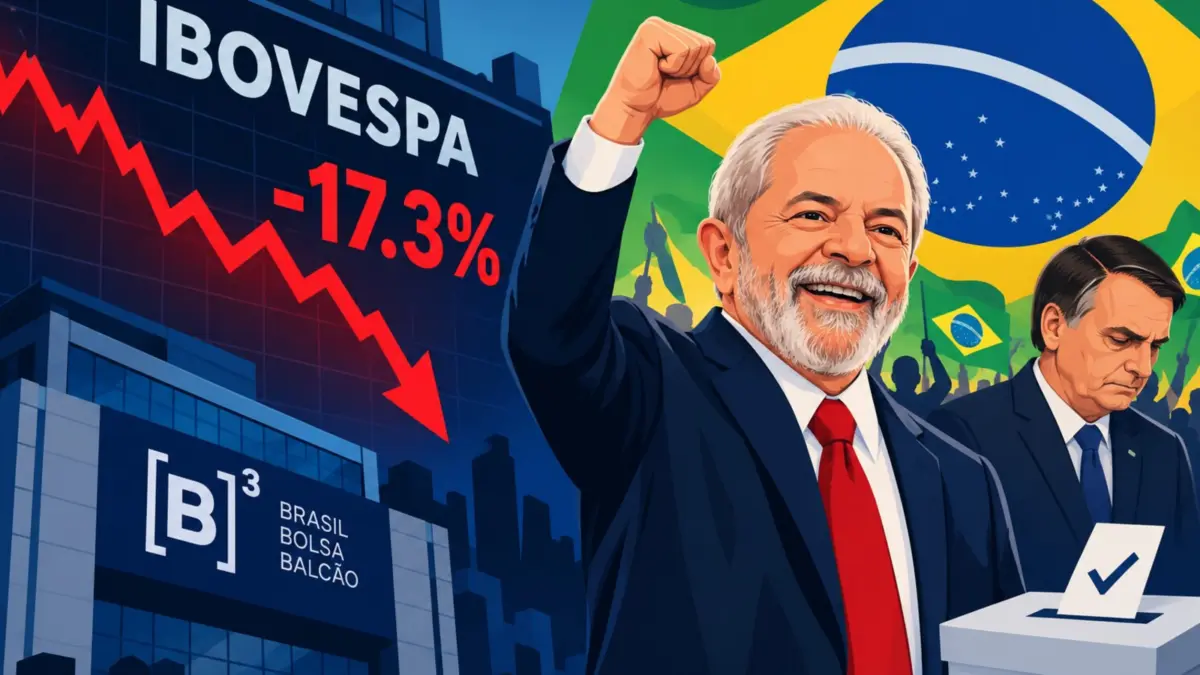
The Brazilian financial markets experienced a historic upheaval on Monday as the Ibovespa, the benchmark index of the São Paulo Stock Exchange (B3), suffered its largest single-day collapse in history. The index plummeted by 17.3% to an intraday low of 169,516 points, a visceral reaction to the news that Luiz Inácio Lula da Silva had secured a narrow victory over Flávio Bolsonaro in the presidential runoff. This unprecedented decline effectively erased months of market gains and shattered the optimism that had characterized the period between the first and second rounds of voting. The scale of the sell-off was so severe that it triggered automatic circuit breakers, forcing a temporary suspension of trading as investors scrambled to reassess the country’s fiscal and economic trajectory under a fourth Lula administration.
A Day of Unprecedented Volatility
The trading session on Monday began with a gap down that immediately signaled deep investor unease. As the reality of the election results set in, the selling pressure intensified, targeting blue-chip stocks and state-owned enterprises particularly hard. The 17.3% drop represents a watershed moment for the Brazilian exchange, surpassing the volatility seen during the height of the 2008 global financial crisis and even the initial shocks of the COVID-19 pandemic in early 2020.
By midday, the Ibovespa had crashed through the 170,000-point threshold, reaching a low of 169,516—its weakest level since late August. The B3 exchange officials were forced to activate a 30-minute "circuit breaker" suspension, a mechanism designed to prevent panic-driven freefalls and allow for the orderly dissemination of information. Despite the pause, the market struggled to find a floor, as the "Bolsonaro trade"—a strategy predicated on fiscal conservatism and privatization—unraveled in real-time.
The Political Shift: Lula’s Historic Fourth Term
The catalyst for the market rout was the confirmation of a fourth term for the veteran leftist leader, Luiz Inácio Lula da Silva. At 81 years old, Lula’s victory marks one of the most significant political comebacks in Latin American history. According to official tallies, Lula secured 51.8% of the valid votes, narrowly defeating the far-right challenger Flávio Bolsonaro, the son of former president Jair Bolsonaro, who garnered 48.2%.
The election was characterized by extreme polarization and a razor-thin margin that reflects a deeply divided nation. While Lula’s supporters celebrated the continuation of social programs and labor protections, the financial sector reacted with trepidation. The victory preserves Brazil’s status as a stronghold of the "Pink Tide"—the shift toward left-wing governments across South America—contrasting with right-wing movements gaining traction in other parts of the world.
Chronology of Market Sentiment: From Optimism to Panic
To understand the magnitude of Monday’s crash, it is essential to look at the timeline of the election cycle.
- The First Round Surprise: In the initial round of voting held earlier in October, Flávio Bolsonaro outperformed nearly all major polling estimates. His strong showing, combined with a robust performance by conservative candidates in congressional races, led investors to believe that even if Lula won, he would be forced to govern from the center.
- The "Bolsonaro Rally": Following the first round, the Ibovespa surged to record highs. Markets priced in the possibility of a Bolsonaro victory or, at the very least, a legislative "gridlock" that would prevent radical shifts in economic policy.
- The Runoff Campaign: As the runoff approached, the race tightened. However, the final result skewed toward Lula’s favor more decisively than some last-minute private polls had suggested.
- Black Monday: The confirmation of Lula’s victory, coupled with the lack of immediate clarity regarding his future finance minister and fiscal framework, triggered the massive sell-off on October 26.
Fiscal Concerns and the "Spending Ceiling"
The primary driver of the market’s anxiety is the future of Brazil’s fiscal health. Under his previous terms, Lula was credited with lifting millions out of poverty, but his recent rhetoric has leaned heavily toward increased public spending to stimulate the economy and expand social safety nets.
Investors are particularly concerned about:
- Public Debt: Brazil’s debt-to-GDP ratio remains a point of contention. Markets fear that an expansionary fiscal policy without a clear "anchor" or spending ceiling will lead to a debt spiral.
- Interest Rates: Brazil currently maintains one of the highest benchmark interest rates (SELIC) in the world. While this has helped control inflation, it has also stifled corporate growth and increased the cost of servicing sovereign debt. The market fears that if Lula’s policies are perceived as inflationary, the Central Bank will be forced to keep rates high for longer, further dampening economic activity.
- State-Owned Enterprises (SOEs): Stocks like Petrobras and Banco do Brasil saw some of the sharpest declines. During the campaign, Lula signaled a move away from the privatization of strategic assets and suggested that Petrobras should focus more on domestic refining and social goals rather than just shareholder dividends.
Comparative Analysis: 2008, 2020, and 2026
The 17.3% decline places the current crash in a rare category of financial disasters. Historically, the Ibovespa has only triggered circuit breakers during moments of global systemic risk:

- 2008 Subprime Crisis: The collapse of Lehman Brothers and the ensuing global credit crunch led to multiple trading halts in São Paulo.
- 2020 COVID-19 Pandemic: The onset of global lockdowns and the uncertainty of the virus caused a series of "Black Swan" events on the exchange.
The 2026 crash is distinct because it is primarily driven by domestic political risk rather than an external global shock. This suggests that the "Brazil risk" premium—the extra return investors demand to hold Brazilian assets—has spiked significantly.
Reactions from the Financial Community
Institutional investors and analysts have expressed a cautious, if not pessimistic, outlook. While the official results are final, the "wait-and-see" approach has been replaced by a "sell-first-ask-questions-later" mentality.
"The market is not necessarily reacting to Lula the person, but to the uncertainty of the fiscal framework," said a senior equity strategist at a major São Paulo-based brokerage. "We saw a massive repositioning today. The optimism of the first round was built on the hope of a reformed, market-friendly right-wing administration. That thesis is now dead."
Conversely, labor unions and social movements have hailed the result as a victory for the working class. They argue that the market’s reaction is an overblown "strike by capital" intended to pressure the incoming administration into adopting neoliberal policies.
Economic Challenges Facing the New Administration
Lula inherits an economy that is a study in contradictions. On one hand, the country is concluding the current cycle with record employment rates and inflation that, while present, has been more controlled than in many neighboring nations. On the other hand, the average Brazilian is struggling with a significant loss of purchasing power and high levels of household indebtedness.
The incoming administration will face the immediate challenge of:
- Balancing the Budget: Reconciling the promise of increased social spending with the reality of a constrained federal budget.
- Monetary Policy Tensions: Potential friction between the executive branch and the independent Central Bank of Brazil regarding interest rate cuts.
- Attracting Foreign Direct Investment (FDI): Restoring confidence among international investors who may see the 17.3% crash as a signal to move capital to more stable emerging markets.
Broader Implications for Latin America
Brazil is the largest economy in Latin America and a key member of the BRICS nations. A period of prolonged financial instability in Brazil could have a "contagion" effect on neighboring markets, particularly those with close trade ties. Furthermore, Lula’s victory cements a regional shift that could see a more unified Latin American front on issues like environmental protection (specifically the Amazon), trade agreements with the European Union, and a potential move toward reduced reliance on the U.S. dollar in regional trade.
Conclusion and Future Outlook
The record-breaking plunge of the Ibovespa serves as a stark reminder of the volatility inherent in emerging market politics. As the dust settles from the election, all eyes will be on Lula’s transition team. The appointment of a credible, market-friendly Finance Minister could potentially soothe nerves and lead to a partial recovery. However, if the administration doubles down on populist rhetoric without a clear fiscal plan, the "biggest-ever one-day crash" may not be the bottom, but rather the beginning of a long period of stagnation for Brazilian assets.
For now, the 169,516-point level stands as a grim milestone in the history of the S.A. exchange, marking the moment when political reality collided head-on with market expectations. Investors are advised to remain vigilant, as the coming weeks of the transition period will likely dictate the direction of the Brazilian economy for the next four years.
