

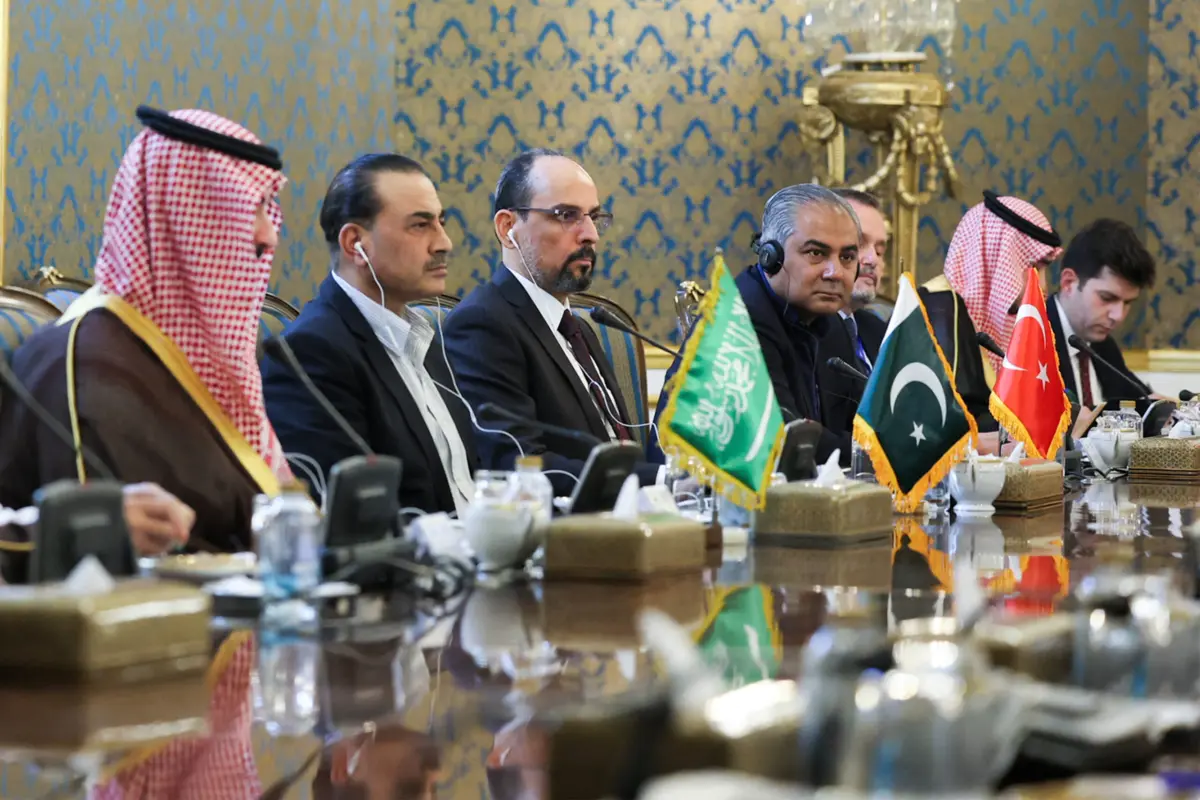
Tehran, Iran – In a critical diplomatic maneuver aimed at de-escalating simmering regional conflicts and averting a potentially catastrophic military confrontation between the United States and Iran, high-level delegations from Pakistan, Saudi Arabia, and Turkiye have converged in Tehran. The unprecedented gathering, bringing together key signatories of the Mecca Joint Defence Agreement, underscores the urgency of addressing a complex web of security challenges, from the ongoing Houthi missile and drone attacks on Saudi Arabia to the looming threat of new US military strikes against Iran. The discussions, among the most significant held in the Iranian capital in recent months, are seen as a concerted effort by these influential regional actors to forge a path toward compromise and stability amidst a volatile geopolitical landscape.
Saudi Defence Minister Khalid bin Salman Al Saud, Pakistani military chief General Asim Munir, and Turkish intelligence chief Ibrahim Kalin were received by Iranian President Masoud Pezeshkian and are scheduled to engage in extensive talks with Iran’s security chief Mohsen Rezaei. This high-profile dialogue represents a strategic pivot towards regional solutions, driven by a shared apprehension over the potential for wider conflict and its devastating repercussions. While specific details of the agenda remain tightly guarded, analysts widely believe the primary objectives include mitigating the immediate threat of US-Iran military escalation and devising collective strategies to counter the persistent Houthi aggression in Yemen.
The Mecca Pact’s Urgent Diplomatic Push
The Mecca Joint Defence Agreement, signed on August 31, 2026, by Pakistan, Saudi Arabia, and Turkiye, established a regional defense alliance designed to foster collective security and stability within a turbulent Middle East and South Asia. The pact’s foundational premise is to promote self-reliance in regional security, offering a framework for cooperation on defense matters, intelligence sharing, and coordinated responses to emerging threats. This eleventh-hour visit to Tehran by its key architects signifies a crucial test of the alliance’s efficacy and its capacity to act as a credible mediating force in times of crisis.
Ali Vaez, deputy director of the Middle East and North Africa Program at the International Crisis Group, articulated the high stakes involved: "The Mecca pact’s 11th-hour visit to Tehran is an attempt to tip the balance in favour of those willing to compromise before the guns start blazing again. But unless they arrive with a credible formula to bridge the US-Iran divide, they may find themselves with little more than goodwill in a race against the clock." This sentiment captures the delicate balance the delegations must strike: offering a credible alternative to military action while navigating deeply entrenched positions. The agreement itself, while outlining general principles of cooperation, faces its most significant challenge yet in translating diplomatic goodwill into tangible security outcomes.
Chronology of Escalation: US-Iran Tensions at a Boiling Point
The backdrop to these crucial talks is a rapidly deteriorating relationship between the United States and Iran, marked by heightened rhetoric and the specter of direct military confrontation. For months, diplomatic efforts to resolve outstanding disputes have stalled, culminating in a fresh wave of escalations. President Donald Trump has publicly indicated that he is considering new attacks on Iran to break a diplomatic deadlock, stating he might be left with a choice to "finish the job" by launching major strikes on Iranian civilian infrastructure. This ominous pronouncement follows a series of tit-for-tat actions and threats that have kept the region on edge.
The current crisis stems from deep-seated disagreements over several critical issues. Washington and its regional allies demand unimpeded international shipping and transit through the strategically vital Strait of Hormuz, a choke point for a significant portion of global oil supplies, which has seen disruptions and attacks attributed to Iran-aligned forces. Furthermore, the US insists on reining in Tehran’s nuclear program, particularly its enrichment of uranium, and seeks the immediate return of international inspectors to assess Iran’s nuclear facilities. Israel, a key US ally, has openly stated its desire to see the overthrow of the Islamic Republic, adding another layer of complexity to the already fraught situation.
Tehran, conversely, has articulated its own set of non-negotiable demands for any peace agreement with Washington. Chief among these is the lifting of the US naval blockade on Iran’s southern ports, which has severely crippled the nation’s crude oil exports and disrupted most trade, inflicting immense economic pressure. Iran also calls for a return to a memorandum of understanding agreed between the two countries in June, the specifics of which have not been fully disclosed but are understood to relate to certain security and economic concessions. The US has steadfastly refused these demands, leading to the current stalemate and the increased likelihood of military action. Past incidents, such as Iranian strikes on US bases in Arab states and critical infrastructure during earlier phases of the conflict, serve as stark reminders of Iran’s capacity to retaliate, potentially engulfing its neighbors in a wider conflagration.
The Yemen Quagmire and Houthi Aggression
Adding another critical layer to the Tehran discussions is the protracted conflict in Yemen and the escalating threat posed by the Houthi rebels, who are closely allied with Iran. Since 2014, Yemen has been embroiled in a devastating civil war, pitting the internationally recognized government, backed by a Saudi-led coalition, against the Houthi movement. The conflict has triggered one of the world’s worst humanitarian crises, displacing millions and causing widespread famine and disease.
Over the past year, the Houthis have intensified their campaign of missile and drone attacks against Saudi Arabia, targeting critical infrastructure, including oil facilities, airports, and urban centers. These "waves of missile and drone attacks," as the original article describes them, represent a direct and persistent security challenge to Riyadh. The attacks, often sophisticated and launched from Yemeni territory, have prompted significant defensive measures from Saudi Arabia and its allies, but the threat remains acute. The US Department of State, recognizing the severity of this threat, issued an order on October 21 for nonemergency US government employees and their family members to leave Saudi Arabia for their safety. This move underscores the tangible danger posed by Houthi capabilities and the regional instability they fuel.
Ayesha Siddiqa, a senior research fellow in the Department of War Studies at King’s College London, commented on the challenges posed by the Houthi threat: "I believe that parties to the Mecca agreement lack options of military engagement with the Houthis, but Riyadh is certainly asserting greater pressure for more, and its expectation of its partners has grown in parallel with the offensive from Yemen." This analysis highlights a significant dilemma for the Mecca Pact members: while Saudi Arabia seeks robust support against the Houthis, its allies, particularly Pakistan and Turkiye, face considerable constraints on direct military intervention.

Objectives and Constraints of the Mecca Pact Allies
The Tehran meetings, therefore, represent a complex balancing act for all parties involved. For Saudi Arabia, the primary objective is to secure a commitment from Iran, through the mediation of Pakistan and Turkiye, to curb Houthi aggression and ensure the stability of its borders. Riyadh’s growing expectation of its partners stems from the direct threat it faces, which has intensified in recent months. The presence of its Defence Minister signals the kingdom’s determination to address this issue at the highest diplomatic levels.
However, Pakistan and Turkiye, while committed to the Mecca Pact, face limitations. Siddiqa notes that despite the collective security arrangement, neither Turkiye nor Pakistan can "afford to commit troops on the ground" in Yemen. Their role is more likely to be one of diplomatic leverage, utilizing their influence with Iran to de-escalate tensions and encourage a more conciliatory approach towards regional security. This position aligns with Iran’s stated preference for "security originating from within the region," suggesting a shared desire among the Mecca Pact members and Iran to reduce external interference in regional affairs.
The timing of these diplomatic overtures is also significant. The latest push is reportedly linked to prior visits by Pakistani army chief General Asim Munir to both Saudi Arabia and Iran last week, indicating a carefully orchestrated preparatory phase. This also coincides with Islamabad’s restrictions on overland border trade with Tehran, implemented amid the US blockade on Iran. This suggests Pakistan is navigating its own complex relationship with both the US and Iran, seeking to maintain stability while adhering to international pressures.
Umer Karim, a researcher specializing in Saudi foreign policy and its implications for regional security, expressed skepticism about the meetings’ ability to prevent a renewed US-Iran war. "Therefore, these talks perhaps are more concerned about the security of Saudi Arabia and involve an attempt by Turkiye and Pakistan to compel Iran to reach a compromise," he told Al Jazeera. Karim’s assessment underscores the immediate focus on Saudi security concerns and the indirect approach to the broader US-Iran standoff.
The Broader Regional Security Landscape
The current crisis is not isolated but rather deeply intertwined with the broader geopolitical dynamics of the Middle East. A renewed war between Iran and the US would inevitably trigger widespread regional turmoil, impacting energy markets, trade routes, and humanitarian conditions across the Arabian Peninsula and beyond. The interconnectedness of conflicts, from Yemen to the Strait of Hormuz, means that a flare-up in one area can quickly cascade into others.
The Mecca Pact’s attempt to mediate highlights a growing trend among regional powers to assert greater agency in resolving their own security challenges. This approach seeks to reduce reliance on external actors, whose interventions have often been perceived as exacerbating rather than resolving conflicts. However, the effectiveness of this strategy hinges on the ability of these regional powers to exert sufficient influence over key players like Iran and the United States, whose strategic calculations are driven by their own national interests and global ambitions.
Economic Repercussions and Global Stability
The potential economic fallout from a major US-Iran conflict or continued instability in the Strait of Hormuz cannot be overstated. The Strait is a vital conduit for global crude oil shipments, and any disruption would send shockwaves through international energy markets, leading to soaring oil prices and potentially triggering a global economic recession. The existing US naval blockade on Iran has already halted crude oil exports and severely disrupted trade, causing significant economic hardship for the Iranian populace. A full-scale conflict would exacerbate these conditions, leading to widespread suffering and further destabilizing an already fragile region.
The humanitarian crisis in Yemen, already catastrophic, would also worsen dramatically if the conflict escalates or if regional security deteriorates further. Aid organizations have struggled to deliver essential supplies amidst the ongoing violence, and a wider war would make their work virtually impossible, putting millions of lives at risk.
Looking Ahead: Pathways to De-escalation or Further Turmoil
As the talks involving Saudi Arabia, Pakistan, and Turkiye continue in Tehran, the stakes could not be higher. While the Mecca Joint Defence Agreement signatories will undoubtedly strive to minimize the impact on Saudi Arabia if war does break out again, the fundamental challenges remain. Karim further notes, "However, since little has changed from an Iranian strategic calculus and the actors involved don’t have the kind of leverage needed to affect Iran’s strategic thinking, these negotiations are going to yield little." This pessimistic outlook underscores the difficulty of altering deeply entrenched national security doctrines and strategic objectives.
The success of these meetings will ultimately depend on whether the delegations can present a credible and mutually acceptable framework for de-escalation that addresses the core concerns of all parties. This includes not only brokering a temporary reprieve from US-Iran tensions but also laying the groundwork for a more sustainable resolution to the Yemen conflict and the broader regional security architecture. Failure to do so risks plunging the Middle East into a new and potentially far more destructive phase of conflict, with profound implications for global stability and the international economy. The world watches keenly as these regional powers attempt to navigate the treacherous path between diplomacy and the brink of war.
