

The landscape of corporate governance is undergoing a profound transformation, demanding more from today’s board directors than ever before. While their fundamental responsibilities—setting strategy, stewarding the business, selecting leaders, and overseeing risk—remain constant, the complexity and dynamism of the issues they confront have escalated significantly. Emerging challenges such as artificial intelligence (AI), escalating cyber threats, geopolitical and trade uncertainties, and an expanding regulatory environment are placing a premium on directors’ judgment and adaptive capabilities. This analysis, derived from a recent memorandum by Teneo, a global advisory firm, highlights critical shifts in board composition, operating models, and strategic priorities, based on extensive interviews with board directors across the U.S., UK, and Canada, alongside a 15-year analysis of board composition data for S&P 500, FTSE 100, and TSX 60 companies.
The insights underscore a growing imperative for boards to proactively redesign their operational frameworks, cultivate AI fluency across all members, foster a more comprehensive understanding of effective director attributes, and view succession planning as an ongoing systemic process rather than a discrete event. This recalibration is essential for boards to effectively navigate strategic challenges and emerging risks in the current volatile global climate.
The Expanding Agenda: A Tightening Schedule
Directors today are grappling with an agenda that has broadened considerably, extending beyond traditional financial stewardship and management performance to encompass critical areas like cybersecurity, geopolitical risks, corporate culture, sustainability, and the transformative potential of AI. This expansion means that issues once solely within the purview of management now necessitate board-level attention and oversight. The implications are tangible: what once might have been a half-day board meeting now frequently requires a full day and a half to adequately address.
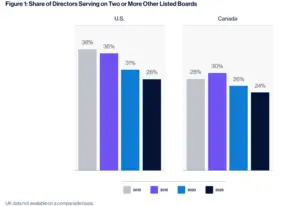
This increased demand on directors’ time has also led to adjustments in board commitments. Data indicates a trend, particularly in the U.S. and Canada, where fewer directors are serving on two or more other boards compared to a decade ago. This suggests a growing recognition that fulfilling the multifaceted responsibilities of directorship in the current environment requires a more focused commitment.

Compositional analysis of boards over the past 15 years reveals a significant evolution in the skills being prioritized. Across the U.S., UK, and Canada, expertise in risk, governance, and regulatory affairs has steadily grown, increasingly rivaling the long-standing emphasis on leadership and strategy experience that historically defined board membership. This shift reflects the increasing weight of oversight responsibilities, which are often characterized by strict timelines, deadlines, and regulatory scrutiny, making them less amenable to compression.
However, this surge in near-term, compliance-driven pressures is inadvertently displacing time that could be dedicated to long-term strategic thinking and growth discussions. Corporate strategy, a topic that directors express a desire to focus on more, is frequently deferred or omitted from agendas as they become consumed by immediate issues. This presents a critical tension: boards must find a way to balance the essential oversight of current value with the imperative of safeguarding time for discussions that will shape the company’s future growth and competitive advantage.
In response, boards are actively re-evaluating their operating models. Fundamental questions are being reopened: what level of detail should management present, are current committee structures fit for purpose, and what are the expectations for directors’ engagement outside of formal meetings? A key strategy emerging is the tightening of board materials to ensure that meeting time is maximized for interrogation and discussion, rather than passive information reception. Some boards have dramatically reduced the volume of pre-reading materials, freeing up valuable in-person time. Furthermore, the work is increasingly extending beyond the boardroom, with enhanced communication between meetings, closer collaboration between committee chairs and executives, and directors proactively developing independent insights on key issues. This refined approach aims to foster deeper discussions and sharper judgment, enabling boards to continually calibrate their function and focus in response to evolving demands.
The Rise of the "Utility Player": Broadening Expertise and Essential Judgment
While the demands on boards have expanded, board sizes have not kept pace. Over the past 15 years, U.S. boards have added an average of only 1.5 seats, while growth in the UK and Canada has been even more modest. This dynamic forces boards to extract more from their existing members. Directors are increasingly expected to bring a broader range of expertise and to contribute beyond the specific experience that initially secured their position.
This shift is evident in board composition data, which shows directors are now credited with more areas of expertise than 15 years ago. In the U.S., the average director is now associated with 3.5 areas of expertise, up from under three. Canada and the UK exhibit similar trends. New capabilities, such as risk management, governance, technology, digital transformation, and sustainability, are being added to the existing requirements of finance, operations, and leadership, rather than replacing them. Consequently, the role of a director now carries a greater spectrum of skill expectations.

However, breadth of expertise is only one facet of what boards seek. The value of experience is increasingly measured not just by what a director has done, but by the quality of judgment that experience cultivates and its applicability to new challenges. Directors often describe the ideal board member as a "utility player"—someone with deep knowledge in specific domains but also the versatility to contribute across a wider agenda. This is particularly crucial in navigating rapidly evolving areas like AI, where the technology itself is still developing, and informed judgment is paramount.
The skills matrix, a common tool for assessing board capabilities, provides a snapshot of collective expertise. However, as director demands evolve, a static matrix can quickly become outdated. The challenge for boards lies not merely in identifying and filling capability gaps as they arise, but in continuously reassessing whether the matrix accurately reflects the evolving needs of the board. This requires a dynamic approach to talent management within the boardroom, ensuring that the board’s composition remains aligned with current and future strategic imperatives.
Building AI Fluency: A Shared Responsibility for the Digital Age
Artificial intelligence (AI) stands out as a rapidly advancing frontier, its influence extending across nearly every aspect of the corporate agenda. The speed of AI’s evolution makes defining and maintaining subject matter expertise challenging, even for seasoned professionals. This tension is reflected in skills data, where AI is among the least commonly reported areas of direct expertise across the U.S., UK, and Canada.
While this might initially appear as a capability gap, directors interpret it differently. For a technology that is still in flux, the critical factor is not the sheer number of AI experts on the board, but rather the board’s collective fluency to exercise informed judgment and its capacity to access deeper expertise when required. Directors generally agree that deep AI expertise can be effectively sourced from external advisors, advisory boards, centers of excellence, or management teams, allowing for continuous refreshment as the technology evolves.
However, a foundational level of AI fluency must extend across the entire board. Directors need sufficient understanding to discern the implications of AI for their specific businesses, including identifying opportunities, recognizing risks, evaluating the trustworthiness of AI-generated insights, and knowing when to challenge management’s assumptions. This capability is not limited to AI; it is essential for understanding the impact of all emerging technologies, enabling directors to navigate disruption, capitalize on new opportunities, and effectively oversee associated risks.

The challenge lies in cultivating a level of fluency that can keep pace with technological advancements. Boards are adopting various strategies, including individual director development budgets, immersive learning programs, pairing non-executive directors with senior management, and providing routine exposure to AI technologies. One board, for example, incorporates three live AI demonstrations at every meeting, allowing directors to witness the technology in action and refine their questioning. While approaches may vary, the responsibility for maintaining AI fluency is shared: boards can facilitate learning opportunities, while individual directors remain accountable for their own ongoing education and understanding.
Navigating Interconnected Risks: Beyond Prediction to Resilience
The contemporary risk landscape is characterized by an intricate web of interconnected threats. Geopolitical developments can rapidly alter the cybersecurity threat landscape, while AI possesses the potential to amplify risks across cyber, data, fraud, and operational domains. These interdependencies are testing traditional governance structures.
While overall oversight remains the board’s purview, there is no universally settled model for accountability in resolving specific interconnected risks. Questions arise about whether responsibility lies with management, specific committees like audit or risk, or the full board. This complexity is further illustrated by anecdotal evidence suggesting considerable variation in how audit committee chairs approach governance of these interconnected issues.
Certain patterns are emerging. When AI exacerbates existing risks, such as data security or fraud, boards are systematically reinforcing existing controls. More broadly, boards are responding to the escalating complexity of interconnected risks by shifting their emphasis from prediction to resilience. This involves a more holistic review of the risk register, seeking to understand intersection points and evaluating management’s preparedness to withstand and adapt to unforeseen events.
Succession as a System: Adapting Leadership for a Changing Future
Selecting the company’s leadership remains the board’s most significant responsibility. The current shift lies not in its importance, but in the evolving demands of the role itself. In an era of rapid change, the leader a company needs in five years may differ significantly from the one required today. Directors are increasingly selecting leaders for specific phases of a company’s development rather than for traditional, longer-term tenures.

Boards face the dual challenge of planning for succession more frequently, with less time for identification and development, and recruiting for a role whose specifications are in constant flux. Consequently, succession is increasingly being viewed as a dynamic and continuous system, one that evolves in tandem with the business. This involves looking earlier and more broadly for high-potential leaders, extending searches beyond the C-suite to access a wider talent pool, and adapting the assessment criteria to align with future business needs.
The harder challenge, however, lies in defining what qualities are being assessed. Traditional succession models often begin with a static role specification. A more dynamic approach starts with the future of the business: its strategic direction, operating model, and competitive environment, and the leadership capabilities required to navigate these shifts. As these assumptions evolve, the leadership specification and the succession pipeline must adapt accordingly.
A growing consensus among directors is that selecting the right leader is becoming less about the credentials listed on a resume and more about the individual’s underlying capabilities. As business transformation accelerates, boards require leaders who can perform effectively when circumstances are uncertain. Directors are increasingly relying on observable behaviors, such as adaptability, response to pressure, and peer and external assessments, to gauge a candidate’s potential. This systemic approach to succession planning ensures that boards are not only identifying available talent but also proactively developing the pipeline necessary for the business’s future success.
