

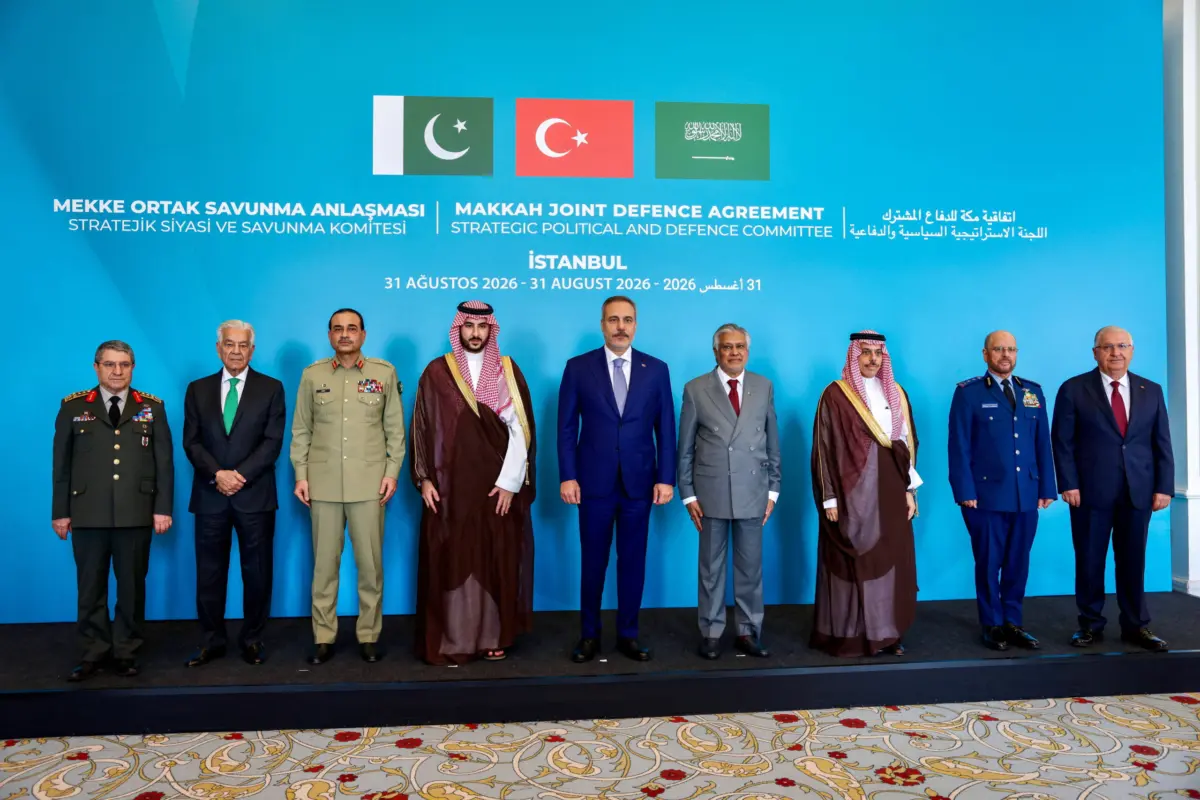
High-level delegations from the Mecca Defence Alliance—comprising Saudi Arabia, Turkiye, and Pakistan—are scheduled to arrive in Tehran on Monday for critical diplomatic talks aimed at stabilizing a region increasingly fractured by the ongoing conflict between Iran and a US-Israeli coalition. This visit represents the first significant high-level contact between the Islamic Republic and the tripartite alliance since Yemen’s Houthi rebels dramatically escalated their missile and drone campaign against Saudi Arabian infrastructure last month. According to Ali Bagheri Kani, the deputy secretary of Iran’s Supreme National Security Council, the meeting will feature a rare gathering of top security and defense officials, including Saudi Defence Minister Khalid bin Salman Al Saud, Pakistani Chief of Army Staff General Asim Munir, and Turkish intelligence chief Ibrahim Kalin.
The Iranian delegation will be led by Mohsen Rezaei, the secretary of the Supreme National Security Council, signaling the high stakes Tehran attaches to these negotiations. Bagheri Kani noted that the participating nations could take an "effective step" toward establishing a regional security framework predicated on the agency of local actors rather than external powers. The visit comes at a time of extreme volatility, as the Mecca Joint Defence Agreement—signed in August 2026—is put to its first major test following renewed hostilities in the Persian Gulf and the Arabian Peninsula.
The Genesis of the Mecca Joint Defence Agreement
The Mecca Joint Defence Agreement was forged in August 2026 as a response to the rapidly deteriorating security environment in Southwest Asia. The pact, signed by Riyadh, Ankara, and Islamabad, established a mutual defense framework modeled after Article 5 of the NATO charter. Under the terms of the agreement, an armed attack on any one member is legally considered an attack on all three, necessitating a collective response. The first article of the pact explicitly states that the signatory parties shall utilize "all necessary means," including military force, to eliminate threats to the territorial integrity, sovereignty, and internationally recognized borders of any member state.
The alliance represents a significant shift in regional geopolitics, bringing together the Middle East’s leading Arab power, a major NATO member with the region’s second-largest standing army, and the world’s only nuclear-armed Muslim state. While the alliance was initially viewed as a deterrent against non-state actors and peripheral threats, the escalation of the US-Israel war on Iran has forced the bloc into a delicate balancing act. Earlier this month, ministers from the alliance countries held an emergency summit in Riyadh, where they agreed to the "rapid deployment" of military assets to Saudi Arabia to bolster its air defense capabilities against the recurring Houthi strikes.
Escalation of Houthi Attacks and the Saudi Response
The urgency of the Tehran visit is underscored by the intensifying conflict in Yemen. Despite years of intermittent peace talks, the Houthi movement, which maintains strong ideological and logistical ties to Tehran, has launched a series of sophisticated strikes deep into Saudi territory. Last month, an attack on Saudi Arabia’s King Fahd Airport resulted in civilian casualties and significant damage to the terminal, marking a turning point in the Houthis’ tactical approach.
On Sunday, Saudi air defense systems intercepted a massive wave of missiles and drones targeting energy facilities in the Kingdom’s Eastern Province. These attacks have transformed Saudi Arabia into a primary pressure point in the wider war involving the United States, Israel, and Iran. Riyadh has expressed increasing frustration with the spillover of the conflict, leading to the current diplomatic push. Rayed Krimly, the Saudi deputy minister for public diplomacy, confirmed the upcoming Tehran visit, stating that it is part of a concerted effort by the Mecca Defence Alliance to promote "de-escalation between parties involved in the ongoing crisis." Krimly emphasized that the mission supports broader mediation efforts currently being facilitated by Qatar and Pakistan.
Pakistan’s Role as a Diplomatic Bridge
Pakistan has emerged as the primary intermediary between Washington and Tehran since the outbreak of full-scale hostilities in February 2026. Islamabad’s unique position—maintaining a strategic partnership with Saudi Arabia, a defense relationship with Turkiye, and a sensitive border with Iran—has made it an indispensable conduit for backchannel communications. General Asim Munir’s visit to Tehran last week laid the groundwork for the upcoming multi-lateral meeting. During his discussions with Iranian President Masoud Pezeshkian, Munir sought to find a pathway toward a ceasefire.
However, the path to peace remains obstructed by rigid preconditions. Iranian state media reported that during Munir’s visit, officials in Tehran reiterated their refusal to engage in direct talks with the United States regarding the US-Israel war until specific Iranian demands are met. These demands reportedly include the lifting of specific sanctions and the withdrawal of Western naval assets from the Persian Gulf. A previous interim agreement brokered in June 2026 briefly lowered the temperature, but that deal collapsed within weeks as direct skirmishes between Iranian and American forces resumed.
Turkiye’s Strategic Interests and Parliamentary Ratification
For Turkiye, the Mecca Defence Alliance is a vehicle for asserting its influence as a regional mediator while securing its southern energy corridors. Ankara has been wary of a total regional collapse that could trigger a new wave of refugees and economic instability. Ibrahim Kalin, the head of the National Intelligence Organization (MIT), has been a key architect of Turkiye’s regional diplomacy. His participation in the Tehran talks suggests that the discussions will likely delve into intelligence-sharing and the verification of de-escalation measures.
Domestically, the Turkish government is moving swiftly to formalize its commitments to the alliance. Efforts by the Turkish parliament to ratify the Mecca Joint Defence Agreement began last week and are currently under deliberation in the Foreign Affairs Committee. Similarly, the Pakistani government approved the pact last week, signaling a unified front among the three nations as they prepare to engage with the Iranian leadership.
The Iranian Perspective: Regionalism vs. Foreign Intervention
Tehran’s willingness to host the Mecca Defence Alliance delegations reflects a strategic desire to prevent the formation of a hostile regional bloc that is entirely aligned with Western military objectives. By engaging with Saudi Arabia, Turkiye, and Pakistan, Iran hopes to foster a "regional security" model that minimizes the role of the US military. Mohsen Rezaei’s leadership of the Iranian delegation suggests that Tehran is looking for a security arrangement that addresses the concerns of its neighbors without compromising its own defensive posture against the US and Israel.
Bagheri Kani’s statement on X (formerly Twitter) reinforced this sentiment, noting that the visit "underscores the pivotal role of Mecca Joint Defence Agreement countries in reinforcing regional security and stability." Iran likely views this meeting as an opportunity to present its own security proposals, potentially offering a cessation of Houthi attacks in exchange for the Mecca Alliance countries distancing themselves from the US-Israeli military campaign.
Broader Implications and Potential Outcomes
The outcome of the Monday meeting in Tehran could determine the trajectory of the Middle East for the remainder of the decade. If the Mecca Defence Alliance can successfully broker a localized de-escalation between Saudi Arabia and the Houthi movement, it would prove the efficacy of the new bloc as a regional stabilizer. Such a development might also create the necessary diplomatic space for a broader ceasefire between the US-Israeli coalition and Iran.
However, the challenges are formidable. The "attack on one is an attack on all" clause of the Mecca Agreement poses a significant risk of escalation. If Houthi attacks continue unabated, Saudi Arabia may feel compelled to invoke the pact, potentially drawing Turkish and Pakistani military assets into a direct confrontation with Iran-aligned groups. This scenario is one that all parties are currently desperate to avoid.
The inclusion of Qatar in the mediation efforts adds another layer of complexity and potential. Qatar has long served as a neutral ground for negotiations involving the Taliban, the US, and various Palestinian factions. Its partnership with Pakistan in this endeavor suggests a sophisticated, multi-tiered diplomatic strategy aimed at creating a "buffer of stability" around the central conflict.
Analysis: A New Era of Middle Eastern Diplomacy
The upcoming summit in Tehran marks a departure from traditional Middle Eastern diplomacy, which has historically relied on Western guarantees. The Mecca Defence Alliance represents a "third way"—a coalition of regional powers attempting to manage their own security environment amidst a great-power conflict. The success of this mission depends on whether Iran is willing to exert its influence over the Houthis and whether the Mecca Alliance can offer Tehran enough security guarantees to offset its fears of US-led encirclement.
As the delegations prepare for Monday’s sessions, the eyes of the international community are on Tehran. The talks represent more than just a bilateral meeting; they are a test of whether the Middle East can pivot away from total war and toward a new, albeit fragile, regional order. With military forces on high alert and the shadow of the February war looming large, the "Mecca-Tehran" dialogue may be the last best hope for preventing a wider continental conflagration.
