

The global transition toward renewable energy has reached a significant milestone in the Yellow Sea, where China has successfully connected the world’s largest open-sea floating photovoltaic (PV) plant to the power grid. Located approximately eight kilometers off the coast of Dongying in the Shandong province, this massive installation represents a leap in engineering and a shift in how nations perceive the potential of the world’s oceans. Spanning an immense 1,223 hectares—an area equivalent to roughly 1,600 standard football fields—the project boasts a capacity of one gigawatt (GW). Operated by the state-owned CHN Energy, the facility is designed to generate nearly 1.78 billion kilowatt-hours of electricity annually, enough to power approximately 2.6 million urban residents while saving an estimated 500,000 tons of standard coal and reducing carbon dioxide emissions by 1.3 million tons.
This achievement in Dongying is not an isolated event but rather the vanguard of a burgeoning global industry. As land-use competition intensifies between agriculture, urban development, and renewable energy infrastructure, policymakers and energy firms are increasingly looking toward "blue energy" solutions. While traditional solar farms require vast tracts of land, floating solar—often referred to as "floatovoltaics"—utilizes the unoccupied surfaces of reservoirs, lakes, and now, the open ocean. However, the move from calm inland waters to the turbulent, corrosive environment of the high seas introduces a complex set of technical challenges and ecological questions that the scientific community is only beginning to address.
A Global Shift Toward Marine Solar Arrays
China’s record-breaking project is the latest in a series of ambitious offshore solar ventures across Asia and Europe. In Taiwan, the renewable energy developer Hexa Renewables recently commissioned a floating solar plant spanning 347 hectares. Capable of delivering 373 megawatts (MW) of power to the Taiwanese grid, the project underscores the region’s commitment to bypassing land scarcity through marine innovation.
Meanwhile, in the harsher environment of the North Sea, the Dutch-Norwegian company SolarDuck is pioneering a different approach. In collaboration with energy giant RWE, SolarDuck is developing a five-megawatt floating solar park integrated directly within an offshore wind farm. This "hybrid" model is seen by many industry analysts as the future of offshore energy. By utilizing the space between wind turbines, developers can share expensive subsea cable infrastructure and balance power output: solar panels often produce peak energy during calm, sunny days when wind speeds are low, while wind turbines thrive in the turbulent weather that typically obscures the sun.
The growth of this sector has been exponential. Data from Bloomberg News indicates that between 2013 and 2022, floating solar installations grew by more than 2,000%. Despite this rapid ascent, the technology remains in its infancy, accounting for only about 1% of the total global solar capacity installed in 2022. The transition from niche experimental projects to gigawatt-scale infrastructure marks a "maturity milestone" for the industry, yet it also accelerates the need for rigorous environmental oversight.
The Evolution of Floating Solar: A Brief Chronology
To understand the current scale of projects like the Dongying plant, it is necessary to look at the rapid evolution of floating PV technology over the last two decades:
- 2007–2008: The first formal floating PV systems were installed at a winery in California and in Aichi, Japan. These were small-scale test beds designed to prove that panels could remain buoyant and functional on calm, inland water surfaces.
- 2013–2015: The industry saw its first megawatt-scale installations. Developers began to realize that floating solar offered a "cooling effect," where the water beneath the panels helped regulate temperature, increasing the efficiency of the PV cells compared to land-based units.
- 2018: China emerged as the global leader in the sector, commissioning large-scale projects on "flooded" former coal mines in Anhui province. These projects demonstrated that floating solar could repurpose industrial disaster zones into green energy hubs.
- 2021–2023: Interest shifted from inland reservoirs to "near-shore" and "open-sea" environments. Engineers began developing reinforced mooring systems and salt-resistant coatings to withstand waves and corrosion.
- 2024: The connection of the 1GW Dongying plant marks the beginning of the "Gigawatt Era" for offshore solar, proving that marine environments can host utility-scale power plants comparable to the largest land-based installations.
Technical Hurdles and the "Blue" Efficiency Gain
Moving solar panels into the ocean is not as simple as placing land-based technology on rafts. The marine environment is inherently hostile to electronic components and structural integrity. Saltwater is highly corrosive, necessitating the use of specialized polymers and high-grade aluminum or stainless steel for mounting frames. Furthermore, "biofouling"—the accumulation of algae, barnacles, and mussels on the underside of floats—can increase weight and drag, potentially compromising the buoyancy of the structures.
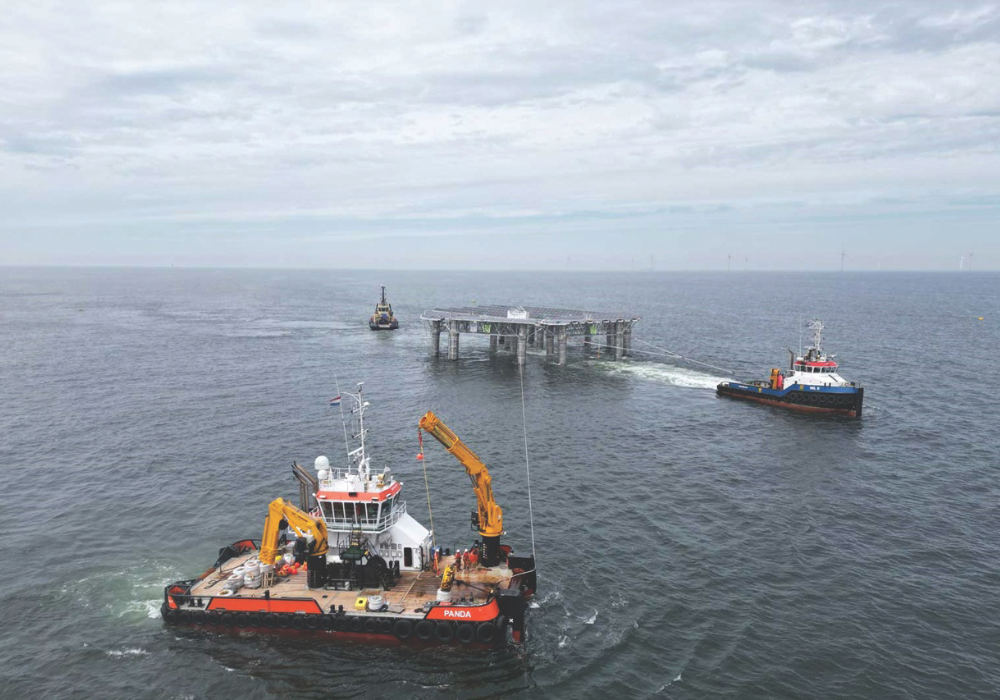
Engineers at CHN Energy and SolarDuck have had to account for significant wave heights and wind loads. In the North Sea, for instance, platforms must be designed to "ride" waves that can reach heights of over 10 meters. The Dongying project utilizes a fixed-pile foundation in shallower coastal waters, a hybrid approach that provides more stability than purely floating pontoons but requires significant subsea construction.
Despite these costs, the efficiency gains are compelling. Solar panels lose efficiency as they heat up. The thermal mass of the ocean acts as a natural heat sink, keeping the panels cooler than they would be in a desert or field. Some studies suggest that floating solar can be 5% to 15% more efficient than land-based equivalents. Additionally, the lack of dust in the middle of the ocean reduces the need for frequent cleaning, which is a major operational expense for terrestrial solar farms.
The Ecological Ledger: Shading and Primary Productivity
While the engineering triumphs are clear, the ecological impact of "paving the ocean" remains a subject of intense debate among marine biologists. Steven Benjamins, a senior lecturer in marine vertebrate ecology at the Scottish Association for Marine Science, warns that the scale of these projects is the primary concern. "If, in a theoretical sense, we pave the ocean, that would be very bad," Benjamins notes, emphasizing that the surface of the sea is a critical interface for gas exchange and light penetration.
The most immediate concern is shading. Phytoplankton, the microscopic organisms that form the base of the marine food web and produce roughly 50% of the Earth’s oxygen, rely on sunlight for photosynthesis. When massive arrays of solar panels cover the water, they block the light necessary for these primary producers to thrive.
A case study conducted in the North Sea provides a cautionary threshold for developers. Researchers found that if the surface area covered by solar panels remains below 20%, the impact on primary productivity is negligible—less than a 10% change. However, once coverage exceeds 40%, the risk of "ecosystem distress" increases significantly. In extreme cases, a total lack of light can lead to anoxia (oxygen depletion) in the water column, potentially causing a localized collapse of the food chain. This is particularly concerning for sensitive habitats like seagrass beds and kelp forests, which serve as nurseries for countless fish species.
The Artificial Reef Effect and Biodiversity Shifts
Interestingly, the introduction of floating solar infrastructure does not only subtract from an ecosystem; it also adds to it. Any hard surface placed in the ocean eventually becomes a "floating reef." In the North Sea, observations have shown that the floats and mooring lines quickly become colonized by mussels, anemones, and other sessile organisms.
Ninon Mavraki, a marine ecologist at Wageningen University, suggests that this phenomenon creates a "very complicated question" for conservationists. While the colonization of these structures increases local biodiversity and can attract fish seeking shelter, the species that thrive on these artificial surfaces are often non-indigenous. "Whether this is good or not… can be seen from many different angles," Mavraki says. "I think the best answer is to say we do not know yet."
There is also the potential for "cross-industry synergy." The mussels that colonize the underside of solar panels could, in theory, be harvested by aquaculture businesses, turning a maintenance problem into a secondary food source. Furthermore, because these vast solar parks are off-limits to commercial shipping and industrial trawling, they may inadvertently function as Marine Protected Areas (MPAs). By creating "no-take zones," the solar farms could allow depleted fish stocks to recover, provided the shading does not destroy the underlying habitat.
Policy Implications and the Road Ahead
The success of the Dongying plant is likely to trigger a wave of similar projects globally, particularly in countries with high population densities and limited land. However, the rapid rollout of this technology must be matched by robust regulatory frameworks. Currently, much of the research regarding the long-term biodiversity effects of floating solar is theoretical or based on small-scale pilots.
For the industry to achieve sustainable growth, experts argue that "careful planning" is paramount. This includes:
- Strategic Siting: Avoiding areas with sensitive benthic habitats like coral reefs or seagrass.
- Modular Spacing: Designing arrays with sufficient gaps to allow light penetration and air-water gas exchange.
- Long-term Monitoring: Implementing real-time ecological sensors to monitor oxygen levels and plankton density beneath the panels.
As the world seeks to meet the targets of the Paris Agreement, offshore floating solar offers a potent new tool in the decarbonization arsenal. The 1GW milestone in China proves that the technology is ready for the big stage. The challenge for the coming decade will be to ensure that in our rush to save the climate, we do not inadvertently compromise the health of the very oceans that sustain life on Earth. As Steven Benjamins concludes, the relationship between solar energy and the sea will ultimately be defined by "scale, careful planning, and long-term ecosystem considerations."
