

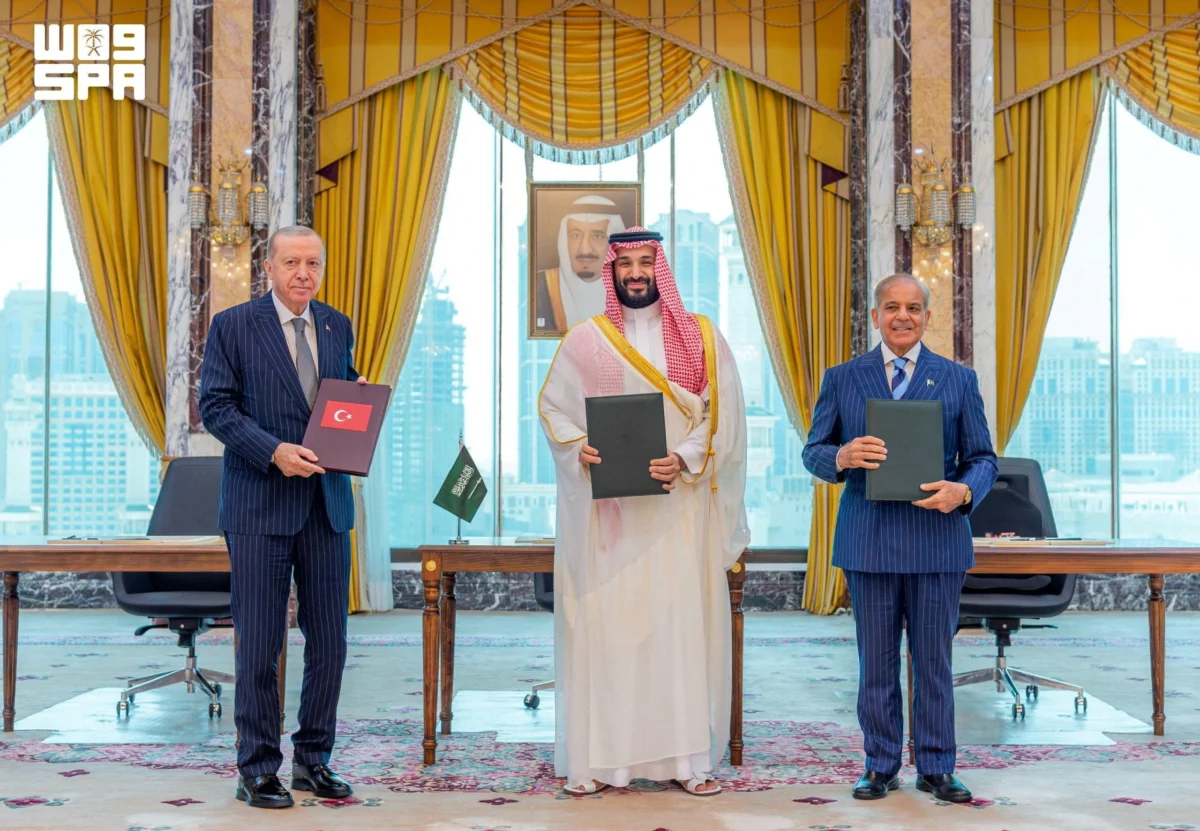
Top diplomatic and military officials from Turkiye, Saudi Arabia, and Pakistan are set to converge in Istanbul on Monday for a pivotal inaugural meeting, marking the first high-level gathering since the three nations inked the groundbreaking Mecca Joint Defence Agreement earlier this month, specifically on August 7, 2026. This unprecedented summit aims to formally establish a dedicated political and defence strategic committee, signalling a significant recalibration of regional security architectures and a deepening of cooperation among these influential Muslim-majority states.
Turkish officials confirmed on Sunday that the delegation for the Istanbul meeting would comprise the foreign ministers, defence ministers, and chiefs of staff from all three participating nations. This comprehensive representation underscores the multi-faceted nature of the newly forged alliance, which is poised to address a broad spectrum of security challenges and foster enhanced military interoperability. The agenda, as communicated by Turkish Foreign Ministry sources, will span critical international security issues and delve into detailed discussions on improving military cooperation and capabilities, reflecting the ambitious scope of the Mecca pact.
The Genesis of the Mecca Joint Defence Agreement
The Mecca Joint Defence Agreement represents a monumental shift in geopolitical alignments, conceived as a collective security pact akin to the North Atlantic Treaty Organization (NATO). Its foundational principle dictates that an attack on one member could be construed as an attack on all, thereby invoking a mutual defence clause. The genesis of this alliance is particularly noteworthy, having been established in the aftermath of the United States-Israel war on Iran. This specific contextual trigger highlights a perceived necessity among the signatory nations to forge independent security frameworks outside of traditional Western-centric alliances, particularly in response to escalating regional instability and evolving geopolitical dynamics in the Middle East.
The formation of such a robust defence bloc, bringing together a NATO power, a nuclear-armed state, and the world’s leading oil exporter, signifies a conscious effort to project collective strength and autonomy. It underscores a growing trend towards multipolarity in global security, where regional powers seek to define their own strategic interests and security parameters without sole reliance on external patrons. The agreement is not merely a defensive alliance but also a declaration of intent to collaboratively manage regional security, potentially influencing the balance of power across the broader Middle East, South Asia, and even parts of Africa.
Istanbul Agenda: Forging a Strategic Blueprint
The primary objective of the Istanbul meeting is the formal establishment of a "political and defence strategic committee." This committee will serve as the operational backbone of the Mecca Pact, tasked with translating the broad principles of the agreement into concrete, actionable strategies. Discussions are expected to revolve around several key areas:
- International Security Issues: The foreign ministers will likely deliberate on a wide array of global and regional security challenges, including counter-terrorism efforts, maritime security, cyber warfare, and the implications of the recent US-Israel war on Iran. The collective perspective of these three nations, spanning different strategic theatres, will be crucial in formulating a unified stance.
- Military Cooperation and Capabilities: Defence ministers and chiefs of staff will focus on practical aspects of military collaboration. This could include planning for joint military exercises to enhance interoperability, intelligence sharing protocols, logistics coordination, and standardisation of military equipment or training methodologies. The goal is to build a cohesive and effective defence posture that can respond swiftly and decisively to threats.
- Defence Industrial Collaboration: Given Turkiye’s burgeoning defence industry, Pakistan’s established military-industrial base, and Saudi Arabia’s significant defence procurement budget, the meeting may explore avenues for joint defence production, technology transfer, and research and development initiatives. Such collaboration could reduce reliance on external defence suppliers and foster greater self-sufficiency within the alliance.
- Strategic Policy Alignment: The committee will also aim to align the foreign and defence policies of the three nations on critical regional and international matters, ensuring a coordinated diplomatic and military approach to crises and long-term strategic objectives. This includes discussions on regional stability, economic security, and humanitarian aid coordination.
The Pillars of the Alliance: Turkiye, Saudi Arabia, and Pakistan
The collective strength of the Mecca Pact signatories stems from their individual and complementary capabilities, each bringing unique strategic assets to the alliance.
Turkiye: As a key member of NATO and possessing the alliance’s second-largest military, Turkiye offers significant conventional military power, advanced defence technology, and extensive experience in modern warfare, particularly through its engagements in Syria, Libya, and the Caucasus. Its strategic geographical position, bridging Europe and Asia, provides a critical land and sea corridor. Turkiye’s independent foreign policy, marked by a willingness to pursue its interests despite Western pressure, makes it a formidable and reliable partner in a non-Western-centric security framework. Its growing domestic defence industry, capable of producing drones, naval vessels, and various armoured vehicles, further enhances the pact’s potential for self-reliance.
Saudi Arabia: The world’s leading oil exporter, Saudi Arabia commands immense economic leverage and possesses a substantial, well-equipped military, albeit historically reliant on Western arms. The Kingdom’s Vision 2030 initiative includes ambitions for greater defence industrialisation and a more assertive foreign policy. Its role as a major financial power within the Muslim world and its strategic location on the Arabian Peninsula, controlling vital shipping lanes, contribute significantly to the pact’s economic and strategic depth. Saudi Arabia’s inclusion signals a desire to diversify its security partnerships and potentially reduce its historical dependence on Western security guarantees.
Pakistan: As the only nuclear-armed Muslim country, Pakistan brings a unique strategic deterrent to the alliance. Its large, professional, and battle-hardened military, with extensive experience in counter-insurgency and conventional warfare, is a significant asset. Pakistan’s defence industry is well-developed, producing a range of military hardware. Its strategic location at the crossroads of South Asia, Central Asia, and the Middle East, along with its long-standing relationships with both Turkiye and Saudi Arabia, positions it as a crucial pillar of this new security architecture. The country’s complex geopolitical landscape, navigating relationships with major powers like China and the United States, adds another layer of strategic importance.
The synergy between these three nations is evident: Turkiye’s military prowess and defence industry, Saudi Arabia’s economic might and regional influence, and Pakistan’s nuclear deterrence and experienced armed forces create a formidable collective security apparatus.
A Chronology of a New Alliance
The formation of the Mecca Joint Defence Agreement and the subsequent Istanbul meeting represent a rapid and decisive response to a shifting geopolitical landscape.
- Early 2026: Escalation of tensions leading to the United States-Israel war on Iran, a conflict that significantly reshaped security perceptions in the Middle East and beyond.
- August 7, 2026: Turkiye, Saudi Arabia, and Pakistan officially sign the Mecca Joint Defence Agreement, establishing a collective security pact. The swiftness of this agreement post-conflict underscores the urgency felt by the signatories to establish a new regional security framework.
- Sunday, August [Current Date -1], 2026: Turkish officials announce the upcoming high-level meeting in Istanbul, confirming the attendance of foreign ministers, defence ministers, and chiefs of staff.
- Monday, August [Current Date], 2026: The inaugural Istanbul meeting convenes, with the primary objective of formally establishing the political and defence strategic committee and charting the operational course for the Mecca Pact.
Potential Expansion and Regional Repercussions
The Mecca Pact is not envisioned as a static alliance, with indications of potential expansion already surfacing. Turkish President Recep Tayyip Erdogan, in an August 15, 2026, interview with Al Jazeera, openly stated that Egypt could potentially join the pact. Egypt, with its large and capable military, strategic control over the Suez Canal, and significant influence in the Arab world and Africa, would be a highly valuable addition, further solidifying the pact’s reach and defensive capabilities.
Furthermore, Bangladesh has also expressed active consideration of joining the agreement. Bangladesh, a rapidly developing nation with a growing economy and strategic access to the Bay of Bengal, would extend the pact’s influence into South Asia and Southeast Asia, enhancing maritime security cooperation and potentially opening new avenues for economic and defence collaboration.
The prospective expansion has not gone unnoticed by regional powers, particularly India. India’s Foreign Ministry spokesperson, Randhir Jaiswal, publicly stated that New Delhi is closely monitoring the developments and would take all necessary steps to safeguard its national security. This reaction underscores the perceived geopolitical implications of the Mecca Pact, particularly if it expands further into South Asia, potentially altering regional power balances and alliances. India, with its own nuclear capabilities and significant military, views such developments through the prism of its complex relationships with Pakistan and its broader strategic interests in the Indian Ocean region.
Beyond these stated interests, the formation of the Mecca Pact is likely being observed with keen interest, and potentially concern, by a host of other international actors. Western powers, including the United States and European NATO members, may view this independent security bloc as a challenge to their traditional influence and security frameworks in the Middle East and South Asia. Other Gulf Cooperation Council (GCC) states might evaluate the pact’s implications for their own security arrangements, potentially leading to varied responses ranging from cautious observation to eventual consideration of alignment. Iran, as the nation whose conflict served as the catalyst for the pact, will undoubtedly be analyzing the implications of this new security architecture for its own regional standing and strategic interests.
Broader Impact and Geopolitical Implications
The establishment of the Mecca Joint Defence Agreement and the formalization of its strategic committee represent a profound shift in global power dynamics with far-reaching implications:
- A Challenge to Traditional Security Architectures: The pact directly challenges the long-standing reliance on Western-led security frameworks in the Middle East. It signifies a move towards greater regional autonomy and self-reliance in defence, potentially paving the way for similar independent blocs in other parts of the world.
- Rise of Multipolarity: This alliance is a tangible manifestation of a multipolar world order, where power is distributed among multiple major poles rather than being concentrated in one or two. It empowers non-Western states to forge their own security alliances based on shared interests and perceived threats.
- Regional Stability and Tensions: While proponents argue the pact will enhance regional stability by providing a robust deterrent, critics might suggest it could exacerbate existing tensions by creating new lines of geopolitical division. The reactions from India and other regional players will be critical indicators of its long-term impact on regional peace and security.
- Economic Dimension: Beyond defence, the alliance could foster deeper economic cooperation among member states, potentially leading to new trade routes, investment opportunities, and shared infrastructure projects, leveraging their collective economic weight and resources.
- Military Industrial Complex Development: The emphasis on improving military capabilities and cooperation is likely to spur significant growth in the defence industrial sectors of the member states. Joint ventures in research, development, and manufacturing of advanced military hardware could reduce dependence on foreign suppliers and create a formidable indigenous defence industrial base.
- Shifting Alliances and Influence: The pact could trigger a broader realignment of alliances in the Islamic world and beyond. Countries previously aligned solely with Western powers might reassess their strategic partnerships, leading to a more complex and fluid geopolitical landscape.
The Istanbul meeting is more than just a procedural gathering; it is a seminal event in the unfolding narrative of a new geopolitical order. As Turkiye, Saudi Arabia, and Pakistan formalize their strategic committee, they are not only cementing their own alliance but also sending a clear signal about the changing nature of international security and the emergence of powerful, independent regional blocs. The world will be watching closely as this ambitious collective security pact begins to define its operational contours and project its influence on the global stage.
