

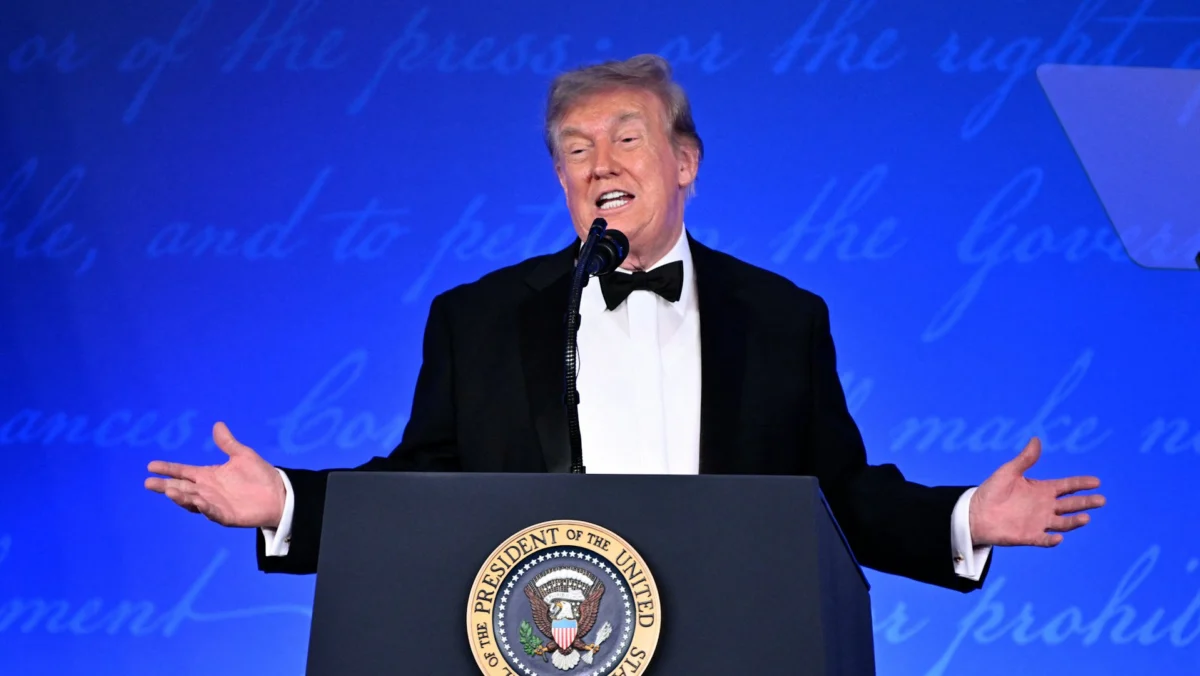
The 2026 White House Correspondents’ Dinner, an event traditionally defined by lighthearted roasts and a celebration of the First Amendment, has instead become the center of a national firestorm following remarks made by President Donald Trump. During his keynote address at the Washington Hilton, the President directed a series of pointed barbs at Democratic leadership, specifically targeting Senate Minority Leader Chuck Schumer. The controversy erupted when President Trump utilized the term "Palestinian" as a derogatory label to describe the veteran New York Senator, sparking immediate condemnation from civil rights organizations, diplomatic circles, and lawmakers across the political spectrum.
The incident occurred approximately twenty minutes into the President’s speech, a set that had already been marked by sharp critiques of the media and his political rivals. While discussing Senator Schumer’s recent voting record and his stance on Middle Eastern foreign policy, President Trump suggested that the Senator’s allegiances had shifted, stating that Schumer had "become a Palestinian" because of his perceived lack of support for specific Israeli security measures. The delivery of the line, which was met with a mix of scattered laughter and audible gasps from the audience of journalists, celebrities, and politicians, has since been characterized by critics as a xenophobic "othering" of an entire ethnic group.
The Context of the 2026 White House Correspondents’ Dinner
The White House Correspondents’ Dinner (WHCD) has long served as a bridge between the executive branch and the press corps. After years of tension and periods where the presidency boycotted the event, the 2026 dinner was seen by some as a potential return to the "normcy" of political satire. However, the tone of the evening shifted dramatically when the President’s rhetoric moved from standard political ribbing to the use of an ethnic identity as a punchline.
The room, filled with over 2,000 guests, became a microcosm of the national divide. While supporters of the President argued that the comment was a metaphorical critique of Schumer’s policy shifts, others viewed it as a dangerous escalation of rhetoric that dehumanizes Palestinians and weaponizes their identity. The timing of the remark is particularly sensitive, coming amidst a period of heightened tensions in the Levant and ongoing domestic debates regarding U.S. military aid and humanitarian obligations.
A Chronology of the Evening and Subsequent Fallout
The timeline of the controversy began at 9:15 PM EST, when President Trump took the podium. By 9:35 PM, the "Palestinian" comment had been made. Within minutes, the clip began circulating on social media platforms, garnering millions of views and triggering immediate "breaking news" segments on major cable networks.
By 10:00 PM, while the dinner was still in progress, several prominent Arab-American and Jewish-American advocacy groups issued preliminary statements on X (formerly Twitter) expressing concern. At 11:30 PM, as the after-parties began, Senator Schumer’s office released a brief but firm rebuttal, calling the President’s language "beneath the dignity of the office" and "an insult to millions of people."
The following morning, July 26, 2026, the backlash intensified. At 8:00 AM, a coalition of civil rights groups announced a joint press conference to address the rhetoric. By noon, international news outlets began reporting on the incident, with several Middle Eastern diplomatic missions expressing "deep concern" over the implications of the President’s choice of words.
Analysis of the Rhetoric: Dehumanization and Political Identity
The use of an ethnic or national identity as an insult is a phenomenon that sociologists and political scientists refer to as "identity weaponization." By using "Palestinian" as a synonym for someone who is weak, or an outcast, the President’s rhetoric suggests that being Palestinian is inherently negative. This is not the first time such rhetoric has appeared in the American political lexicon, but its delivery from the podium of the WHCD gives it a unique and controversial platform.
Political analysts note that this tactic serves a dual purpose: it appeals to a specific base that views Middle Eastern geopolitics through a binary lens, and it forces opponents into a defensive posture where they must defend an identity group that is often marginalized in American discourse. However, the risk of such rhetoric is the potential for increased hate speech and a breakdown in diplomatic nuance.
Supporting Data: Public Perception and Demographic Impact
Data from recent polling highlights why this rhetoric is so volatile. According to a 2025 Pew Research Center study, American attitudes toward the Israeli-Palestinian conflict have become increasingly polarized along generational lines. Among voters under the age of 30, 48% expressed a more favorable view of the Palestinian people than in previous decades, while voters over 65 remained staunchly aligned with traditional pro-Israel narratives.
Furthermore, demographic data from the 2024 U.S. Census Bureau indicates that the Arab-American population is one of the fastest-growing demographics in key swing states, including Michigan, Pennsylvania, and Ohio. In Michigan alone, there are over 300,000 residents of Middle Eastern or North African descent. Political strategists suggest that using "Palestinian" as an insult could have tangible electoral consequences in these regions, potentially alienating a crucial bloc of voters ahead of the 2026 midterm elections.
Official Responses and Political Reactions
The reaction from the Democratic Party was swift and unified. House Minority Leader Hakeem Jeffries issued a statement saying, "The President’s comments were not only offensive but dangerous. To use any group of people as a slur is an abdication of moral leadership." Several Republican lawmakers, however, defended the President, suggesting that the media was overreacting to a "joke" and that the focus should remain on Senator Schumer’s policy decisions.
From the civil rights sector, the American-Arab Anti-Discrimination Committee (ADC) condemned the remarks in a lengthy press release. "Being Palestinian is not an insult; it is an identity rooted in history, culture, and resilience," the statement read. "When the President of the United States uses our name as a way to mock a political opponent, he signals to the world that our lives and our identities are of lesser value."
Similarly, J Street, a pro-Israel, pro-peace advocacy group, criticized the President for "using the complex and painful reality of the Palestinian people as a cheap political cudgel," arguing that such rhetoric makes a two-state solution and regional peace even more difficult to achieve.
Broader Impact and Global Implications
The global implications of the President’s remarks are significant. The United States has long positioned itself as a mediator in the Middle East. When the head of state uses the identity of one of the parties in a regional conflict as a derogatory term, it undermines the perceived neutrality and credibility of the U.S. diplomatic mission.
In Ramallah, a spokesperson for the Palestinian Authority called the remarks "unfortunate and indicative of a lack of respect for international norms." Meanwhile, in Israel, the reaction was mixed, with some right-wing commentators praising the President’s "frankness" while others expressed concern that such polarizing language could complicate Israel’s own diplomatic efforts with its neighbors.
The incident also raises questions about the future of the White House Correspondents’ Dinner itself. Critics have argued for years that the event creates an uncomfortably close relationship between the press and the people they cover. This latest controversy has prompted some news organizations to reconsider their participation in the event, citing a desire to distance themselves from rhetoric that violates their editorial standards of inclusivity and respect.
Conclusion: The Path Forward
As the dust settles on the 2026 White House Correspondents’ Dinner, the focus remains on whether the President will offer a clarification or if this rhetoric will become a staple of his upcoming campaign appearances. Historically, President Trump has rarely apologized for controversial remarks, often doubling down on his statements as a rejection of "political correctness."
The fallout from the "Palestinian" insult serves as a stark reminder of the power of presidential language. In an era of deep social and political fragmentation, the words chosen by the Commander-in-Chief have the power to either bridge divides or widen them. For the millions of Palestinian-Americans and the global community watching, the events of July 25, 2026, represent a pivotal moment in the ongoing evolution of American political discourse—a moment where the boundaries of "humor" and "insult" were once again tested on the national stage.
As the 2026 midterm elections approach, the impact of this rhetoric will likely be measured not just in headlines, but in the polling booths of Michigan, the halls of Congress, and the diplomatic corridors of the United Nations. The "Palestinian" comment has moved beyond the ballroom of the Washington Hilton, becoming a permanent fixture in the debate over the soul and direction of American leadership.
