

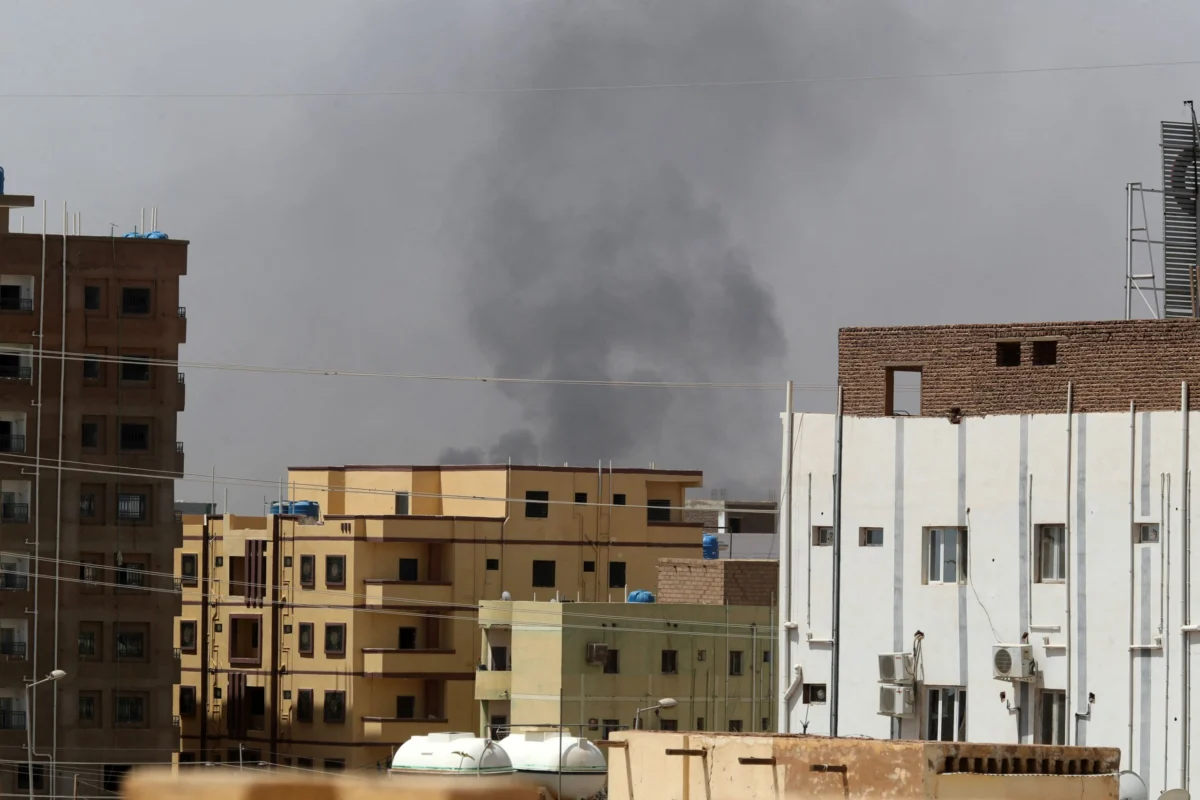
Sporadic fighting between Sudan’s warring military factions continued to resonate across the capital city of Khartoum on Sunday, according to local residents, casting a shadow of doubt over a newly brokered Saudi and U.S. ceasefire deal. The week-long truce, intended to provide a reprieve for the embattled civilian population, was signed following weeks of intensive negotiations in the Saudi coastal city of Jeddah. While the agreement has raised cautious hopes for a temporary cessation of hostilities in a conflict now entering its second month, the persistence of gunfire and artillery strikes in the capital highlights the immense challenges of enforcing peace on the ground.
The ceasefire agreement, signed by representatives of the Sudanese Armed Forces (SAF) and the paramilitary Rapid Support Forces (RSF), is scheduled to officially take effect on Monday evening. Unlike previous verbal commitments that were almost immediately ignored, this deal includes a formalized, internationally supported monitoring mechanism. This oversight body is intended to track compliance and facilitate the safe passage of humanitarian aid to millions of trapped civilians. However, the absence of the two primary antagonists—army chief General Abdel Fattah al-Burhan and RSF commander Mohamed Hamdan Dagalo, better known as Hemedti—from the signing ceremony has led analysts to question the depth of the leadership’s commitment to the truce.
The Immediate Reality: A Capital Under Fire
As the countdown to the Monday evening deadline began, the sounds of war remained the dominant soundtrack in Khartoum. Witnesses reported heavy clashes in central and southern districts of the city, where the RSF has established a significant presence in residential neighborhoods. The urban nature of the conflict has turned the capital into a labyrinth of checkpoints, snipers, and scorched buildings.
For the residents remaining in Khartoum, the situation is increasingly desperate. Safaa Ibrahim, a 35-year-old resident who spoke via telephone, described a life defined by fear and fragmentation. She noted that her family has been scattered across various Sudanese towns and even into neighboring Egypt as they fled the violence. Her plea for a return to "normal life and safety" reflects a growing exhaustion among the populace. Similarly, Mohamed Hamed, a local activist, emphasized that the city is "waiting for the truce" as the health situation deteriorates daily.
The struggle for survival is compounded by a total collapse of essential services. Mass looting of markets and private homes has left food supplies dwindling, while the destruction of infrastructure has resulted in prolonged blackouts and a lack of running water. Hospitals have not been spared; many have been occupied by combatants or forced to close due to a lack of medicine, electricity, and personnel.
A Chronology of Sudan’s Descent into Conflict
The current war did not emerge in a vacuum but is the culmination of years of political instability following the 2019 popular uprising that toppled long-time autocrat Omar al-Bashir. To understand the current impasse, a review of the timeline is essential:
- April 2019: After months of mass protests, the Sudanese military ousts President Omar al-Bashir. A Transitional Military Council (TMC) takes power.
- August 2019: Under international pressure, a power-sharing agreement is signed between the military and civilian groups (the Forces for Freedom and Change), creating a Sovereignty Council led by General Burhan with Hemedti as his deputy.
- October 2021: The fragile transition is shattered when Burhan and Hemedti join forces to lead a military coup, arresting civilian Prime Minister Abdalla Hamdok and dissolving the transitional government.
- December 2022: Amid a collapsing economy and continued protests, the military signs a "framework agreement" with civilian parties to return to a transition toward elections.
- Early 2023: Tensions escalate between the SAF and the RSF over the timeline for integrating the paramilitary group into the regular army. The SAF pushed for a two-year integration period, while the RSF demanded ten years.
- April 15, 2023: Armed clashes erupt in Khartoum and Merowe, quickly spreading across the country as both sides vie for control of strategic assets like the airport and the presidential palace.
The Jeddah Declaration: A New Diplomatic Approach
The ceasefire signed in Jeddah represents a shift in diplomatic strategy. Previous attempts at truces were largely informal and lacked a framework for accountability. The "Jeddah Declaration of Commitment to Protect the Civilians of Sudan" focuses on humanitarian imperatives rather than a final political settlement.
The agreement specifies that both parties must vacate hospitals and essential public facilities. It also calls for the restoration of essential services, such as electricity and water pumping stations, which have been damaged in the crossfire. The monitoring mechanism, reportedly involving representatives from Saudi Arabia, the United States, and the warring factions themselves, is a first for this conflict.
Despite these formal steps, the rhetoric from military leadership remains hawkish. Senior army general Yassir al-Atta recently appeared on Sudan state TV, asserting the army’s right to remove RSF forces from civilian areas by force. He even suggested that while the army does not yet require civilian militias, residents have a "natural right" to arm themselves for self-defense—a statement that many fear could lead to the further fragmentation of the conflict and the rise of uncontrolled vigilante groups.
The Humanitarian Crisis in Numbers
The scale of the human suffering in Sudan is staggering. According to the World Health Organization (WHO), at least 705 people have been confirmed killed and over 5,287 injured. However, medical officials on the ground warn that these figures are significant undercounts, as many bodies remain uncollected in the streets of Khartoum and Darfur, and many deaths go unrecorded in rural areas.
The displacement crisis is equally severe. The United Nations reports that approximately 1.1 million people have been forced from their homes. Roughly 840,000 are internally displaced within Sudan, while over 250,000 have crossed borders into neighboring countries.
- Egypt: Has received the largest share of refugees, with tens of thousands of Sudanese families waiting at border crossings like Qustul and Argeen.
- Chad: Already hosting hundreds of thousands of refugees from previous conflicts, Chad is struggling to accommodate the new influx of people fleeing the violence in Darfur.
- South Sudan and Ethiopia: Thousands have returned to South Sudan, often to areas already struggling with food insecurity and internal conflict.
The World Food Programme (WFP) has warned that the number of people facing acute food insecurity in Sudan could rise to 19 million—more than 40% of the population—if the fighting does not cease. The disruption of the planting season, combined with the destruction of food factories and the looting of aid warehouses, has created a "perfect storm" for a famine.
Regional Instability and the Darfur Factor
While the eyes of the world are on Khartoum, the situation in the western region of Darfur has taken a particularly dark turn. The conflict there has reignited old ethnic tensions, with reports of Janjaweed-aligned militias attacking non-Arab communities. Darfur was the site of a genocide in the early 2000s, and the current vacuum of authority has allowed for a resurgence of targeted violence, arson, and mass displacement.
The regional implications are profound. Sudan borders seven countries, many of which are already grappling with their own internal instabilities. A prolonged civil war in Sudan threatens to become a playground for regional proxies, as various external actors have historical ties to either Burhan or Hemedti. The potential for the conflict to spill over borders or create a permanent corridor of instability in the Sahel and the Horn of Africa is a primary concern for the international community.
Analysis: Challenges to a Permanent Peace
The core of the issue remains the existential nature of the struggle between Burhan and Hemedti. For both men, the war is not just about political control but about personal survival. If the SAF wins, the RSF—and by extension, Hemedti’s vast business empire—will likely be dismantled. If the RSF maintains its ground, it secures its status as a permanent, autonomous military force within the state.
Furthermore, the lack of a clear command structure within some units means that even if a ceasefire is ordered from the top, local commanders may continue to fight for resources or tactical advantage. The urban environment favors the RSF’s guerrilla-style tactics, while the SAF relies on its superior air power and heavy artillery, which inevitably results in high civilian casualties and infrastructure damage.
The Jeddah talks are viewed by mediators as a "step-by-step" process. The current ceasefire is a "short-term" measure intended to build enough trust to move toward "preliminary negotiations" for a permanent cessation of hostilities. However, without a path toward civilian-led governance, many Sudanese activists fear that any peace deal will simply result in a return to the military-dominated status quo that preceded the April 15 outbreak.
As Monday evening approaches, the people of Sudan—and the international community—are watching to see if the guns will finally fall silent. The success or failure of this ceasefire will not only determine the immediate fate of Khartoum’s residents but will also signal whether Sudan can avoid a descent into a protracted, multi-sided civil war that could haunt the region for decades. For now, the "waiting for the truce" continues amidst the smoke and the sound of distant explosions.
