

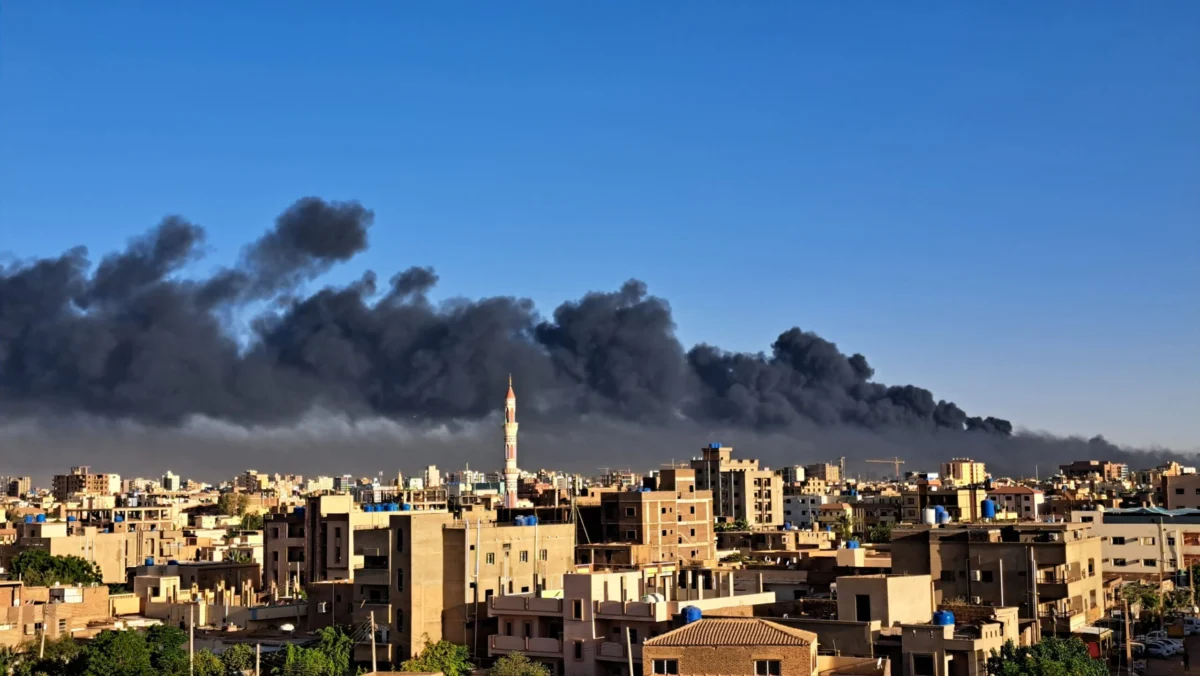
The capital of Sudan, Khartoum, has transformed into a high-intensity battleground as the Sudanese Armed Forces (SAF) and the paramilitary Rapid Support Forces (RSF) entered their fifth consecutive day of heavy combat. On Wednesday, April 19, 2023, the city was rocked by continuous bombardments and heavy artillery fire, signaling the definitive collapse of a U.S.-brokered 24-hour humanitarian ceasefire. As the two rival factions vie for control of the nation’s strategic heart, the escalating violence has trapped millions of civilians, thwarted international evacuation efforts, and pushed the country’s healthcare system to the brink of total failure.
The conflict, which erupted on April 15, pits General Abdel Fattah al-Burhan, the head of the Sudanese army and the country’s de facto ruler, against his former deputy, General Mohamed Hamdan Dagalo, widely known as Hemedti, who leads the RSF. What began as a power struggle over the timeline and methodology of integrating the RSF into the regular military has now devolved into a full-scale civil war within one of Africa’s most populous urban centers.
Escalation at the General Command and Strategic Sites
The focus of Wednesday’s violence remained centered on the General Command of the Sudanese Armed Forces. For several days, RSF units have launched waves of attacks aimed at seizing the army headquarters, where General Burhan is believed to be directing operations. Thick plumes of black smoke rose over the central district as the army deployed heavy artillery and air strikes to repel the paramilitary advances.
While the RSF claimed to have made inroads into the compound, the military issued a defiant statement asserting that the "armed forces are responding to a new attack in the vicinity of the General Command," and claimed to have inflicted significant losses on the "rebel militia."
Simultaneously, the battle for Khartoum International Airport continues to rage. The airport, a critical gateway for the nation, has been rendered non-functional since the first hours of the conflict. Satellite imagery and eyewitness reports show multiple civilian aircraft, including a Saudi Arabian Airlines Airbus A330 and a SkyUp Airlines Boeing 737, destroyed or severely damaged on the tarmac. The loss of the airport has not only severed Sudan’s link to the outside world but has also effectively grounded all large-scale evacuation flights for foreign nationals.
In Northern Sudan, the military appeared to have gained a tactical advantage. State-linked media and footage from Al Arabiya suggested that the army had retaken the Merowe military airport, a strategic site where the RSF had previously detained several Egyptian soldiers who were in the country for joint training exercises.
The Collapse of the Humanitarian Truce
International diplomatic efforts, led by U.S. Secretary of State Antony Blinken and supported by regional powers like Egypt and Saudi Arabia, had secured a commitment from both generals for a 24-hour ceasefire starting Tuesday evening. The goal was to provide a "humanitarian window" for civilians to seek medical aid and for foreign missions to coordinate departures.
However, the truce was violated within minutes of its commencement. Gunfire and explosions continued unabated throughout the night and intensified on Wednesday morning. Both sides traded blame for the failure; the SAF accused the RSF of using the pause to regroup and move more fighters into the city, while the RSF alleged that the army used its air force to strike residential neighborhoods in violation of the agreement.
On Wednesday afternoon, the RSF announced its readiness to observe a new 24-hour ceasefire starting at 6:00 PM local time. However, the Sudanese military remained skeptical, with senior officials indicating that they would only honor a truce if the RSF withdrew from residential areas and strategic government buildings.
A Growing Humanitarian Catastrophe
The human cost of the power struggle is mounting rapidly. According to data provided by the World Health Organization (WHO) and the Sudanese Health Ministry, at least 270 people have been killed and more than 2,600 injured since Saturday. These figures are widely considered to be undercounts, as many bodies remain in the streets of Khartoum, unreachable due to the intensity of the snipers and shelling.
The situation for the 5.5 million residents of Khartoum is increasingly dire. Most neighborhoods are suffering from total power outages and a lack of running water. Food supplies are dwindling as grocery stores remain shuttered and supply chains are severed. "Today we were starting to run out of some essentials," said Hadeel Mohamed, an architect living in the capital. "The risk of going out is immense, but the risk of starving at home is becoming real."
The healthcare sector is facing a "total collapse," according to the Sudanese Doctors’ Trade Union. Out of the 59 hospitals in Khartoum and nearby states, approximately 39 are currently out of service. Some have been shelled, while others have been forcibly evacuated by armed groups to be used as military outposts. The remaining facilities lack basic medical supplies, oxygen, and blood bags. Humanitarian workers have also been targeted; the United Nations reported instances of sexual violence against aid workers and the looting of humanitarian warehouses. The World Food Programme (WFP) suspended its operations—one of the largest in the world—after three of its employees were killed in North Darfur.
Chronology of the Power Struggle
To understand the current crisis, it is necessary to examine the timeline of the deteriorating relationship between the SAF and the RSF:
- 2019: Mass protests lead to the ouster of long-time autocrat Omar al-Bashir. The military and the RSF form a Transitional Military Council to share power with a civilian coalition.
- October 2021: General Burhan and Hemedti join forces to lead a military coup, dissolving the civilian-led government and derailing the democratic transition.
- December 2022: A "Framework Agreement" is signed between the military and civilian groups, promising a return to civilian rule. However, tensions begin to simmer over the RSF’s integration.
- Early April 2023: The RSF begins mobilizing forces toward Khartoum and Merowe without the army’s permission.
- April 15, 2023: Fighting breaks out in Khartoum and across the country after weeks of failed negotiations regarding the military chain of command.
International Evacuation Efforts Thwarted
The persistence of the fighting has left thousands of foreign diplomats, students, and workers stranded. Several nations have prepared contingency plans, but the closure of the airspace makes any operation high-risk.
- United States: The State Department confirmed that there are currently no plans for a government-coordinated evacuation due to the "uncertain security situation."
- Germany: Reports surfaced that a mission involving three Luftwaffe A400M transport planes to evacuate 150 citizens was aborted on Wednesday as the security of the landing site could not be guaranteed.
- Japan: The Japanese government has dispatched Self-Defense Forces planes to Djibouti, preparing to airlift approximately 60 Japanese nationals once a window of safety opens.
- United Kingdom & European Union: Both have urged their citizens to shelter in place, as the streets remain too dangerous for overland travel to the border or the coast.
Geopolitical Implications and Regional Stability
Sudan’s internal conflict has the potential to destabilize the entire Horn of Africa and the Sahel region. The country occupies a strategic position on the Red Sea and shares borders with seven nations, many of which—including Chad, South Sudan, and Ethiopia—are already dealing with their own internal instabilities.
The rivalry also reflects a broader geopolitical competition. Russia, through the Wagner Group, has historically maintained ties with Hemedti’s RSF, primarily focused on gold mining concessions. Meanwhile, the United States and its allies have sought to foster a transition to a civilian government that would be more aligned with Western democratic norms. Egypt, which views the Sudanese army as a guarantor of its own national security and interests in the Nile waters, has remained a staunch supporter of General Burhan.
If the conflict persists, analysts warn it could become a protracted proxy war. The RSF, which grew out of the Janjaweed militias of the Darfur conflict, has significant experience in irregular desert warfare and possesses substantial financial resources. The SAF, while possessing superior air power and heavy weaponry, faces the challenge of fighting a decentralized enemy within a dense urban environment.
Analysis: The Path Forward
The refusal of both General Burhan and Hemedti to negotiate suggests that both believe a decisive military victory is possible. However, the urban nature of the fighting in Khartoum suggests that a "clear-cut" win is unlikely in the short term. Instead, the city faces a prolonged period of attrition that will likely result in the destruction of its infrastructure and a massive exodus of its population.
The international community faces a dilemma. While there is a consensus on the need for a ceasefire, there is little leverage to force the hands of the two generals. Sanctions are being discussed, but their effectiveness is questionable given the internal wealth of both factions.
As the Eid al-Fitr holiday approaches—marking the end of the holy month of Ramadan—the Sudanese people find themselves in a state of mourning and terror. What was supposed to be a period of celebration is now a struggle for survival. Without a significant shift in the military landscape or a breakthrough in high-level mediation, the "Battle for Khartoum" threatens to become the opening chapter of a long and bloody fragmentation of the Sudanese state.
