

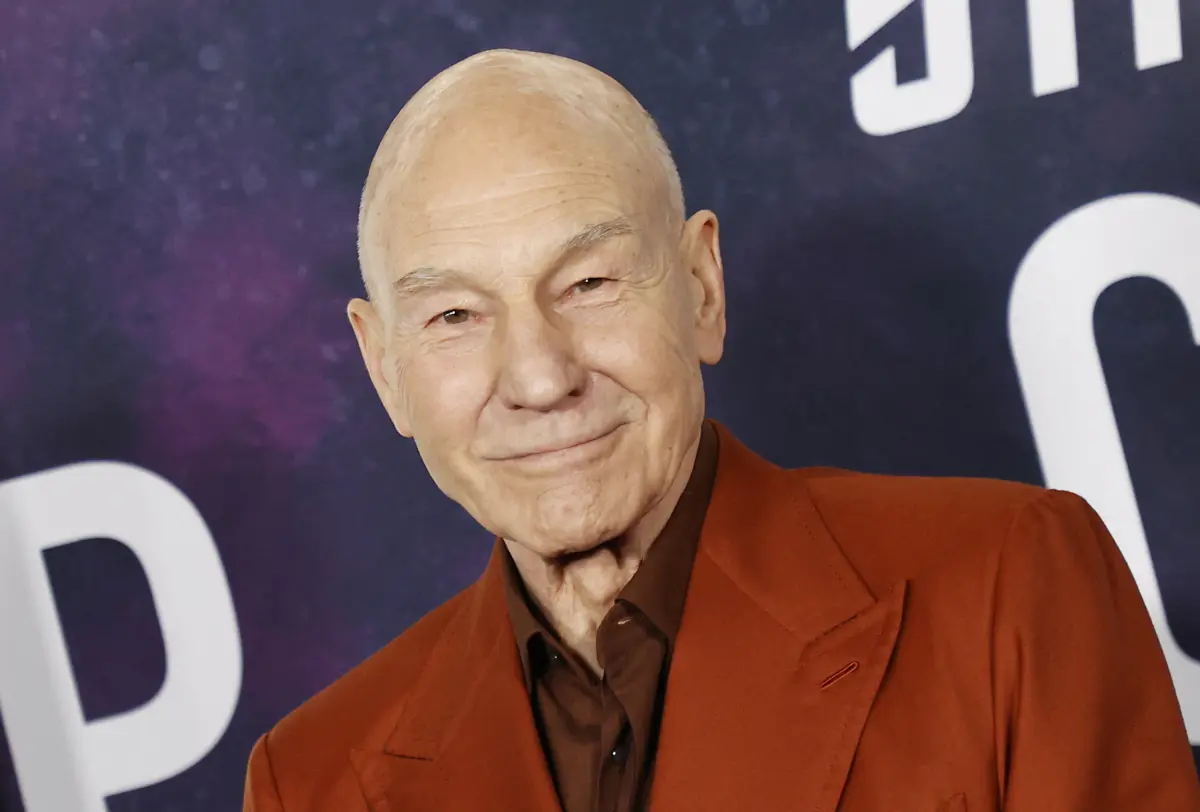
Patrick Stewart, the revered British actor whose commanding presence graced both classical theatre and iconic science fiction, has passed away at the age of 86. The news of his death on Wednesday in Los Angeles was confirmed on Thursday by spokesperson Kelly Bush Novak, who stated that Stewart’s passing followed "a brief and poignant journey" with Alzheimer’s disease and Lewy body dementia. His remarkable career, spanning over six decades, left an indelible mark on audiences worldwide, solidifying his status as one of the most versatile and respected performers of his generation. From the hallowed stages of the Royal Shakespeare Company to the captain’s chair of the USS Enterprise and the powerful mind of Professor Charles Xavier, Stewart’s legacy is defined by a profound dedication to his craft and an ability to imbue complex characters with dignity, intelligence, and humanity.
A Life Defined by Resilience and Artistic Dedication
Born on July 13, 1940, in Mirfield, West Yorkshire, England, Stewart’s early life was marked by humble beginnings and significant challenges. Growing up in a working-class environment, his childhood home lacked basic amenities like an indoor bathroom, a stark contrast to the sophisticated future he would later portray on screen. His father, Alfred Stewart, a former regimental sergeant major in the British Army, suffered from post-traumatic stress disorder, which manifested in repeated domestic violence against his mother, Gladys Barrowclough. These traumatic experiences profoundly shaped Stewart’s worldview and later fueled his passionate advocacy against domestic abuse, notably as a patron of Refuge, a charity supporting survivors. He often spoke candidly about his past, famously stating in a newspaper piece, "Violence is always a choice a man makes and he alone is responsible for it." This personal commitment to social causes highlighted a compassion that extended far beyond his professional roles.
Stewart’s journey into acting began early, a testament to his innate talent and unwavering determination. At the age of 12, he joined an amateur drama group, discovering a world where he could channel his experiences and emotions into performance. As a teenager, his fascination with William Shakespeare led him to memorize soliloquies purely for enjoyment, a practice that would lay the groundwork for a distinguished theatrical career. His dedication paid off when he secured a scholarship to the prestigious Bristol Old Vic Theatre School, a pivotal moment that launched his professional acting career. It was during these formative years that Stewart developed alopecia, leading to his distinctive baldness from the age of 19, a feature that would become synonymous with his iconic characters.
A Titan of the Stage: From Yorkshire to the Royal Shakespeare Company
Before achieving global recognition on film and television, Patrick Stewart was a formidable presence in British theatre, particularly revered for his interpretations of Shakespearean roles. He spent 14 years with the Royal Shakespeare Company (RSC), joining in 1966 and becoming a cornerstone of its ensemble. During his tenure, he tackled a staggering array of leading roles, embodying characters such as Mark Antony in Antony and Cleopatra, King Henry IV, Shylock in The Merchant of Venice, and Oberon in A Midsummer Night’s Dream. His performances were consistently lauded for their intellectual rigor, vocal power, and psychological depth. Critics and audiences alike recognized his ability to strip away theatrical artifice, presenting Shakespeare’s complex characters with raw honesty and profound insight.

His time with the RSC was not merely a stepping stone but a foundational period that honed his craft to an exceptional degree. He often recounted the immersive experience of classical theatre, noting, "People who were not in the company would say to me, ‘Give it a break. Why don’t you go somewhere else?’ And I would say, ‘To do what? Telly?’" This anecdote underscored his deep commitment to the stage and his initial skepticism about the allure of television and film. However, his theatrical work extended beyond Shakespeare, showcasing his remarkable versatility. He became particularly known for his one-man adaptation of Charles Dickens’ A Christmas Carol, a tour-de-force performance where he portrayed over 30 characters, earning critical acclaim and delighting audiences on both sides of the Atlantic.
In later years, Stewart continued to captivate theatregoers with acclaimed performances in West End and Broadway productions. His collaborations with longtime friend and fellow knight, Sir Ian McKellen, became legendary. Their performances in Harold Pinter’s No Man’s Land and Samuel Beckett’s Waiting for Godot garnered widespread praise, highlighting their extraordinary chemistry and individual brilliance. These productions toured extensively, allowing audiences to witness two theatrical giants at the peak of their powers. One of the most significant accolades of his stage career came in 2007 for his portrayal of Macbeth. His performance earned him his only Tony Award nomination, with The Times of London describing it as "an enthralling creation of frailty, appetite, egotism and grim humour." Reflecting on the role, Stewart told the Associated Press in 2008, "Nearly 50 years I’ve waited. I learned it when I was 14. I memorized all the soliloquies just because I thought they were great. And they stuck, so I didn’t have to learn those bits of the play, which is a blessing, because learning lines has now become the one curse of this job." This testament to his lifelong passion for Shakespeare underscores the depth of his commitment to the dramatic arts.
Stellar Trajectory: From Starship Commander to Mutant Mentor
Stewart’s transition from the classical stage to mainstream film and television was not immediate but proved to be transformative. After a decade and a half with the RSC, he began to explore other avenues, including a memorable role in John Boorman’s 1981 fantasy epic Excalibur, where he played Leondegrance. However, it was in 1987, shortly after a critically lauded performance in Edward Albee’s Who’s Afraid of Virginia Woolf?, that he was offered a role that would forever change his career trajectory: Captain Jean-Luc Picard in Star Trek: The Next Generation.
At the time, the idea of a classically trained British actor leading a syndicated American science fiction series was met with skepticism, even by Stewart himself. "I found myself in Hollywood shooting a syndicated science fiction series, which I was assured would fail," he famously recounted. Contrary to expectations, Star Trek: The Next Generation became a cultural phenomenon, running for seven highly successful seasons and 178 episodes. Stewart’s portrayal of Captain Picard, the morally upright, intellectually curious, and deeply compassionate commander of the USS Enterprise (NCC-1701-D), redefined the archetype of a starship captain. Picard’s signature command, "Make it so," became an iconic phrase, embodying his decisive leadership and unwavering commitment to exploration and diplomacy. Stewart brought a gravitas and nuanced authority to the role that resonated deeply with viewers, elevating the series beyond mere science fiction to a platform for philosophical inquiry and social commentary. His performance cemented Picard as one of television’s most beloved and influential characters, inspiring generations of fans and leaders. The success of The Next Generation led to four feature films, where Stewart reprised his role, further solidifying Picard’s place in cinematic history and in the hearts of "Trekkies" worldwide. He later returned to the role in the critically acclaimed series Star Trek: Picard, which explored the character’s later years and legacy, proving the enduring appeal of his portrayal.
Just as he had redefined a science fiction icon, Stewart went on to embody another legendary character in the burgeoning superhero genre. In 2000, he took on the role of Professor Charles Xavier, the powerful telepathic leader and founder of the X-Men, in the eponymous film X-Men. His casting was pivotal, lending immediate credibility and gravitas to the comic book adaptation. Stewart’s portrayal of Xavier, a figure of immense wisdom, compassion, and moral fortitude, became a benchmark for superhero film performances. He reprised the role in several sequels, including X2: X-Men United (2003), X-Men: The Last Stand (2006), X-Men: Days of Future Past (2014), and a poignant, critically acclaimed final performance in 2017’s Logan. In Logan, Stewart’s Xavier was depicted as frail and suffering from dementia, a performance that earned widespread praise for its emotional depth and raw vulnerability, showcasing his incredible range and ability to portray the complexities of aging and illness with profound empathy. His on-screen chemistry with Hugh Jackman, who played Wolverine, became a beloved aspect of the franchise, cementing their characters as central to its emotional core.

A Legacy of Humanity, Advocacy, and Enduring Influence
Beyond his celebrated acting career, Patrick Stewart was a dedicated humanitarian and a passionate advocate for various causes. His knighthood, bestowed by Queen Elizabeth II in June 2010 for services to drama, recognized not only his artistic achievements but also his significant contributions to public life. He also served as an ambassador for the International Rescue Committee (IRC), an organization dedicated to helping people whose lives and livelihoods are shattered by conflict and disaster. His work with the IRC involved raising awareness and funds for refugees globally, a cause he championed with characteristic eloquence and conviction. His lifelong commitment to combating domestic violence, spurred by his childhood experiences, remained a constant thread throughout his public life, inspiring many to speak out and seek help.
The news of Sir Patrick Stewart’s passing prompted an outpouring of tributes from across the entertainment industry and from his legion of fans. Colleagues from the Star Trek universe, including Jonathan Frakes (Commander Riker), Marina Sirtis (Counselor Troi), Gates McFadden (Dr. Crusher), and Brent Spiner (Data), are expected to share heartfelt remembrances of his leadership, professionalism, and camaraderie on set. Similarly, his X-Men co-stars, including Sir Ian McKellen, Hugh Jackman, and Halle Berry, will undoubtedly mourn the loss of a mentor and friend who brought unparalleled dignity to their shared cinematic universe. McKellen, in particular, often spoke of their deep bond, both personal and professional, describing their friendship as one of the most significant of his life. Fans worldwide have taken to social media, sharing favorite quotes, scenes, and memories of the characters he brought to life, underscoring the profound emotional connection he forged with audiences.
Stewart’s death comes just days after that of Walter Koenig, who played Ensign Pavel Chekov in the original Star Trek series, marking a poignant moment for the Star Trek family and its enduring legacy. This confluence highlights the passing of an era, as many of the foundational figures of iconic franchises begin to leave us.
Sir Patrick Stewart’s battle with Alzheimer’s disease and Lewy body dementia also brings renewed attention to these debilitating neurological conditions. Lewy body dementia (LBD), often mistaken for Alzheimer’s or Parkinson’s disease, is a progressive dementia that leads to a decline in thinking, reasoning, and independent function due to abnormal protein deposits (Lewy bodies) in the brain. Alzheimer’s disease, the most common cause of dementia, involves progressive memory loss and cognitive decline. Stewart’s public and private journey with these conditions serves as a stark reminder of their impact on individuals and families, potentially fostering greater awareness and support for research into these complex diseases.
Ultimately, Sir Patrick Stewart’s legacy is one of unparalleled versatility, intellectual curiosity, and profound humanity. He seamlessly navigated the worlds of classical theatre and popular culture, proving that artistic excellence knows no bounds. His characters, whether quoting Shakespeare on stage or commanding a starship, were always imbued with a deep sense of integrity and a commitment to moral principles. He was more than an actor; he was a cultural icon, a humanitarian, and a testament to the power of resilience. His voice, his presence, and his unwavering dedication to his craft will be profoundly missed, but his indelible contributions to stage and screen will continue to inspire for generations to come. He taught us to "Engage!" with life, to "Make it so" in our endeavors, and to always strive for a better future, embodying the very best of humanity both on and off screen.
