

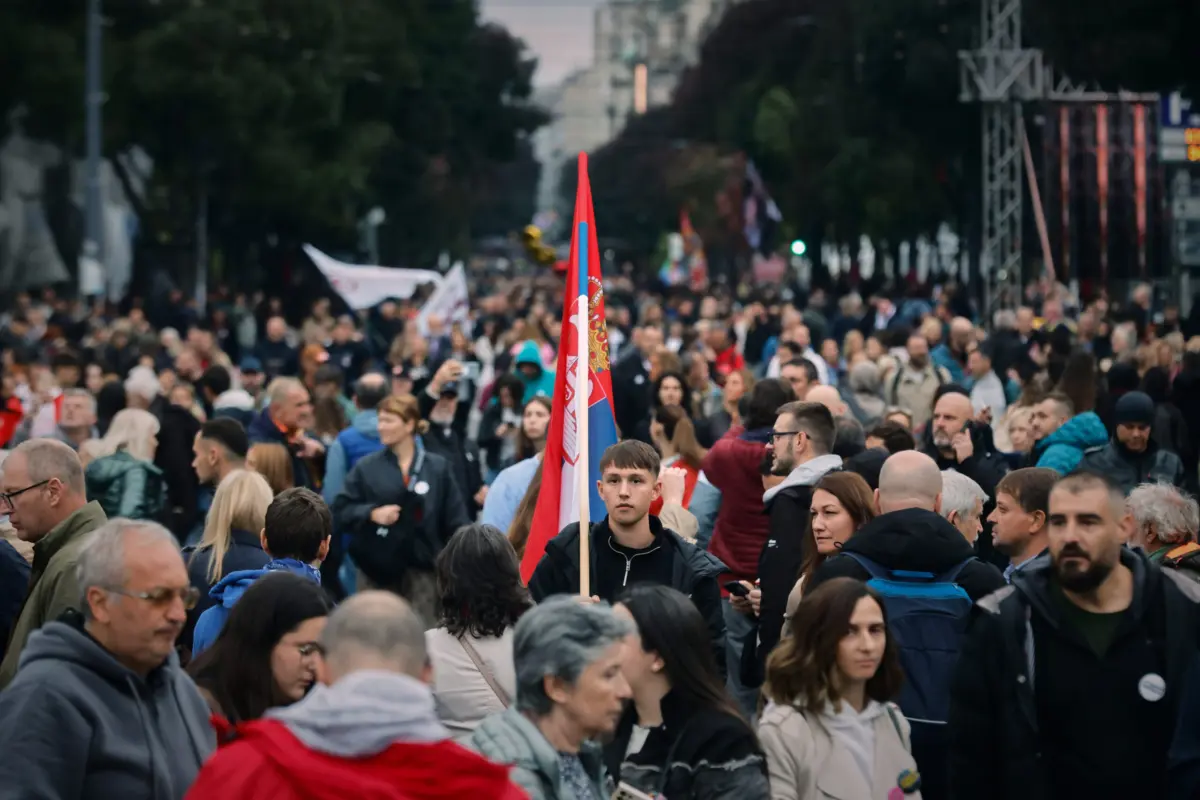
While much of Europe remained largely unaware over the past two years, Serbia was undergoing a profound internal transformation. A burgeoning nationwide student movement meticulously built over months of sustained activism ultimately delivered an unprecedented electoral blow to a deeply entrenched government on Sunday, succeeding where established opposition parties had faltered for more than a decade. This remarkable triumph, largely overlooked by international media until the decisive election results, has repositioned Serbia on the geopolitical map and offers a compelling case study for civil society movements across the continent.
The Genesis of Discontent: A Deep-Rooted Crisis
For years, President Aleksandar Vucic and his Serbian Progressive Party (SNS) had steadily consolidated power, leading to a political landscape often characterized by shrinking democratic space, pervasive media control, and a significant reliance on foreign investment that, while stimulating growth, also created avenues for corruption and limited genuine social mobility. The country’s economy, while showing some signs of growth, struggled with high youth unemployment, persistent brain drain, and a widening gap between a connected elite and the struggling populace. Public services, infrastructure, and the general standard of living for many ordinary Serbians faced continuous erosion.
The immediate catalyst for the student movement’s widespread emergence was a tragic incident in 2024: the death of 16 individuals in a train canopy collapse at a newly renovated station. This catastrophe, which authorities attributed to structural failure, ignited public fury. For many, it was not merely an accident but a stark symbol of systemic corruption, mismanagement, and a perceived disregard for human life and public safety. The incident laid bare the consequences of what students and their families had experienced for years: being "squeezed from all sides" by local elites whose graft and inefficiency diminished their quality of life, and by international corporations that often benefited from, and inadvertently fed, this corruption while offering employment with limited prospects for advancement.
A New Paradigm of Protest: Independence and Direct Democracy
The protests that followed the Novi Sad tragedy were not the first against President Vucic’s administration. Serbia had seen numerous demonstrations, including the "1 in 5 Million" protests in 2018-2019 which, despite drawing large crowds, ultimately failed to translate into significant political change. What distinguished the student movement this time was its unwavering commitment to independence. Unlike previous movements that either aligned with existing domestic political factions or sought external backing, these students deliberately distanced themselves from both. They eschewed affiliation with Serbia’s fragmented opposition parties, many of which were perceived as small, centralized, and increasingly out of touch with the daily struggles of ordinary citizens. Their vulnerability to corruption in a country heavily dependent on foreign capital further diminished their appeal. Crucially, the students also maintained strict neutrality from the four major international powers that heavily influence Serbian affairs: Russia, China, the European Union, and the United States. This independence was a cornerstone of their strategy, safeguarding their credibility and public trust.
For almost two years, while Europe remained largely oblivious, these students methodically built and practiced an alternative model of politics. Their approach was radical in its simplicity and effectiveness. They moved beyond conventional street protests to create a parallel political infrastructure. Across the country, they occupied and blockaded universities, effectively bringing higher education to a standstill in certain regions. They transformed academic institutions into hubs of political experimentation and community organizing.
A prime example of this innovative approach was observed at the Faculty of Technical Sciences in Novi Sad, Serbia’s largest university department with over 16,000 students. By March 2025, when a visiting academic was invited to speak there, the faculty bore little resemblance to its former self. Student guards, equipped with communication gear and metal fencing, controlled entrances. LED screens in corridors announced plenaries and alternative lectures. Rooms were meticulously stocked with food and medical supplies, tended to by student nurses. Kitchens, reading rooms, and an entirely student-run administration operated within the occupied premises.
Discussions on pressing political and economic issues, organized by the students’ alternative education sections, frequently drew 300 to 400 participants and lasted for five or six hours. These intensive debates covered a wide array of topics, many of which would later form the core of the movement’s electoral program. This high level of organization, centered around student plenaries that operated on principles of direct democracy, earned them profound respect from the general population. It also enabled them to withstand repeated attempts by police to evict them. The more the government and its repressive apparatus moved against them, the more public support rallied behind the students, solidifying a deep bond between the movement and the wider populace.
From Protest to Political Power: The "Student List"
As the bond between the students and the broader population deepened, the scope of democratic participation expanded. By March 2025, facing escalating attacks and repression, the students issued a call for citizens to establish their own assemblies, mirroring the student plenaries, to collectively seek justice for the 16 victims of the Novi Sad tragedy. This decentralized approach fostered a sense of collective ownership and amplified their demands. Recognizing that merely protesting was insufficient for systemic change, and in response to the government’s unyielding repressive strategy, the students made their first public demand for snap elections.
Their transition into electoral politics was executed with the same principles that defined their protest movement: independence, transparency, and direct democracy. Decisions were made collectively. They consciously chose not to nominate established politicians, clearly articulating their rejection of the leadership-based political models that they believed were failing across Europe. Instead, they invited academics and activists who had previously engaged with their occupied faculties to discuss and debate with well-known public figures. Candidates for "The Student List" were selected through a rigorous and transparent process, including extensive interviews with students. A testament to their commitment to inclusive representation, gender distribution was equal, and candidates represented various university regions.
An observer at one such interview session near Novi Sad last summer described a large gathering of 300 students meticulously questioning each candidate, with phones prohibited to ensure focus and integrity. This unique process, conducted away from traditional party headquarters, symbolized a new kind of politics – leaderless in its conventional sense, driven by a network of assemblies, local committees, and informal institutions. In that moment, it demonstrably worked.
The Electoral Earthquake: A Shift in Serbian Politics
On Sunday, the culmination of two years of grassroots organizing, direct democracy, and a steadfast commitment to independence delivered a stunning electoral victory. "The Student List," a political entity born not from established power structures but from the very heart of civil society, dealt an unprecedented blow to the incumbent government, shattering the political inertia that had characterized Serbian politics for over a decade. While specific vote percentages are still being analyzed, the initial results confirm a significant mandate, positioning "The Student List" as a major political force and initiating negotiations to form the next government. This outcome represents a seismic shift, signaling a public yearning for authentic representation and a rejection of the status quo.
Challenges Ahead: Navigating Domestic and Geopolitical Minefields
The journey ahead for "The Student List" is fraught with immense challenges. Domestically, undoing the damage of the past 14 years – from systemic corruption and institutional decay to economic precarity – will be a monumental task. Rebuilding public trust in institutions, strengthening democratic norms, and fostering sustainable economic development will require sustained effort and innovative policies.
Even more challenging, however, is the complex geopolitical arena the new government will inherit. Serbia has long pursued a multi-vector foreign policy, balancing relations with the European Union, the United States, Russia, and China. This delicate equilibrium is now poised for a significant test.
A critical early challenge will emerge from "The Student List’s" electoral program, which unequivocally condemns the genocide in Gaza and pledges non-complicity. This principle, if translated into practice, carries substantial geopolitical weight. Under the previous Vucic administration, Serbian-Israeli relations had notably strengthened. Following the events of October 2023, Serbian arms exports to Israel surged dramatically, from $3.3 million in that year to an estimated $126 million in 2025. Furthermore, in September, President Vucic inaugurated a factory for the production of Israeli drones within Serbia.
Should the new government adhere to its electoral program, it would, at a minimum, have to halt arms exports to Israel. This would be far more than a symbolic gesture. It would signify an extension of the political change won at the elections into the economic sphere, directly unsettling Serbia’s foreign relations and challenging the country’s established place within the wider geopolitical order. Such a decision could indeed be a truly revolutionary moment, with profound implications.
Given the substantial industrial weight of the arms sector, Serbia’s security cooperation with Israel, and the country’s broader reliance on foreign investment, a decision to alter these ties could provoke significant resistance from domestic vested interests and exert considerable pressure from various foreign partners. Already, in the final days of the electoral campaign, US-based conservative influencers intervened, framing support for Vucic as a defense of Serbia’s Christian identity against "Islamisation" and a perceived "Muslim threat." Concurrently, the Conservative Political Action Conference (CPAC), a powerful US conservative organization, is slated to open a Serbian chapter in November, with Vucic expected to play a central role. Any shift in Serbia’s carefully managed ties to these global superpowers will severely test "The Student List’s" ability to survive as a governing force and its capacity to manage internal and external tensions while avoiding conflict within Serbia itself.
A Blueprint for Europe?
The Serbian case, therefore, resonates far beyond the confines of the Balkans. Europe, currently grappling with its own emerging student movements in Belgium, France, Italy, and Spain – often spurred by similar frustrations over economic precarity, perceived political stagnation, and democratic deficits – has largely overlooked the remarkable developments in Serbia.
However, if civil society begins to falter in the continent’s core countries under increasing economic strain and disillusionment with traditional politics, the political experiment successfully concluded by Serbian students may prove invaluable. Their model of independent, decentralized, directly democratic, and resilient organizing offers a potential blueprint for how grassroots movements can not only challenge but fundamentally alter established political orders. The critical question is no longer whether lessons can be drawn from Serbia’s unique trajectory, but rather whether Europe is prepared to learn from them – or if it will once again choose to look away, only to confront a similar crisis arriving at its own doorstep. The world is watching to see if this student-led revolution can navigate the treacherous path from protest to sustainable governance, and in doing so, offer a beacon of hope for democratic renewal.
