

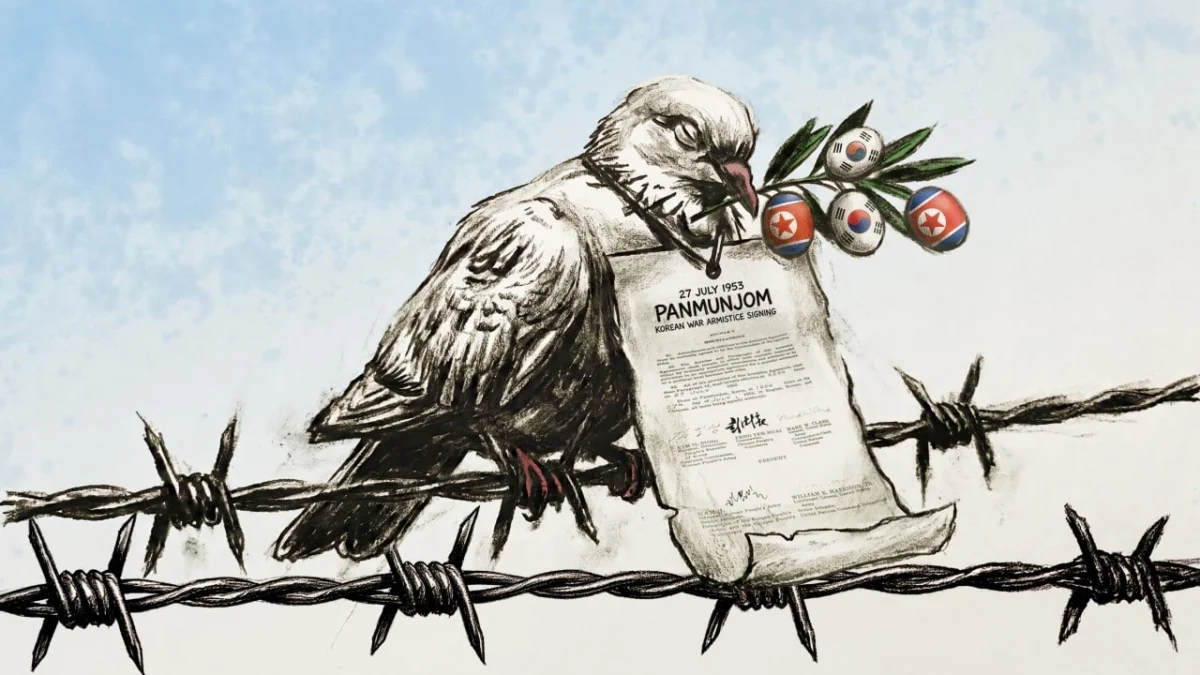
For over seven decades, the absence of a formal peace treaty has dictated the geopolitical landscape of Northeast Asia. However, the current era of the "forever war" is entering a more volatile phase. The traditional diplomatic playbook, long dominated by the United States’ demand for North Korea to abandon its nuclear weapons before receiving economic or security concessions, is increasingly viewed by analysts as anachronistic. As the deadlock persists, the Democratic People’s Republic of Korea (DPRK) has not only refined its military capabilities but has also successfully diversified its strategic partnerships, effectively insulating itself from the very pressures Washington intended to exert.
The 1953 Armistice: A Legacy of Suspended Conflict
The origins of the current impasse are rooted in the specific nature of the Korean War’s conclusion. On July 27, 1953, the Korean Armistice Agreement was signed at Panmunjom by representatives of the Korean People’s Army (KPA), the Chinese People’s Volunteers, and the United States-led United Nations Command. Notably, South Korea’s then-president, Syngman Rhee, refused to sign the agreement, as he remained committed to a unified peninsula under Seoul’s control.
This historical nuance remains a critical factor in modern diplomacy. Because the United States remains the primary signatory for the UN Command, it is the indispensable party in any transition from an armistice to a permanent peace regime. However, the legal state of war provides Pyongyang with a convenient justification for its "byungjin" policy—the simultaneous development of its economy and its nuclear deterrent. To the North Korean leadership, the nuclear program is not a bargaining chip but a survival necessity in the face of what it perceives as "hostile U.S. policy."
A Chronology of Missed Opportunities and Escalation
The path to the current 2026 stalemate has been marked by cycles of engagement followed by rapid deterioration.
- 1994: The Agreed Framework: The U.S. and North Korea signed a deal to freeze the North’s plutonium production in exchange for light-water reactors and fuel oil. The deal collapsed in 2002 amid allegations of a secret uranium enrichment program.
- 2003–2009: The Six-Party Talks: These multilateral negotiations involving the U.S., China, Russia, Japan, and the two Koreas aimed at denuclearization. North Korea conducted its first nuclear test in 2006, and the talks eventually dissolved.
- 2018–2019: The Summit Era: President Donald Trump and Kim Jong-un met in Singapore and Hanoi. While the summits produced high-profile imagery, the Hanoi meeting ended without a deal because the U.S. maintained its "all or nothing" approach to sanctions relief.
- 2022–2024: The Strategic Pivot: Following the Russian invasion of Ukraine, Pyongyang seized the opportunity to align with Moscow. This period saw a record number of missile tests and a formal declaration by Kim Jong-un that North Korea’s nuclear status is "irreversible."
- 2025–2026: The New Cold War: The deepening of the Russia-DPRK mutual defense pact has fundamentally altered the security architecture of the region, making U.S.-led sanctions largely ineffective.
The Failure of "Denuclearisation First"
The core of the diplomatic failure lies in Washington’s "denuclearisation first" posture. For decades, the U.S. State Department has operated on the assumption that economic pressure and diplomatic isolation would eventually force Pyongyang to trade its nuclear arsenal for integration into the global economy. This strategy, often termed "strategic patience" under the Obama administration or "maximum pressure" under the Trump administration, has yielded the opposite of its intended effect.

Data from the last decade highlights the acceleration of North Korea’s program during these periods of isolation. In 2022 alone, North Korea launched more than 90 missiles, including multiple Intercontinental Ballistic Missiles (ICBMs). By 2026, the DPRK has successfully tested solid-fuel ICBMs like the Hwasong-18, which are more mobile and harder to detect than their liquid-fuel predecessors. Furthermore, the regime has moved toward "tactical nuclear" capabilities, intending to use smaller warheads on the battlefield against South Korean and U.S. targets.
By insisting on denuclearization as a prerequisite for peace talks, the U.S. has effectively removed itself from the negotiating table. Analysts argue that this binary approach—either a nuclear-free North Korea or no engagement at all—ignores the reality that Pyongyang now views its nuclear weapons as the only guarantee against regime change, citing the fates of leaders like Muammar Gaddafi in Libya who abandoned their WMD programs only to be ousted years later.
The Shifting Geopolitical Landscape: The Russia-China Factor
One of the most significant consequences of the U.S. deadlock has been the widening of Pyongyang’s strategic options. The world of 2026 is vastly different from the unipolar era of the 1990s. The deepening rift between the United States and the Russia-China axis has provided North Korea with a diplomatic and economic lifeline.
Russia’s ongoing conflict in Ukraine has turned Pyongyang from a pariah into a critical strategic partner for Moscow. In exchange for millions of artillery shells and ballistic missiles provided by North Korea, Russia has reportedly supplied the Kim regime with energy, food, and, more critically, advanced military technology. This includes assistance with satellite launch capabilities and potentially telemetry data for ICBMs. This "transactional" relationship has rendered the UN Security Council’s sanctions regime virtually defunct, as Russia, a veto-wielding member, no longer enforces the measures it once helped draft.
China, while more cautious than Russia, has also stabilized its relationship with North Korea. Beijing views the stability of the Kim regime as a vital buffer against U.S. influence in Northeast Asia. As long as the U.S. maintains its "denuclearisation first" stance, China is unlikely to exert significant pressure on Pyongyang, fearing that a collapse of the North Korean state would lead to a unified, pro-U.S. Korea on its border.
Internal Dynamics: The South Korean Instability
The situation is further complicated by the political volatility in Seoul. The administration of former President Yoon Suk-yeol, which pursued a hardline "peace through strength" policy, faced severe domestic and international criticism. Prosecutors and opposition leaders have accused the ousted Yoon government of attempting to goad North Korea into a military provocation to justify the declaration of martial law—a move seen by many as a desperate attempt to cling to power amid falling approval ratings.

These internal South Korean tensions have weakened the trilateral cooperation between Washington, Seoul, and Tokyo. When the South Korean government is perceived as unstable or prone to using the North Korean threat for domestic political gain, it undermines the credibility of the alliance’s deterrent posture.
Analysis of Implications: A New Approach Needed?
The current deadlock suggests that the goal of "complete, verifiable, and irreversible denuclearization" (CVID) is no longer a realistic short-term objective. The international community is now facing a North Korea that is a de facto nuclear weapon state with a diversified economy and powerful allies.
The implications of continuing the current U.S. policy are twofold:
- Increased Risk of Miscalculation: Without active diplomatic channels, the risk of a minor border skirmish escalating into a nuclear exchange remains dangerously high.
- Arms Race in Northeast Asia: Pyongyang’s advancements are fueling calls in South Korea and Japan for their own independent nuclear deterrents, a move that would lead to the total collapse of the global non-proliferation regime.
Experts suggest that a shift toward "threat reduction" or "arms control" might be the only viable path forward. This would involve acknowledging North Korea’s current capabilities and seeking to freeze its program in exchange for incremental sanctions relief and a formal end to the Korean War. By prioritizing a peace treaty over immediate denuclearization, the U.S. could potentially reduce the regime’s perceived need for an ever-expanding arsenal.
Conclusion
As North Korea concludes its "Victory Day" celebrations, the message from Pyongyang is clear: the regime is prepared for a long-term confrontation. Washington’s insistence on a policy that has failed to produce results for three decades has not only allowed North Korea to become a more formidable military power but has also pushed it into the arms of America’s greatest geopolitical rivals.
The 1953 armistice was intended to be a temporary measure. In 2026, it remains the foundation of a precarious status quo. Unless the United States can adapt its strategy to the new realities of the 21st century—moving away from the "denuclearisation first" dogma toward a more nuanced peace-building framework—the Korean Peninsula will remain the world’s most dangerous flashpoint, with Pyongyang holding more options than ever before.
