

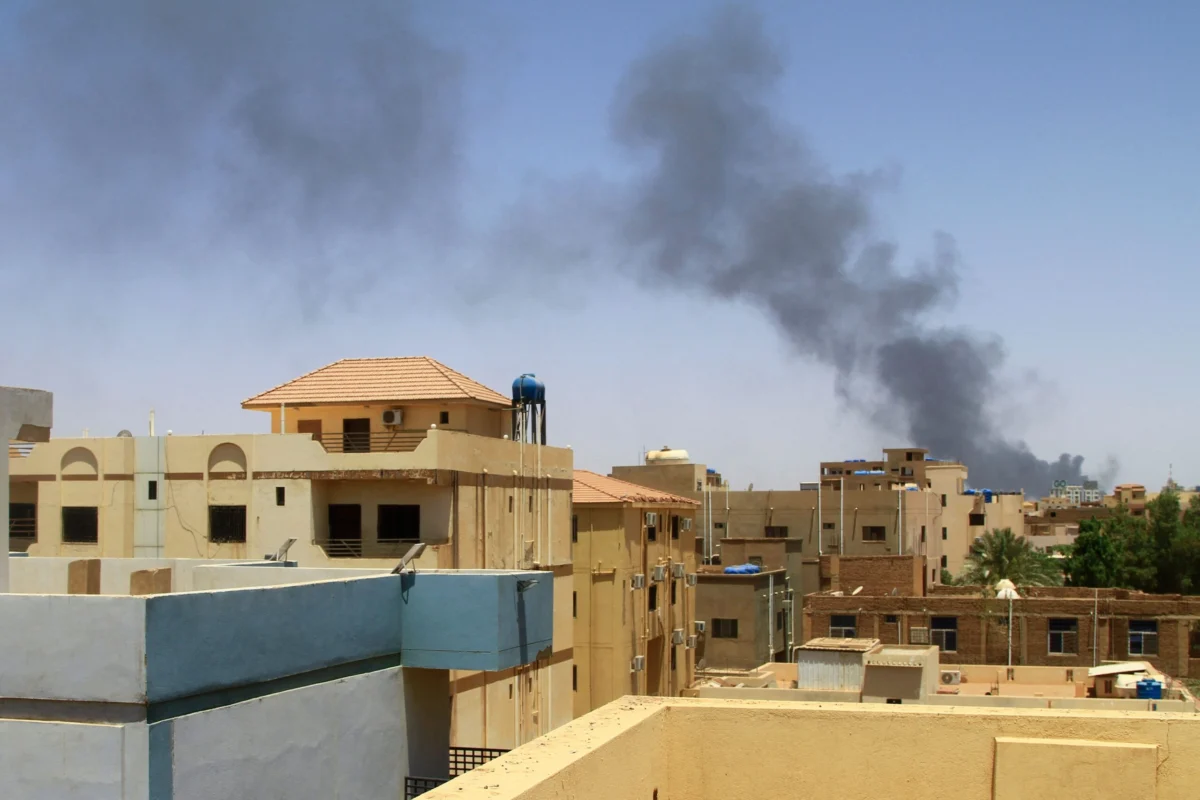
The hope for a temporary reprieve in Sudan’s intensifying civil conflict vanished on Friday as heavy gunfire and explosions continued to rock the capital city of Khartoum, despite a unilateral 72-hour ceasefire declaration by the paramilitary Rapid Support Forces (RSF). The truce, intended to coincide with the Muslim holiday of Eid al-Fitr, was positioned by the RSF as a humanitarian gesture to allow civilians to seek safety and reunite with their families after nearly a week of relentless urban warfare. However, the Sudanese Armed Forces (SAF), led by General Abdel Fattah al-Burhan, did not formally reciprocate the agreement, and witnesses on the ground reported that army troops were being deployed on foot in residential neighborhoods, signaling a shift toward more intensive street-to-street combat.
As the morning call to prayer for Eid echoed through the smoke-filled streets of Khartoum and its sister city, Bahri, the sound of heavy artillery and automatic weapons fire provided a grim accompaniment. The RSF’s statement, released early Friday morning, claimed the group was committed to a "complete ceasefire" to open humanitarian corridors. Yet, the reality for the millions trapped in the capital remains one of terror and deprivation. The lack of a unified commitment to the armistice from the military leadership has left international mediators and Sudanese civilians in a state of precarious uncertainty, as the death toll continues to climb and the country’s infrastructure teeters on the brink of total collapse.
A Chronology of the Conflict: From Tensions to Total War
The current eruption of violence did not occur in a vacuum but is the culmination of months of friction between the two most powerful men in Sudan: General Abdel Fattah al-Burhan, the commander of the Sudanese Armed Forces, and General Mohamed Hamdan Dagalo, better known as Hemedti, the leader of the RSF.
The immediate catalyst for the fighting, which began on Saturday, April 15, was a dispute over the integration of the RSF into the regular military. This integration was a key requirement of an internationally backed "Framework Agreement" designed to transition Sudan back to civilian rule. The two generals, who had jointly orchestrated a coup in October 2021 to oust a transitional civilian government, found themselves at odds over the timeline for this integration and who would hold ultimate authority over the unified force.
On the morning of April 15, the first shots were fired at the Soba military base south of Khartoum. By midday, the conflict had spread to the Presidential Palace, Khartoum International Airport, and the headquarters of the state broadcaster. Since then, the conflict has rapidly devolved into a full-scale war for control of the state, with the SAF utilizing its superior air power to strike RSF positions in densely populated urban areas, while the RSF has leveraged its mobility and experience in guerrilla tactics to embed itself within residential neighborhoods.
The Humanitarian Toll: A Nation in Crisis
The humanitarian statistics emerging from Sudan paint a devastating picture of the conflict’s impact. According to data from the World Health Organization (WHO) and the Sudanese Doctors’ Union, at least 350 people have been confirmed dead, though the actual figure is widely believed to be significantly higher as many bodies remain uncollected in the streets. Thousands more have been wounded, and the healthcare system in Khartoum is nearing a total breakdown. Reports indicate that nearly 70% of hospitals in and around the conflict zones are out of service, either due to direct shelling, a lack of medical supplies, or the inability of staff to reach the facilities.
The displacement of civilians has reached critical levels. In the western region of Darfur, a long-standing flashpoint of violence, the fighting has forced between 10,000 and 20,000 people to flee across the border into neighboring Chad. In Khartoum, a mass exodus is underway as residents take advantage of brief lulls in the shelling to flee toward safer provinces or rural villages. Those who remain are facing acute shortages of water, food, and electricity. The World Food Programme (WFP) was forced to suspend its operations in Sudan—one of its largest global programs—after three of its employees were killed in the early days of the fighting. This suspension threatens the food security of millions who were already reliant on international aid due to Sudan’s pre-existing economic crisis.
In El-Obeid, a strategic city west of the capital, the situation has become similarly dire. Local medical groups reported that at least 26 people were killed in a single day of clashes on Thursday, with widespread looting of markets and humanitarian warehouses further compounding the misery of the local population.
The Political Rivalry: Burhan vs. Hemedti
To understand the ferocity of the current fighting, one must examine the divergent backgrounds and ambitions of the two protagonists. General Burhan is a career soldier who rose through the ranks of the traditional military establishment. He represents the "old guard" of the Sudanese security apparatus, which has dominated the country’s politics for much of its post-independence history.
In contrast, Hemedti rose to power as a leader of the Janjaweed militias in Darfur during the early 2000s. His RSF was formally established as a paramilitary force to protect the regime of former autocrat Omar al-Bashir, but it eventually grew into a powerful autonomous entity with its own sources of funding, including gold mining interests and the provision of mercenary forces for regional conflicts.
The alliance between Burhan and Hemedti was always one of convenience. They cooperated to remove Bashir in 2019 following mass pro-democracy protests, and they joined forces again in 2021 to sideline civilian politicians. However, as the deadline for a transition to democracy approached, the competition for the top spot in the military hierarchy became an existential struggle. Burhan has characterized the RSF’s actions as a "power grab" and a rebellion against the state, while Hemedti has framed his struggle as a defense of the revolution against "remnants of the old regime" and a "criminal" military leadership.
Geopolitical Stakes and Regional Stability
The conflict in Sudan is not merely an internal affair; it has the potential to destabilize the wider Horn of Africa and the Sahel region. Sudan shares borders with seven countries—Egypt, Libya, Chad, the Central African Republic, South Sudan, Ethiopia, and Eritrea—many of which are already grappling with their own internal instabilities.
Egypt has long-standing ties with the Sudanese military and views a stable, army-led Sudan as essential for its own national security, particularly regarding the management of the Nile waters. On the other side, regional actors have historically maintained various levels of contact with Hemedti, given his influence in Darfur and his involvement in regional security issues.
The involvement of global powers further complicates the landscape. Russia, through the Wagner Group, has been active in Sudan’s gold mining sector and has sought to establish a naval base on the Red Sea. Meanwhile, the United States and its Western allies have invested heavily in the transition to a civilian government, seeing it as a way to bring Sudan out of decades of international isolation. A protracted civil war could turn Sudan into a new theater for "great power competition," making a negotiated settlement even more difficult to achieve.
International Response and the Path Forward
The international community has been swift to condemn the violence, but its influence on the ground remains limited. United Nations Secretary-General Antonio Guterres, following a virtual meeting with the heads of the African Union and the Arab League, issued an urgent appeal for a ceasefire. "There was a strong consensus on condemning ongoing fighting in Sudan and calling for cessation of hostilities as an immediate priority," Guterres stated, emphasizing that trapped civilians must be allowed to reach medical treatment and essential supplies.
The United States, the European Union, and several Arab nations have also been engaged in intensive "phone diplomacy," speaking directly with both Burhan and Hemedti. However, both leaders have remained defiant. In a recent interview with Al Jazeera, General Burhan stated he saw "no other option but the military solution," while Hemedti dismissed the possibility of negotiations with Burhan, calling him a criminal who must be brought to justice.
Analysis: The Threat of a Failed State
The current trajectory of the conflict suggests that Sudan is at risk of descending into a prolonged period of state fragmentation. If neither side can achieve a decisive military victory in the coming weeks, the fighting may evolve into a war of attrition, with different factions controlling different regions of the country. Such a scenario would likely see the return of ethnic-based violence, particularly in Darfur and the Blue Nile regions, where local militias could align themselves with either the SAF or the RSF based on tribal loyalties.
The failure of the Eid ceasefire is a sobering reminder of the lack of trust between the warring parties. For the transition to democracy to be revived, there must first be a recognition that a "military solution" is a path toward national ruin. As long as the two generals prioritize their personal survival and institutional dominance over the welfare of the Sudanese people, the prospect of a peaceful, civilian-led Sudan remains a distant and fading hope. For now, the citizens of Khartoum and beyond remain caught in the crossfire, waiting for a peace that—despite the arrival of the holy holiday—seems nowhere in sight.
