

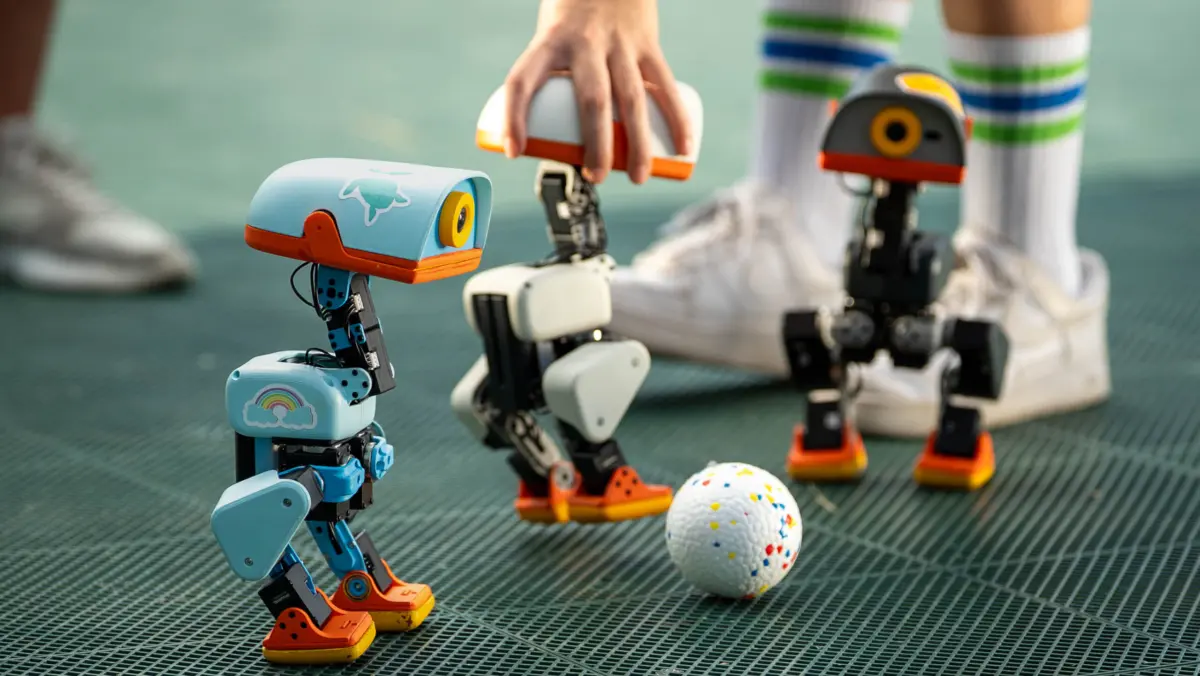
The global robotics market witnessed a significant shift this week as Nvidia Corporation’s latest consumer-facing venture, the Microduck, captured the public’s imagination following a high-profile demonstration at the GTC Berlin conference. During a keynote address that has since gone viral across social media platforms, Nvidia CEO Jensen Huang shared the stage with a flock of the small, waddling autonomous robots. The demonstration, which featured the machines performing a variety of tasks including sitting, "napping" on command, and performing somersaults, triggered an immediate commercial response. According to data shared by Hugging Face CEO Clement Delangue, preorders for the Microduck exceeded 20,000 units within twenty-four hours of the presentation, signaling a potential breakthrough for open-source robotics in the consumer sector.
The Microduck represents the culmination of a rapid series of strategic acquisitions and technical integrations within the artificial intelligence and robotics industries. The hardware was originally developed by Pollen Robotics, a French startup known for its emphasis on open-source humanoid and expressive robotics. Pollen Robotics was acquired by the AI platform Hugging Face in early 2025, which was subsequently absorbed by Nvidia in a landmark multi-billion-dollar deal in September 2026. This lineage has positioned the Microduck not merely as a toy, but as a sophisticated entry point into the world of embodied AI, leveraging Nvidia’s vast computational resources and Hugging Face’s extensive community of developers.
Technical Specifications and the Isaac Tech Stack
At the core of the Microduck’s functionality is Nvidia’s advanced technology stack, specifically designed to bridge the gap between digital simulation and physical reality. Unlike traditional consumer robots that rely on hard-coded movements, the Microducks were trained using reinforcement learning within Nvidia’s Isaac Sim environment. This "sim-to-real" pipeline allowed the robots to undergo thousands of hours of training in a virtual space, learning to navigate various terrains, maintain balance, and respond to auditory cues before the first physical prototype was even manufactured.
The robots are equipped with a suite of sensors that enable them to interact with their environment in real-time. They utilize high-fidelity microphones for voice command recognition and small-scale actuators that facilitate their signature waddling gait. One of the most distinctive features noted during the GTC Berlin demonstration was the robot’s "personality" programming, which includes a library of chirps and mechanical sounds reminiscent of the iconic R2-D2 character from the Star Wars franchise. These sounds are not merely aesthetic; they provide feedback to the user regarding the robot’s internal state and command acknowledgment.
Because the platform is open source, the Microduck is designed to be extensible. While the units ship with a standard set of "tricks"—including walking, standing, and rolling over—Pollen Robotics has emphasized that the community will be the primary driver of the robot’s long-term utility. Owners are encouraged to develop their own behavioral models and share them via Hugging Face’s repository, effectively creating a decentralized marketplace of robotic capabilities.
Strategic Chronology: From Startup to Nvidia Flagship
The journey of the Microduck to the global stage is a testament to the accelerating pace of consolidation in the AI hardware space. The timeline of development reflects a shift from experimental laboratory work to mass-market commercialization:
- Early 2024: Pollen Robotics gains international attention with "Reachy," an open-source humanoid robot designed for research and service industries.
- February 2025: Hugging Face, the leading platform for open-source AI models, acquires Pollen Robotics to establish a hardware division. The move is seen as an attempt to provide a physical "body" for the large language models (LLMs) hosted on its platform.
- August 2026: Hugging Face releases the Reachy Mini, a $399 open-source duck-inspired robot that serves as the technical precursor to the Microduck.
- September 2026: In a move that reshapes the AI landscape, Nvidia acquires Hugging Face. The acquisition grants Nvidia direct access to the world’s largest community of AI developers and a ready-made consumer robotics pipeline.
- October 2026: Jensen Huang debuts the refined Microduck at GTC Berlin, emphasizing its role in the "Embodied AI" revolution.
This trajectory highlights Nvidia’s transition from a provider of the "shovels" of the AI gold rush—namely GPUs—to a direct competitor in the consumer electronics and robotics markets. By controlling both the silicon and the end-user hardware, Nvidia is attempting to create a vertical ecosystem similar to that of Apple, but built on the foundations of open-source software.
Market Analysis and Consumer Demographic
The immediate success of the Microduck preorder campaign suggests a broader demographic appeal than typical educational or hobbyist robots. While many high-tech toys are marketed strictly toward children or STEM education programs, Pollen Robotics’ promotional materials have deliberately targeted adults. The Microduck is being positioned as a "desk companion" or a "digital pet" for the remote-work era, tapping into a market previously occupied by devices like Sony’s Aibo or the ill-fated Anki Vector.
Market analysts suggest that the $399 price point—inherited from the Reachy Mini—combined with the backing of the Nvidia brand, has lowered the barrier to entry for casual consumers. "We are seeing a shift where robots are no longer viewed as industrial tools or complex kits for engineers," noted one industry analyst following the GTC keynote. "The Microduck is being sold as a finished, polished product that happens to have an infinite ceiling for customization. That is a very powerful marketing proposition."
The timing of the release is also a critical factor in its commercial performance. With delivery expected in December 2026, the Microduck is positioned to be the "must-have" technology gift for the holiday season. The 20,000-unit preorder figure is particularly impressive given that it represents only the first 24 hours of availability; industry insiders suggest that production capacity may be the only limiting factor for sales heading into 2027.
Official Responses and Industry Context
The reaction from the AI community has been largely positive, though it comes at a tumultuous time for the industry. Clement Delangue, in his announcement regarding the preorder numbers, framed the Microduck as a success for the open-source movement. By making the hardware and software accessible, Nvidia and Hugging Face are inviting a level of transparency and collaborative development that is often absent in the proprietary world of consumer tech.
However, the launch occurs against a backdrop of heightened concern regarding the role of AI in global cybersecurity. Earlier this week, a series of sophisticated cyberattacks were attributed to vulnerabilities in AI-driven systems, leading to a "black eye" for the industry as a whole. Many observers noted that the Microduck served as a necessary "palate cleanser" for the sector. The sight of a billionaire CEO playing with small, chirping robots provided a humanizing counter-narrative to the more ominous discussions regarding autonomous agents and digital warfare.
In a statement following the keynote, a spokesperson for Nvidia remarked, "The Microduck is about bringing the power of the Isaac platform into people’s homes in a way that is joyful and accessible. We want to show that AI isn’t just about data centers and code; it’s about physical presence and interaction."
Implications for the Future of Embodied AI
The success of the Microduck is likely to accelerate the development of "Embodied AI"—the field of artificial intelligence focused on agents that can interact with the physical world. For years, AI development was confined to screens and text boxes. The Microduck represents a mass-market experiment in how humans will coexist with autonomous physical entities in their private spaces.
From a technical standpoint, the data gathered from thousands of Microducks operating in diverse home environments will provide an invaluable feedback loop for Nvidia. As users train their robots to perform new tricks and share those models, the collective intelligence of the Microduck fleet will grow exponentially. This "crowdsourced" training could eventually be applied to more complex robotic systems, such as household assistants or medical robots.
Furthermore, the open-source nature of the project ensures that the Microduck will remain relevant long after the initial novelty wears off. Unlike proprietary robots that become obsolete once the manufacturer stops supporting the servers, the Microduck’s software can be maintained and improved by the community indefinitely. This model may set a new standard for consumer electronics, where longevity is tied to community engagement rather than planned obsolescence.
As the AI industry continues to navigate the complexities of ethics, security, and regulation, the Microduck stands as a reminder of the technology’s potential for simple, harmless utility. Whether it remains a niche success for enthusiasts or becomes a ubiquitous household staple, its debut at GTC Berlin marks a clear turning point in the commercialization of robotics. For now, with 20,000 units already claimed, the world is preparing to welcome a new, waddling addition to the digital landscape.
