

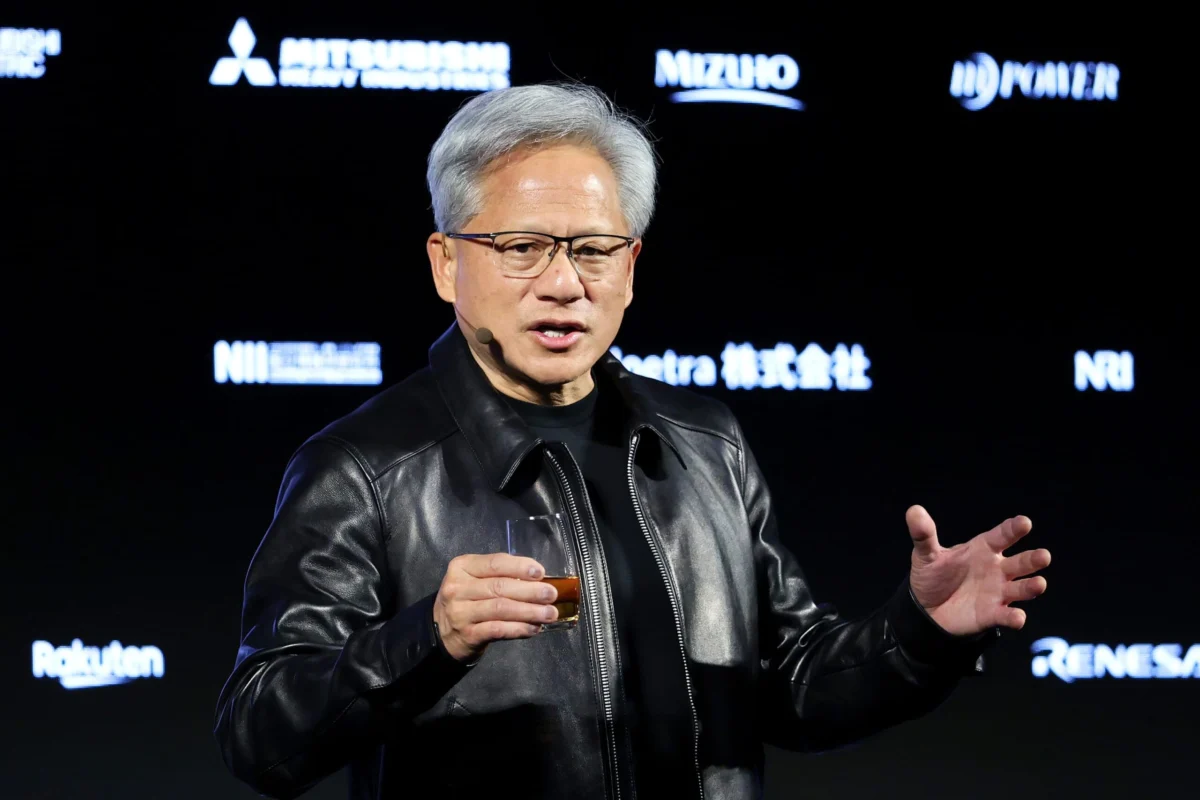
Nvidia Corp. has significantly expanded its strategic footprint in East Asia with the unveiling of Cosmos 3 Edge, a sophisticated artificial intelligence model specifically engineered for robotics and autonomous vision agents, marking a pivotal moment in the company’s long-term commitment to the Japanese market. During a high-profile two-day visit to Tokyo in July 2026, Nvidia Chief Executive Officer Jensen Huang detailed a comprehensive roadmap for "Physical AI," a domain where digital intelligence intersects with the mechanical world to automate complex industrial tasks. This initiative is underpinned by a new coalition of Japanese industrial titans, including Fujitsu, Hitachi, and Kawasaki Heavy Industries, all of which aim to integrate Nvidia’s latest world models into their manufacturing and logistics pipelines. The announcement signals a shift in the AI landscape from purely generative text and image models toward systems capable of understanding and navigating the three-dimensional physical world in real-time.
The introduction of Cosmos 3 Edge represents a technological evolution from the original Cosmos 3 framework launched in May 2026. Unlike traditional large language models (LLMs) that process and predict sequences of text, Cosmos 3 Edge is categorized as a "world model." These systems are designed to ingest a much broader array of sensory inputs, including high-resolution video, LiDAR data, and spatial telemetry, allowing them to internalize the laws of physics. By understanding concepts such as gravity, friction, and object permanence, robots equipped with Cosmos 3 Edge can operate with a level of autonomy and safety previously unattainable in unstructured environments. This capability is particularly critical for the next generation of humanoid robots and autonomous mobile robots (AMRs) that are expected to populate Japanese factory floors and healthcare facilities over the coming decade.
During a reception for the "Japan AI Ecosystem" in Tokyo, Jensen Huang emphasized that Japan is uniquely positioned to lead this new era of intelligent industry. Huang noted that the nation which pioneered modern high-precision manufacturing is now at the threshold of a "once-in-a-generation opportunity" to reinvent production through AI. The CEO’s vision for Physical AI involves moving beyond the "chatbot" phase of artificial intelligence and into the "robotic" phase, where AI systems can perform physical labor, conduct intricate repairs, and manage complex supply chains with minimal human intervention. To facilitate this, Nvidia is providing the foundational software and hardware—ranging from Blackwell-architecture GPUs to the specialized Cosmos models—that allow local firms to build bespoke autonomous solutions.
A Chronology of Strategic Investment in Japan
The current expansion is the culmination of a multi-year effort by Nvidia to entrench itself within the Japanese technological landscape. While the July 2026 visit highlights the launch of Cosmos 3 Edge, the groundwork was laid years prior. In 2023, Nvidia first announced its collaboration with Mitsui subsidiary Xeureka to launch Tokyo-1, a generative AI supercomputer dedicated to the pharmaceutical industry. By early 2024, Nvidia had already begun deepening its ties with the Japanese government, which has been vocal about its desire to achieve "AI sovereignty" to reduce dependence on foreign cloud infrastructure.
The timeline of AI development in Japan has seen a massive influx of capital from other U.S. tech giants as well. In 2024 and 2025, Microsoft committed over $10 billion to expand its data center footprint and cybersecurity capabilities within the country. This was followed by significant moves from SoftBank Group, whose founder Masayoshi Son has pivoted the conglomerate’s entire strategy toward artificial intelligence. SoftBank’s collaboration with Microsoft and Sakura Internet to build domestic AI infrastructure created a competitive yet complementary environment for Nvidia. While Microsoft provides the cloud scale and SoftBank provides the investment and telecommunications backbone, Nvidia has positioned itself as the provider of the "intelligence engine" through its specialized chips and domain-specific models like Cosmos and BioNeMo.
Strengthening the Industrial and Manufacturing Coalition
The newly formed coalition between Nvidia and Japanese industrial leaders represents a formalization of "Agentic AI" in the manufacturing sector. Fujitsu and Hitachi, both long-standing pillars of Japanese engineering, are expected to utilize Cosmos 3 Edge to enhance their digital twin technologies. Digital twins are virtual replicas of physical assets that allow companies to simulate scenarios and optimize performance before implementing changes in the real world. By integrating world models, these digital twins become dynamic environments where AI agents can "practice" tasks in a simulated space that perfectly mimics the physics of the actual factory.
Kawasaki Heavy Industries, a global leader in robotics, is perhaps the most prominent partner in the robotics push. The collaboration aims to create robots that do not require rigid programming for every individual movement. Instead, by utilizing the Cosmos 3 Edge model, Kawasaki’s robots can be given high-level instructions—such as "assemble this component"—and the AI will determine the most efficient and safe physical path to complete the task. This flexibility is essential for "high-mix, low-volume" manufacturing, where production lines must be frequently reconfigured to meet changing market demands.
Advancements in Biotech and Healthcare Through Agentic AI
Nvidia’s expansion in Japan extends far beyond the factory floor and into the laboratory. The company is aggressively scaling its presence in the healthcare and biotechnology sectors, leveraging Japan’s world-class pharmaceutical industry. Central to this effort is the expansion of the Tokyo-1 consortium. Powered by the Nvidia BioNeMo Agent Toolkit, Tokyo-1 serves as a massive specialized supercomputing resource where researchers can use generative AI to discover new drug candidates and simulate molecular interactions.
Major Japanese pharmaceutical companies, including Astellas Pharma Inc., Daiichi Sankyo, and Ono Pharmaceutical, have already integrated these tools into their research and development workflows. The BioNeMo platform allows these firms to bypass years of traditional "wet lab" testing by using AI to predict how different chemical compounds will behave in the human body. Furthermore, Nvidia is exploring the use of Cosmos 3 Edge in medical robotics, aiming to assist in minimally invasive surgeries and automated diagnostic imaging. The goal is to create "Agentic AI" for the advanced sciences—systems that do not just provide data to scientists but actively suggest hypotheses and design experiments.
Economic Data and Market Outlook
The strategic importance of Japan to Nvidia is underscored by the country’s projected market growth. According to data from the International Trade Administration, Japan’s AI market is on a trajectory to reach approximately $27.9 billion by 2029. This growth is fueled by a combination of government subsidies for semiconductor production and a cultural readiness to adopt robotic solutions. Unlike some Western markets where there is significant public anxiety regarding AI replacing human workers, Japan views AI and robotics as a necessary solution to its demographic crisis. With a shrinking workforce and an aging population, the automation of physical labor is seen as a matter of national economic survival.
Ajay Rajadhyaksha, global chairman of research at Barclays, recently noted that Japan holds a distinct advantage in the Asian theater due to its "clean structural growth story." While other regional economies face geopolitical complexities, Japan’s stable regulatory environment and its aggressive push for digital transformation make it an ideal partner for Silicon Valley firms. The Japanese government’s active promotion of international partnerships has created a "flywheel effect," where foreign investment leads to domestic innovation, which in turn attracts more global talent and capital.
Broader Implications and the Future of Physical AI
The move by Nvidia to launch Cosmos 3 Edge specifically in Tokyo highlights a broader trend in the technology sector: the localization of AI. As nations become more protective of their data and industrial secrets, the era of "one-size-fits-all" global AI models is giving way to specialized models tailored to specific regional industries. By embedding its technology within the core of Japan’s manufacturing and biotech sectors, Nvidia is ensuring that its ecosystem becomes the standard for the next generation of industrial hardware.
The implications for the global supply chain are profound. If Japan succeeds in "reinventing manufacturing for the age of intelligent industries," as Jensen Huang suggests, it could set a global benchmark for efficiency. The integration of world models into robotics could lead to a significant reduction in production costs and a dramatic increase in the speed of innovation. However, this transition also requires a massive upgrading of digital infrastructure. The partnerships with Microsoft and SoftBank to build the necessary data centers and high-speed networks are essential prerequisites for the Physical AI revolution.
In conclusion, Nvidia’s latest maneuvers in Japan represent a sophisticated blend of technological innovation and strategic diplomacy. By providing the tools for "Physical AI" through Cosmos 3 Edge and fostering deep ties with both the industrial and pharmaceutical sectors, Nvidia is positioning itself as an indispensable partner in Japan’s future economy. As the boundary between the digital and physical worlds continues to blur, the collaboration between Silicon Valley’s computational power and Japan’s industrial expertise may well define the next decade of global technological progress.
