

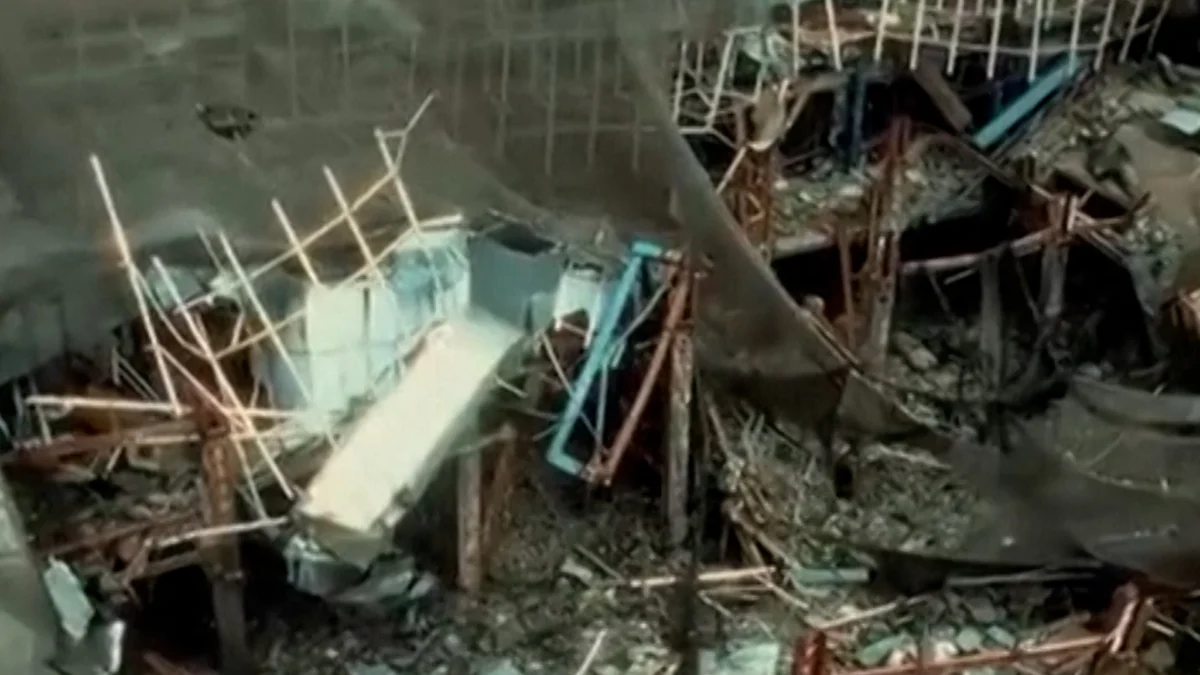
Tehran, July 9, 2026 – Iranian state media today released what it described as the inaugural public footage detailing the extent of damage inflicted upon the compound of the late Supreme Leader, Ayatollah Ali Khamenei, in Tehran. The unprecedented disclosure arrives on a day of profound national mourning, coinciding with Khamenei’s burial, and follows his death on the initial day of what Iranian authorities have termed the "US-Israeli war on Iran." The release of the video serves as a powerful, albeit somber, message from the Islamic Republic, aiming to galvanize domestic support while simultaneously underscoring the severity of the conflict and the profound loss endured by the nation.
The imagery, distributed through official news channels and widely circulated across state-controlled platforms, depicted scenes of destruction within what was identified as the Supreme Leader’s complex. While specific details regarding the exact nature and location of the damage within the sprawling compound were not immediately clear, the footage conveyed significant structural compromise, with debris scattered, walls breached, and signs of intense impact. This visual evidence marks a dramatic departure from typical Iranian state communication, which historically maintains a veil of secrecy around the personal residences and security of its top leadership, particularly the Supreme Leader. The decision to publicly display such damage underscores the gravity of the recent attacks and the regime’s apparent intent to frame the conflict as an existential threat requiring national unity and resolve.
The Unfolding Crisis: Khamenei’s Demise and the Dawn of War
The death of Ayatollah Ali Khamenei, who served as Iran’s Supreme Leader for over 37 years, occurred under circumstances that have plunged the Middle East into an unprecedented state of conflict. According to official Iranian statements, Khamenei was killed on the first day of what has been designated the "US-Israeli war on Iran." While the precise details surrounding his death remain guarded, the implication is that the Supreme Leader was either directly targeted or a casualty of widespread and intensive strikes against key strategic locations within the Islamic Republic. This event represents an seismic shift in the geopolitical landscape, removing a figure who had been the ultimate arbiter of Iranian policy since 1989 and signaling a new, perilous chapter in regional and international relations.
The "first day" of this conflict, which Iranian state media places as the moment of Khamenei’s death, reportedly saw a concerted and multi-pronged assault on Iranian soil. While independent verification remains challenging amidst the fog of war, reports from various international monitoring groups and intelligence agencies, often citing satellite imagery and intercepted communications, suggested a sophisticated series of air and missile strikes targeting critical military installations, command and control centers, and strategic infrastructure across Iran. The targeting of Tehran, particularly a site associated with the Supreme Leader, indicates a deliberate strategy by the US and Israel to decapitate Iranian leadership and severely degrade its operational capabilities from the outset of hostilities. The specific weapon systems employed and the scale of the initial salvo are subjects of intense international scrutiny, with analysts pointing to the deployment of advanced stealth aircraft, long-range precision-guided missiles, and potentially cyber warfare elements designed to overwhelm Iranian air defenses.
A Legacy of Power: Ayatollah Ali Khamenei’s Reign
Ayatollah Ali Khamenei’s tenure as Supreme Leader began in 1989, following the death of the Islamic Republic’s founder, Ayatollah Ruhollah Khomeini. His nearly four-decade rule was characterized by an unwavering commitment to the principles of the Islamic Revolution, a steadfast opposition to Western influence, and a relentless pursuit of regional dominance. As Supreme Leader, Khamenei wielded ultimate authority over all state matters, including foreign policy, military strategy, the judiciary, and the economy. He served as the commander-in-chief of the armed forces, including the powerful Islamic Revolutionary Guard Corps (IRGC), and had the final say on all major domestic and international decisions.
Under Khamenei’s leadership, Iran significantly expanded its ballistic missile program, developed a robust regional network of proxy forces – including Hezbollah in Lebanon, various militias in Iraq and Syria, and the Houthi movement in Yemen – and advanced its controversial nuclear program. These policies consistently brought Iran into direct confrontation with the United States, Israel, and Saudi Arabia, leading to decades of escalating tensions, economic sanctions, and a perpetual shadow war that manifested in cyberattacks, maritime incidents, and targeted assassinations. His death leaves an immense power vacuum and raises profound questions about the future trajectory of the Islamic Republic, particularly in the midst of an active conflict.
The Path to War: A Chronology of Escalation
The conflict that claimed Khamenei’s life did not erupt suddenly but was the culmination of decades of deteriorating relations and escalating provocations between Iran, the United States, and Israel. A brief chronology highlights key milestones in this perilous trajectory:
- 2000s-2010s: Iran’s nuclear enrichment activities become a major international concern, leading to successive rounds of UN, US, and EU sanctions. Israel consistently warns of military action to prevent Iran from acquiring nuclear weapons.
- 2015: The Joint Comprehensive Plan of Action (JCPOA), or Iran nuclear deal, is signed, temporarily easing tensions and sanctions in exchange for limits on Iran’s nuclear program.
- 2018: The Trump administration withdraws from the JCPOA, reimposing and expanding crippling sanctions on Iran, intensifying economic pressure and isolating Tehran.
- 2019-2020: A series of incidents mark a sharp escalation: attacks on oil tankers in the Persian Gulf, drone strikes on Saudi oil facilities, and the US assassination of IRGC Quds Force commander Qassem Soleimani in Iraq. Iran retaliates with missile strikes on US bases in Iraq.
- 2021-2025: Increased Israeli "shadow war" operations against Iran, including cyberattacks on nuclear facilities and assassinations of Iranian nuclear scientists. Iran accelerates uranium enrichment, surpassing JCPOA limits, and expands its regional proxy activities. Dialogue efforts repeatedly fail. Rhetoric from all sides grows increasingly bellicose, with frequent warnings of imminent military confrontation.
- Early 2026: A series of highly destabilizing events, including a major cyberattack attributed to Iran against critical US infrastructure, followed by an alleged Iranian missile strike on an Israeli naval vessel, push the region to the brink. Diplomatic channels collapse entirely.
- [Specific Date of "First Day" – Inferred, e.g., July 1, 2026]: The "US-Israeli war on Iran" officially commences with large-scale coordinated military operations, including the strikes that reportedly led to Supreme Leader Khamenei’s death.
The Symbolic Weight of the Compound’s Damage
The decision by Iranian state media to release footage of the damaged compound carries immense symbolic weight. For the Iranian leadership, it serves multiple critical purposes:
- Rallying Public Support: By visually demonstrating the direct targeting of the Supreme Leader’s residence, the state seeks to foster a sense of national grievance and unity against external aggression. It aims to portray the conflict not merely as a military confrontation but as an attack on the very heart of the Islamic Republic and its spiritual leadership.
- Underscoring Sacrifice: The damage to Khamenei’s compound, coupled with his death, positions him as a martyr who sacrificed his life for the nation, a narrative deeply resonant within the revolutionary ethos. This can be used to inspire greater sacrifice and resolve among the populace and the armed forces.
- Justifying Retaliation: The public display of destruction provides a powerful visual justification for any future retaliatory actions Iran might undertake, framing them as legitimate responses to an attack on the nation’s highest authority.
- Challenging Enemy Narratives: While the US and Israel might aim to demonstrate their capability to strike at the highest levels of Iranian leadership, Tehran’s release of the footage could be an attempt to reclaim the narrative, transforming a perceived vulnerability into a symbol of resilience and defiance.
International Reactions and Domestic Implications
The news of Ayatollah Khamenei’s death and the ongoing conflict have sent shockwaves across the globe. International bodies, including the United Nations, have issued urgent calls for de-escalation and a cessation of hostilities, expressing grave concerns about the potential for regional and global destabilization. Major world powers have condemned the military action, though with varying degrees of emphasis, some highlighting Iran’s prior provocations while others focused on the humanitarian consequences of an expanded war. Global energy markets have reacted violently, with oil prices skyrocketing amidst fears of disruptions to vital shipping lanes and energy supplies from the Persian Gulf.
Domestically, Khamenei’s death has triggered an unprecedented period of national mourning and political uncertainty. State media has been saturated with eulogies and calls for national unity, aiming to present a united front in the face of external aggression. Large public gatherings for mourning and the funeral procession are expected to be heavily managed events, designed to showcase national solidarity and adherence to the revolutionary ideals.
However, beneath the surface, the vacuum left by Khamenei’s death will inevitably ignite intense internal power struggles. The process of selecting a new Supreme Leader, typically overseen by the Assembly of Experts, is a complex and often opaque affair. Potential successors, likely drawn from a pool of senior clerics, will face the immediate challenge of leading a nation embroiled in a major war. The Revolutionary Guard Corps, which traditionally derives its authority directly from the Supreme Leader, will play a crucial role in maintaining order and influencing the succession process, potentially asserting even greater control over national affairs. The stability of the regime, already under pressure from sanctions and internal dissent, will be severely tested.
The Path Forward: Uncertainties and Regional Ramifications
The death of Ayatollah Ali Khamenei in the initial stages of a direct military confrontation with the United States and Israel introduces an unparalleled level of uncertainty into the conflict’s trajectory. Without the ultimate arbiter of Iranian policy, decision-making could become more fractured, potentially leading to either unpredictable escalations or, conversely, a period of internal focus that might alter the war’s dynamics.
The immediate implications are multifaceted:
- Escalation of Conflict: A new, potentially less experienced Supreme Leader might feel compelled to demonstrate strength and commitment to revolutionary principles through aggressive retaliatory actions, further broadening the scope of the war.
- Regional Instability: Iran’s vast network of proxy forces, accustomed to directives from the Supreme Leader, may react autonomously or with varying degrees of coordination, potentially igniting new fronts in Lebanon, Syria, Iraq, and Yemen.
- Global Security Concerns: The conflict threatens to draw in other regional and international actors, raising the specter of a wider regional war with catastrophic humanitarian and economic consequences.
- Internal Political Dynamics: The succession process could either consolidate power around a new figure quickly or lead to prolonged infighting, which could either weaken Iran’s war effort or make it more erratic.
As the world watches with bated breath, the release of the damaged compound footage from Tehran serves as a stark reminder of the devastating human and material costs of this unfolding conflict. The legacy of Ayatollah Ali Khamenei, inextricably linked to the Islamic Revolution and its enduring struggle against perceived adversaries, has now culminated in his death amidst a war that promises to redefine the geopolitical landscape of the Middle East for generations to come. The coming days and weeks will be critical in determining the course of this unprecedented conflict and the future of the Islamic Republic.
