

Inside the cavernous, gleaming corridors of 11 Skies, a massive retail and office complex situated adjacent to the Hong Kong International Airport (HKIA), the silence is palpable. Despite its architectural grandeur and its position as a cornerstone of the city’s ambitious "SkyCity" development, the 3.8 million-square-foot facility currently stands as a stark symbol of the challenges facing Hong Kong’s post-pandemic economic recovery. A recent inspection of the site revealed a landscape of shuttered storefronts and cordoned-off zones, where all 800 planned retail outlets remain vacant and only two out of 120 designated food and beverage spaces are currently operational.
The development, which is roughly equivalent in size to 53 standard football pitches, was originally slated to begin full operations by late 2023. However, visitors navigating the complex today find an environment described by many as eerie. The few individuals present are typically transit travelers wheeling luggage toward the nearby Regala Skycity Hotel or office workers from the K11 ATELIER towers seeking one of the few open coffee shops. Large sections of the interior are obscured by hoardings decorated with vibrant advertisements for "Skytopia"—the overarching brand for the airport’s integrated megaproject—contrasting sharply with the empty, dimly lit halls they conceal.
Strategic Reconfiguration and Management Shift
In a significant shift in the project’s trajectory, the Airport Authority Hong Kong (AAHK) has taken over the direct management of 11 Skies from the original developer, New World Development. This transition marks a pivot in strategy as the Authority seeks to salvage the commercial viability of the space. Recognizing that the traditional retail model may no longer suffice in a shifting economic landscape, the AAHK is currently spearheading a comprehensive reconfiguration of the retail floor plans.
The new mandate focuses on transforming the vacant spaces into specialized dining and immersive entertainment venues. This pivot is a response to evolving consumer behaviors, particularly among travelers from mainland China and the surrounding region, who are increasingly prioritizing "experience-based" consumption over traditional luxury shopping. The AAHK now estimates that the most opportune window for a full-scale opening of the reconfigured 11 Skies will not arrive until 2028 or beyond. This revised timeline suggests a five-year delay from the original projections, highlighting the depth of the logistical and market-driven hurdles the project faces.
The Broader Context: The HK$141.5 Billion Three-Runway System
The stagnation of 11 Skies occurs against the backdrop of the Hong Kong International Airport’s massive HK$141.5 billion (US$18 billion) Three-Runway System (3RS) project. This infrastructure undertaking is one of the largest in the city’s history, designed to expand the airport’s capacity to handle 120 million passengers and 10 million tonnes of cargo annually. The 3RS includes the reclamation of 650 hectares of land, the construction of a new 3,800-meter runway, the expansion of Terminal 2, and the installation of a new automated people mover and baggage handling system.
While the third runway itself was commissioned in late 2022, the full integration of the system remains a work in progress. The success of the 3RS is intrinsically linked to the commercial success of SkyCity and 11 Skies, which were intended to serve as the "front door" for visitors entering the Greater Bay Area via Hong Kong. The current vacancy rates at 11 Skies represent a significant gap in the projected revenue streams needed to justify the immense capital expenditure of the airport expansion.
Reopening of Terminal 2: A Strategic Milestone
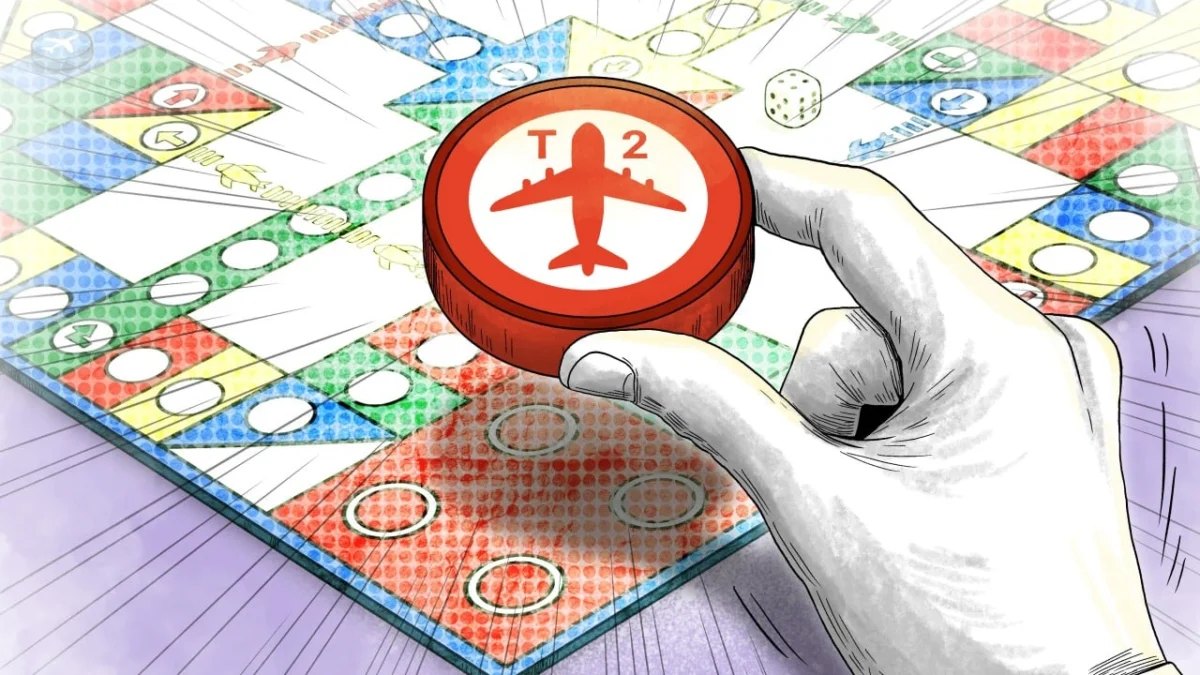
In an effort to regain momentum and reinforce Hong Kong’s status as a global aviation hub, the Airport Authority is scheduled to reopen the expanded Terminal 2 on Wednesday. This reopening is viewed as a critical step in the phased activation of the 3RS. The expanded terminal will provide enhanced check-in, security, and immigration facilities, aimed at streamlining the passenger experience and increasing the airport’s overall throughput.
Lawmaker Mark Chong Ho-fung has characterized the reopening of Terminal 2 as a "shot in the arm" for Hong Kong’s aviation sector. According to Chong, the terminal’s upgraded infrastructure will help the city maintain its competitive edge even as it navigates a "perfect storm" of external pressures. These pressures include the ongoing volatility in the Middle East, which has disrupted global flight paths and fuel prices, and the intensifying competition from regional rivals.
Regional Competition and Market Headwinds
The delay in the 11 Skies project comes at a time when Hong Kong is facing unprecedented competition from other major aviation hubs in Asia. Singapore’s Changi Airport, with its "Jewel" complex, has already set a high global benchmark for integrating retail, nature, and entertainment within an airport environment. Simultaneously, mainland Chinese airports in the Greater Bay Area, such as Guangzhou Baiyun and Shenzhen Bao’an, have rapidly expanded their international networks and improved their infrastructure, potentially siphoning off transit traffic that once relied exclusively on Hong Kong.
Furthermore, the changing travel patterns of mainland Chinese tourists—historically the primary drivers of Hong Kong’s retail sector—present a long-term challenge. Recent data suggests that these visitors are spending less on high-end retail goods in Hong Kong, opting instead for domestic duty-free destinations like Hainan or focusing their budgets on unique cultural and culinary experiences. The decision by the AAHK to reconfigure 11 Skies toward entertainment and dining is a direct acknowledgement of this "new normal" in tourism economics.
A Timeline of Development and Delays
To understand the current state of 11 Skies, it is essential to look at the project’s chronological progression:
- 2018: The Airport Authority awards the tender for the SkyCity development to New World Development, envisioning a world-class destination for retail, dining, and entertainment.
- 2020-2022: Construction continues through the COVID-19 pandemic, though global travel restrictions severely hamper the outlook for the project.
- July 2022: The first phase of the project, the K11 ATELIER office towers, officially opens, hosting tenants in the wealth management and healthcare sectors.
- Late 2022: The third runway of the 3RS is officially commissioned for flight operations.
- 2023: The original target date for the opening of the 11 Skies retail and entertainment components passes with the complex remaining largely empty.
- Late 2024: The Airport Authority takes over management and announces a strategic pivot, pushing the full opening of the retail/dining sectors to 2028.
- November 2024: Reopening of Terminal 2 to facilitate increased passenger traffic.
Economic Implications and Future Outlook
The financial implications of the 11 Skies delay are multi-faceted. For the Airport Authority, the lack of rental income from 800 shops represents a significant budgetary shortfall. For the city of Hong Kong, the "empty" complex serves as a visual reminder of the slow pace of economic revitalization in certain sectors. However, some analysts argue that the 2028 timeline may be a realistic, albeit painful, adjustment. By 2028, the global aviation industry is expected to have fully stabilized, and the infrastructure of the Three-Runway System will be operating at peak efficiency.
The AAHK’s strategy to wait for a more "opportune time" suggests a focus on long-term sustainability over short-term optics. By reconfiguring the space now, they aim to ensure that when 11 Skies finally opens, its offerings are aligned with the demands of the 2030s rather than the outdated retail trends of the 2010s.
The success of this gamble hinges on several factors: the continued recovery of global air travel, the successful integration of the Greater Bay Area’s transport links (including the Hong Kong-Zhuhai-Macau Bridge), and Hong Kong’s ability to redefine itself as more than just a shopping destination. While the corridors of 11 Skies may be eerie today, the reopening of Terminal 2 provides a glimmer of hope that the airport’s grand vision remains on track, even if the destination has been pushed further into the horizon.
As the city watches the "Skytopia" project unfold, the focus remains on whether these massive investments in physical infrastructure can successfully translate into a renewed economic vibrancy for the "Oriental Pearl." For now, the empty shops of 11 Skies stand as a testament to the volatility of the modern global economy and the complex task of building a future-proof aviation hub.
