

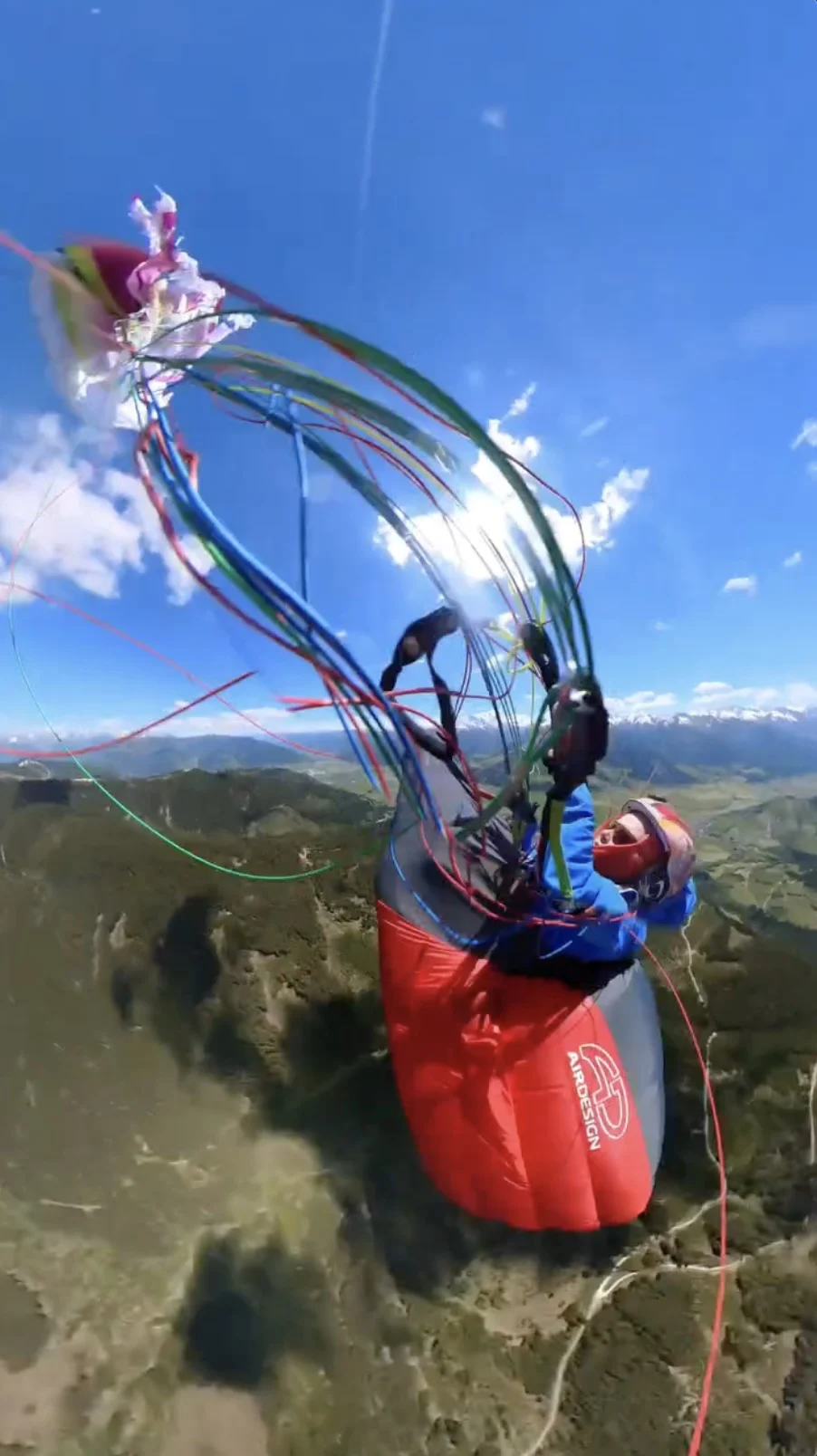
The serene skies over the Austrian Alps became the backdrop for a near-fatal aviation incident when a 44-year-old paraglider survived a mid-air collision with a sightseeing plane. The incident, captured in harrowing detail by the pilot’s own bodycam, has sent shockwaves through both the general aviation and free-flying communities. The footage illustrates the sheer unpredictability of mountain thermals and the critical importance of emergency backup systems in extreme sports. While mid-air collisions are statistically rare in the vast expanse of the sky, the convergence of recreational paragliders and light aircraft in popular tourist regions like the Austrian Alps presents a unique set of challenges for aviation safety and airspace management.
The survivor, an experienced paraglider whose identity has been kept private by local authorities, was navigating the thermal currents typical of the Austrian mountainous terrain when the incident occurred. According to preliminary reports, the sightseeing plane, a small fixed-wing aircraft frequently used for local tours, struck the paraglider’s wing from behind and slightly above. The impact was instantaneous, with the plane’s propeller or wing structure tearing through the delicate fabric and lines of the paraglider. Within seconds, the aerodynamic lift of the paraglider was neutralized, sending the pilot into a violent, uncontrolled descent toward the jagged terrain below.
Detailed Chronology of the Incident
The day began as a routine excursion for the paraglider, who launched from a well-known site in the Austrian highlands. Weather conditions were reported as favorable, with clear visibility and moderate thermal activity—conditions that typically attract a high volume of both paragliders and light aircraft pilots. For the first thirty minutes of the flight, the pilot maintained a steady altitude, utilizing rising air currents to navigate the ridgelines.
At approximately 2:15 PM local time, as the paraglider was circling within a thermal to gain altitude, the sightseeing plane entered the same immediate airspace. Evidence from the bodycam suggests that neither the pilot of the plane nor the paraglider was aware of the other’s proximity until the moment of impact. The aircraft appeared to be on a standard flight path used for aerial photography and sightseeing when it intersected the paraglider’s trajectory.
The collision caused the paraglider’s canopy to collapse and wrap around itself, a condition known in the sport as a "total collapse" or "cravat," which prevents the wing from reinflating. The 44-year-old pilot was subjected to intense centrifugal forces as she began to spin toward the earth. With only seconds to react before reaching an unrecoverable altitude, she followed emergency protocols, successfully deploying her reserve parachute. The reserve, a smaller, round-shaped canopy designed for rapid inflation, slowed her descent sufficiently to allow for a rough but non-fatal landing in a wooded area on the mountainside.
Local emergency services were alerted by witnesses on the ground and by the pilot of the sightseeing plane, who remained in the air to coordinate the search before returning to a nearby airfield. The paraglider was located within an hour by an Alpine rescue team and was treated for minor injuries and shock.
The Role of the Reserve Parachute
The survival of the pilot is being credited almost entirely to the successful deployment of her reserve parachute. In the world of paragliding, a reserve—often referred to as a "second chance"—is a mandatory piece of safety equipment. Unlike the main wing, which is designed for gliding and maneuverability, the reserve is designed for one purpose: to get the pilot to the ground at a survivable vertical speed when the main wing fails.
Technical experts note that the window for deploying a reserve in a collision scenario is incredibly narrow. When a paraglider collapses, the pilot can lose hundreds of feet of altitude in a matter of seconds. The "G-forces" generated by a spiral dive can also make it physically difficult for a pilot to reach the deployment handle, which is usually located on the side or bottom of the harness. The fact that the 44-year-old pilot was able to maintain presence of mind during such a high-stress event is a testament to her training and experience.
Airspace Safety and Shared Skies in Austria
This incident has reignited a long-standing debate regarding the sharing of airspace between motorized aircraft and unpowered recreational craft. In Austria, much of the mountainous terrain where paragliding occurs is classified as Class G airspace. This is "uncontrolled" airspace where pilots of both small planes and paragliders operate under Visual Flight Rules (VFR).
Under VFR, the primary method of collision avoidance is the "See and Avoid" principle. Pilots are responsible for maintaining a visual lookout for other aircraft and taking evasive action when necessary. However, the "See and Avoid" method has inherent limitations:
- Relative Size: A paraglider is significantly smaller than a plane and can be difficult to spot against the complex background of a mountain face.
- Blind Spots: Both paragliders and fixed-wing aircraft have structural blind spots. For a paraglider, the wing above blocks upward visibility. For a plane, the engine cowling or the high-wing/low-wing configuration can obscure the view of lower-altitude objects.
- Closing Speeds: Even a slow-moving sightseeing plane travels much faster than a paraglider, leaving a very small margin of error for detection and reaction.
Austro Control, the agency responsible for air traffic management in Austria, has previously issued guidelines for pilots operating in the Alps, emphasizing the density of recreational flyers during the summer months. Despite these guidelines, the proximity of flight paths remains a constant risk.

Supporting Data and Statistical Context
Statistically, mid-air collisions involving paragliders are rare but often result in fatalities. According to data from the European Hang Gliding and Paragliding Union (EPU), the majority of paragliding accidents are caused by weather-related collapses or pilot error during takeoff and landing. Collisions with motorized aircraft represent less than 1% of total reported incidents annually.
However, the frequency of "near-misses" is believed to be much higher. In a 2023 survey of Alpine paraglider pilots, nearly 15% reported having at least one encounter with a motorized aircraft that they deemed "dangerously close." In Austria alone, there are over 20,000 licensed paraglider pilots, and the country is a premier destination for thousands of visiting pilots every year. When combined with the high volume of light aircraft traffic from flight schools and tourism operators, the mathematical probability of a "conflict of interest" in the sky increases.
Official Responses and Ongoing Investigation
The Federal Safety Investigation Authority (Bundesanstalt für Verkehr – BEV) has launched a formal investigation into the collision. The investigation will focus on several key factors: the exact altitudes of both parties, the flight path of the sightseeing plane, and whether any local airspace restrictions were bypassed.
A spokesperson for the local police department stated, "We are extremely fortunate that this incident did not result in a loss of life. The footage provided by the paraglider will be instrumental in determining the sequence of events. We are also interviewing the pilot of the sightseeing plane and witnesses who were on the ground."
The pilot of the sightseeing plane, who has not been named, reportedly told authorities that he did not see the paraglider until the moment of impact. The aircraft sustained minor damage to its exterior but remained airworthy enough to land safely. Aviation experts suggest that the plane’s propeller likely clipped the paraglider’s lines, which are made of high-strength materials like Kevlar or Dyneema but are no match for a spinning metal or composite blade.
Technological Solutions and Future Implications
In the wake of this event, there are renewed calls for the mandatory adoption of electronic conspicuity devices in the paragliding community. Systems like FLARM (Flight Alarm) are already widely used by glider pilots and some light aircraft in Europe. FLARM is a low-cost, low-power electronic device that alerts pilots to potential collisions with other aircraft equipped with the same technology.
While many paragliders use GPS-based flight computers, many of these devices do not transmit the pilot’s position to other aircraft. Proponents of increased safety regulations argue that requiring paragliders to carry active transponders or FLARM devices in high-traffic areas could virtually eliminate the "See and Avoid" failure point. However, some in the paragliding community resist these measures, citing the cost, weight, and the "free-spirit" nature of the sport.
The incident also highlights the potential for "geofencing" and dedicated flight corridors. In some parts of the world, specific zones are carved out for paragliding activities where motorized aircraft are strictly prohibited or required to maintain a higher minimum altitude. Implementing such zones in the rugged and geographically constrained valleys of Austria, however, remains a logistical challenge for air traffic planners.
Psychological and Physical Recovery
For the 44-year-old woman, the physical recovery is expected to be swift, but the psychological impact of surviving a mid-air collision is significant. Survival stories of this nature often lead to a re-evaluation of safety margins within the sport. Experts in aviation psychology note that "near-miss" survivors often experience a period of heightened anxiety, but many eventually return to the sport with a renewed focus on defensive flying techniques.
The paragliding community has rallied around the pilot, with many using the bodycam footage as a teaching tool. Instructors are emphasizing the need for "active scanning"—the practice of constantly looking around and behind—rather than focusing solely on the terrain or the flight instrument.
Conclusion
The miracle over the Austrian Alps serves as a stark reminder of the inherent risks of aviation, regardless of the craft being flown. It underscores a fundamental truth of the sky: it is a shared resource that requires constant vigilance, respect for regulations, and a reliance on well-maintained safety equipment. While the investigation continues, the dramatic footage of a paraglider’s wing being shredded by a plane will remain a haunting visual of how quickly a peaceful afternoon in the clouds can turn into a fight for survival. For now, the 44-year-old pilot stands as a symbol of the effectiveness of emergency training and the thin line between tragedy and a miraculous "second chance."
