

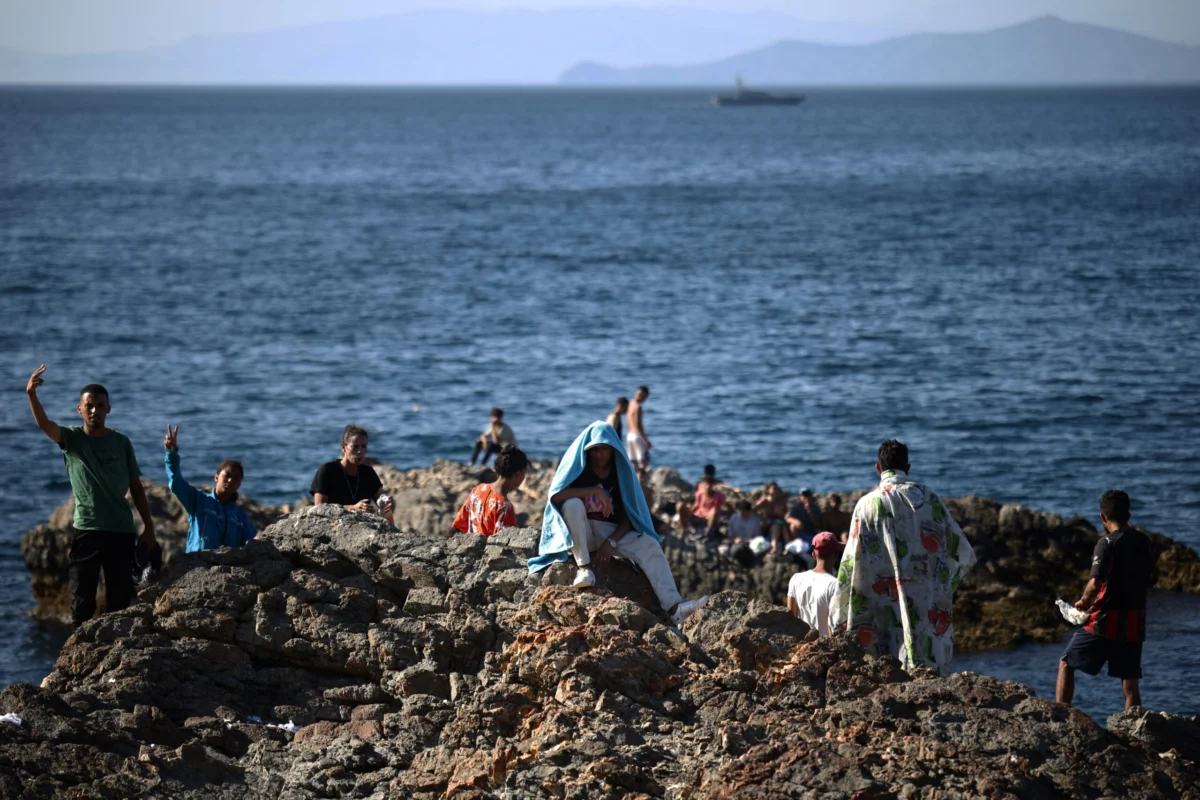
For several tumultuous days, the Spanish autonomous city of Ceuta, a vital European outpost nestled on the northern tip of Africa, found itself at the epicentre of an unprecedented humanitarian and geopolitical crisis. An estimated 60,000 migrants, predominantly young men from Morocco, surged across the border, overwhelming local infrastructure and prompting an immediate, forceful response from Spanish authorities. This dramatic influx, which unfolded rapidly over a 48-hour period, plunged the city into chaos, forcing businesses to close and exhausting all available accommodation, while simultaneously igniting a fierce debate on migration, border security, and international relations.
Immediate Impact and Eyewitness Accounts
The initial days of the surge saw the bustling port city of Ceuta transformed. Daily life ground to a halt as thousands of individuals, many exhausted and dehydrated, streamed onto its shores and streets. The sheer volume of arrivals quickly rendered the city’s limited resources inadequate. Residents like Isabel Hossein, a port police officer in Algeciras who commutes daily from her home in Ceuta, described a scene of profound disarray and fear. "People were afraid; there were so many young men everywhere," she recounted, highlighting the palpable tension that gripped the community. Her personal experience underscored the unique cross-cultural fabric of Ceuta, where Christian and Muslim populations traditionally coexist peacefully. "I am half Christian, half Muslim, as many in Ceuta are. We live peacefully together. But the numbers this time were scary," she stated, reflecting a widespread sentiment of alarm among locals accustomed to, yet overwhelmed by, this particular scale of migration.
The logistical challenges extended beyond Ceuta itself. With all beds in the enclave occupied, journalists and aid workers found themselves commuting from mainland Spain. The Spanish port city of Algeciras, a mere one-hour ferry ride across the Strait of Gibraltar, became a temporary base, its ferries a conduit for observers and those like Isabel, whose daily routines were upended. This maritime link, typically a route for Moroccans returning home for summer holidays, underscored the stark contrast between documented, planned travel and the desperate, undocumented crossings witnessed in Ceuta. Road signs up to 1,000 kilometres away in Spain, bearing the Arabic word for Algeciras, traditionally guide holidaymakers; now, the same route became a symbol of two vastly different journeys.
A Detailed Chronology of the Crisis
The migrant surge began in earnest on Wednesday, July 29, 2026, and escalated dramatically into Thursday, July 30. Reports indicate that Moroccan border guards, for reasons that remain contested, significantly reduced their usual patrols, effectively opening a pathway for thousands to attempt the crossing. Many migrants braved the waters of the Mediterranean, swimming around the Tarajal breakwater, while others scaled the formidable border fence. The overwhelming majority arrived by sea, using inflatable rafts, rubber dinghies, or simply swimming, often with makeshift flotation devices.
Within 24 hours, the estimated number of arrivals swelled to an unprecedented 60,000. Spanish authorities, caught off guard by the sheer scale and suddenness of the influx, deployed military units to the border, as confirmed by the Spanish interior ministry. Soldiers and Guardia Civil officers were tasked with containing the situation, pushing back new arrivals, and managing the throngs already within the city. Photographs from the ground depicted military personnel, sometimes with a "watchful, occasionally threatening, eye," overseeing the return of migrants.
By Saturday, August 1, just two days after the peak of the crisis, a significant shift had occurred. Through a combination of Spanish military and police intervention, diplomatic pressure, and voluntary returns, approximately 90 percent of the estimated 60,000 Moroccan migrants had been returned to Morocco. This rapid repatriation effort was a testament to the swift, decisive action taken by Madrid, albeit one that raised questions among human rights observers regarding due process and the right to asylum. On Saturday evening, police divers were still engaged in the grim task of recovering bodies from the surrounding waters, a tragic testament to the deadly risks inherent in these desperate journeys. Dozens were reported to have perished in the attempt, highlighting the severe humanitarian cost of the crisis.
The Undocumented Ones: Motivations and Disillusionment
The motivations driving such a mass movement were complex and multifaceted. For many of the young men who undertook the perilous journey, the promise of a "good life, humanity, safety, and all the things you need" fueled their hopes, as expressed by one migrant, Abdelmajid. This aspiration for better economic prospects, social stability, and perceived human rights in Europe stands in stark contrast to the realities of their lives in Morocco, where high youth unemployment, limited opportunities, and social inequalities persist.
However, the reality upon arrival in Ceuta was a stark and brutal disappointment. Instead of the "good life," they encountered extreme heat, thirst, and a decidedly hostile reception. The city’s resources were stretched to breaking point, and the immediate response focused on containment and repatriation rather than reception and integration. The dream of a new beginning quickly devolved into a desperate struggle for survival, culminating in mass returns.
Disturbingly, some accounts suggested that the mass influx was not entirely spontaneous. One local observed, "They were told to come. I saw it on Instagram, ‘Go to Spain and get money, jobs.’ It’s all a game." This points to the potential role of social media in disseminating information, or misinformation, and coordinating movements, possibly exploited by criminal gangs or even state actors. While the Spanish government officially blamed criminal gangs and traffickers for orchestrating the event, the notion of a "game" with such tragic consequences underscores the cynical manipulation of human desperation. The sight of migrants rotating their wrists, indicating they would "simply try again," spoke volumes about the enduring hope and profound desperation that transcends immediate setbacks.
Broader Context: Ceuta’s Unique Position and Migration Dynamics
Ceuta, alongside Melilla, represents Europe’s only land border with Africa, making it a permanent flashpoint for irregular migration. Its strategic location at the mouth of the Strait of Gibraltar has historically made it a coveted territory. For centuries, it has served as a crossroads of cultures and civilizations, but in the modern era, it functions as a heavily fortified external border of the European Union. The city covers approximately 18.5 square kilometres and has a population of around 85,000, making the arrival of 60,000 people in such a short span utterly disproportionate to its capacity.

The economic disparity between Spain and Morocco is a primary driver of migration. Morocco, despite economic growth in recent decades, still grapples with significant socio-economic challenges, particularly for its youth. The allure of the EU, with its higher living standards and perceived opportunities, acts as a powerful magnet. Historically, migration attempts into Ceuta and Melilla have occurred via land (scaling border fences) and sea (swimming or using small boats). While significant surges have occurred before, notably in 2005 and 2014, the sheer volume of the 2026 event was unprecedented, indicative of a potential shift in tactics or underlying pressures.
Official Responses and Geopolitical Tensions
The Spanish government’s response was swift and unequivocal. Prime Minister Pedro Sánchez condemned the influx, characterizing it as a grave challenge to Spain’s territorial integrity and European borders. Madrid swiftly deployed the military and emphasized its commitment to protecting its borders and repatriating those who entered irregularly. Spain also called for solidarity from the European Union, framing the crisis as an issue for the entire bloc, not just a bilateral matter. Officials in Madrid were quick to point fingers at Morocco, suggesting that the sudden relaxation of border controls was a deliberate act of political pressure. This accusation stemmed from recent diplomatic tensions between Spain and Morocco, particularly over the Western Sahara dispute and Spain’s reception of a Sahrawi independence leader for medical treatment. The crisis was thus perceived by many as a form of "hybrid warfare," using human lives as leverage in a diplomatic dispute.
The Moroccan government’s initial silence on the matter was conspicuous. Later, Rabat engaged in a rapid repatriation effort, cooperating with Spanish authorities to facilitate the return of its citizens. However, it refrained from explicitly acknowledging or explaining the initial relaxation of border controls, leaving ample room for speculation regarding its motives. This incident highlighted the delicate and often fraught relationship between Spain and Morocco, two neighbours whose cooperation is vital for regional stability and migration management, yet whose interests can diverge sharply.
The European Union reacted with expressions of concern and pledges of support for Spain. The European Commission reiterated its solidarity with Spain and emphasized the need for a comprehensive European approach to migration, balancing border control with humanitarian responsibilities. However, the crisis also exposed the perennial fault lines within the EU regarding burden-sharing and the implementation of a common asylum policy, underscoring the challenges of managing external borders.
Political Narratives and the Far-Right’s Amplification
The Ceuta crisis rapidly became a battleground for political narratives, particularly amplified by right-wing and far-right figures across Europe. Alvise Perez, a far-right influencer and Member of the European Parliament representing Spain’s Se Acabó la Fiesta party, was present in Ceuta, guarded by police. He, along with others, was instrumental in framing the event as an "invasion," a term widely adopted by anti-immigration factions.
Zia Yusuf, a senior figure in the UK’s anti-immigration Reform UK party, also traveled to Ceuta. Surrounded by "muscled minders" and in a crisp white shirt, Yusuf engaged with young Moroccan men, some of whom spoke little English, to gather material for his social media platforms. On his X (formerly Twitter) account, he told his nearly 150,000 followers: "I am in Ceuta, the scene of the 60,000 strong invasion. Spain has effectively militarised its border. Already spoken to Moroccan men here who say they are trying to get to Britain. More to come."
This narrative, suggesting that migrants were primarily aiming for Britain, was largely anecdotal and contested by those on the ground. While the aspiration to reach more prosperous European nations, including the UK, is understandable for many migrants, direct evidence from interviews in Ceuta during the crisis did not overwhelmingly support this claim. However, the swift propagation of such messages across social media platforms underscored the power of these channels in shaping public opinion and galvanizing political movements, often with limited factual basis. The deliberate use of terms like "invasion" aimed to demonize migrants and foster a sense of existential threat, feeding into broader anti-immigration agendas across Europe.
Long-Term Implications and Unanswered Questions
The Ceuta crisis of 2026 carries significant long-term implications for Spain, Morocco, and the wider European Union. For Spain, it reinforced the vulnerability of its African enclaves and highlighted the ongoing challenge of managing its southern border. It also underscored the potential for migration to be weaponized in diplomatic disputes, necessitating a re-evaluation of its foreign policy approach to Morocco.
For Morocco, the incident raised questions about its commitment to international border agreements and its role as a key partner in migration control for Europe. While Rabat eventually cooperated in repatriations, the initial period of relaxed controls severely strained trust with Madrid and Brussels. The underlying socio-economic conditions that drive such mass migration attempts remain unaddressed, suggesting that similar events could recur if fundamental issues are not tackled.
For the European Union, the crisis served as another stark reminder of the urgent need for a cohesive and humane common migration and asylum policy. The reactive, often militarized response, coupled with the humanitarian tragedy of deaths at sea, highlights the moral and practical challenges of securing external borders while upholding human rights. The incident also amplified calls for increased EU funding and support for frontline states like Spain, as well as for enhanced cooperation with origin and transit countries to address the root causes of irregular migration.
The detritus of flippers and rubber floating devices left strewn across Ceuta’s beaches served as a poignant memorial to a "game with tragic consequences." The crisis laid bare the desperation of those seeking a better life, the geopolitical complexities of border management, and the enduring human cost of a fractured global approach to migration. As Europe continues to grapple with these challenges, the events in Ceuta in the summer of 2026 will undoubtedly serve as a critical case study in the ongoing struggle to balance security, sovereignty, and humanity.
