

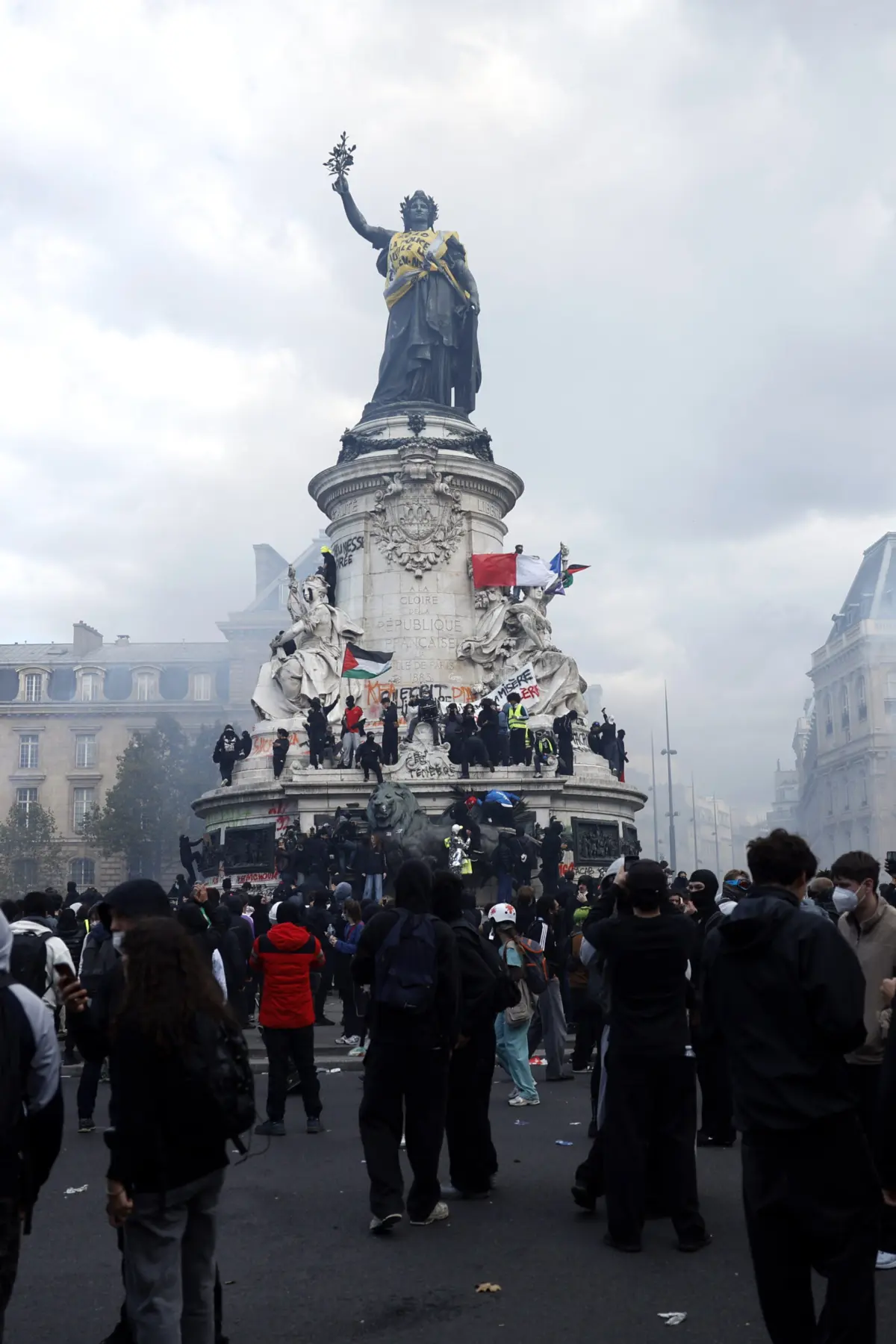
Tens of thousands of protesters took to the streets across France on Saturday, marking one of the largest coordinated demonstrations the country has seen in years. From the historic Place de la République in Paris to the administrative hubs of Marseille, Lyon, and Bordeaux, a diverse coalition of citizens converged to voice their growing indignation over a deepening economic crisis and a perceived decline in the nation’s public education system. The "Grand Mobilization," as organizers have dubbed it, brought together an eclectic mix of veteran Yellow Vest (Gilets Jaunes) activists, secondary school and university students, major trade unions, and civil servants, all unified by a shared sense of abandonment by the central government.
The demonstrations, which began early Saturday morning and continued well into the night, were characterized by a mixture of peaceful marches and sporadic outbreaks of civil unrest. In Paris, the atmosphere was particularly charged as protesters filled the square, waving banners that decried "the death of the public school" and "the starvation of the working class." While the majority of participants remained peaceful, the day was marred by reports of property damage in the capital’s commercial districts, leading many residents to express a sense of profound dismay at the escalating volatility within the city’s streets.
A Convergence of Grievances: Education and the Economy
The current wave of unrest is rooted in a "dual-crisis" that has been simmering since the start of the 2026 academic year. The first pillar of the protest involves the deteriorating state of France’s national education system. Teachers’ unions and parent-teacher associations have sounded the alarm over chronic underfunding, which they claim has led to dangerously large class sizes and a critical shortage of qualified educators. According to recent data from the Ministry of National Education, nearly 4,500 teaching positions remained vacant at the start of the September term, a 15% increase from the previous year.
Protesters argue that the government’s attempts to address these shortages through "fast-track" training programs have compromised the quality of instruction. Students, who formed a significant portion of the crowds on Saturday, expressed frustration over crumbling school infrastructure and the lack of specialized support for those from disadvantaged backgrounds. "We are told that the youth are the future, but our schools are falling apart," said one 19-year-old student from the Sorbonne. "There aren’t enough chairs in the lecture halls, and our teachers are overworked and underpaid."
The second pillar of the protest is the skyrocketing cost of living. Despite government assurances that inflation is being managed, the price of essential goods—particularly food and fuel—has continued to climb. Consumer price index (CPI) data for the third quarter of 2026 shows a 7.2% year-on-year increase in grocery costs, significantly outpacing wage growth in the private and public sectors. The resurgence of the Yellow Vest movement, which first gained global notoriety in 2018, underscores the persistent anger over fuel prices and the perceived disconnect between the Parisian political elite and the struggles of rural and suburban households.
Chronology of the Unrest: The Road to October 17
The massive mobilization on October 17 was not an isolated event but the culmination of several weeks of escalating tension.
- Late August 2026: Budget negotiations in the National Assembly stalled as opposition parties rejected a proposed austerity package that included further cuts to public services. This deadlock signaled to the public that little relief was on the horizon for the upcoming winter.
- September 15, 2026: A nationwide "Day of Action" by teachers’ unions saw roughly 30% of schools across the country closed. The government’s response—a promise of a marginal one-time bonus for educators—was widely panned as "insulting" by union leaders.
- October 5, 2026: Fuel prices hit a new record high due to geopolitical instability and the expiration of a state-funded rebate. Spontaneous road blockades began appearing in the northern and western regions of France, reminiscent of the early days of the 2018 protests.
- October 12, 2026: A coalition of student unions (UNEF) and trade unions (CGT and FO) called for a "national convergence" on October 17, urging all sectors of society to join in a unified demand for systemic change.
- October 17, 2026: Protests erupted in over 80 cities. In Paris, the demonstration began at 2:00 PM at Place de la République, moving toward the Bastille. By 6:00 PM, clashes between a minority of "Black Bloc" protesters and security forces led to the use of tear gas and water cannons.
Supporting Data: The Economic Reality
The intensity of the protests is mirrored by bleak economic indicators that have eroded the purchasing power of the average French citizen. According to the National Institute of Statistics and Economic Studies (INSEE), the average household’s discretionary income has shrunk by 4.8% over the last eighteen months.
Energy costs have been a primary driver of this decline. While the government previously implemented "price shields" to protect consumers, the gradual phasing out of these subsidies throughout 2025 and 2026 has left many families vulnerable. Electricity rates in France have risen by an average of 18% since January 2026, a spike that has hit low-income families and small business owners particularly hard.
Furthermore, the "social fracture" that the Yellow Vest movement originally highlighted has only widened. A recent study by a leading French think tank indicated that 42% of residents in rural departments feel "completely ignored" by the current administration’s policies. This sentiment has fueled the diverse demographic makeup of the current protests, which now includes not just the traditional working class but also middle-class professionals who find themselves struggling to maintain their standard of living.
Official Responses and Political Reaction
The French government has adopted a dual strategy of emphasizing security while promising future dialogue. Interior Minister Gérald Darmanin stated in a late-night press conference that while the right to protest is fundamental, the "unacceptable violence and destruction" witnessed in Paris would be met with the full force of the law. According to the Prefecture of Police, over 150 arrests were made in the capital alone, with charges ranging from property damage to assault on law enforcement officers.
From the Elysée Palace, the administration has signaled that it is listening, though it remains firm on its fiscal targets. A spokesperson for the government indicated that a new "National Consultation on Public Services" would be launched in November to address the concerns of teachers and healthcare workers. However, this has done little to appease opposition leaders.
Marine Le Pen of the National Rally (RN) accused the government of "arrogance" and "blindness to the suffering of the people," while Jean-Luc Mélenchon of the France Unbowed (LFI) party called for a "civic revolution" at the ballot box. The political polarization in the country is reaching a fever pitch, with the opposition framing the protests as a referendum on the government’s legitimacy.
Impact on the Ground and Public Sentiment
The physical impact of the protests was most visible in the heart of Paris. Shop windows along the Boulevard Voltaire were smashed, and several bus shelters were set on fire. For many Parisians, the damage is a source of deep frustration. Speaking to Al Jazeera, several residents expressed a sense of "protest fatigue."
"I support their right to be angry, but I don’t understand why they have to burn my neighbor’s car or break the windows of a local bakery," said one resident of the 11th Arrondissement. "These small businesses are also suffering from the high costs. We are all in the same boat, and destroying our neighborhood doesn’t lower the price of bread."
Conversely, those on the front lines of the march argue that such damage is the only way to get the attention of an indifferent government. "We have tried petitions, we have tried peaceful marches, and we have tried voting," said a masked protester near the Place de la Bastille. "Nothing changes. If the government only cares about the economy, then we will show them what happens when the economy stops."
Analysis of Implications and Future Outlook
The events of October 17 suggest that France is entering a period of prolonged social volatility. The "convergence of struggles"—the merging of economic, educational, and social grievances—represents a significant challenge for the current administration. Unlike previous single-issue strikes, this movement lacks a centralized leadership, making it difficult for the government to negotiate a definitive end to the unrest.
Analysts suggest that the government faces a "Catch-22" situation. To appease the protesters, it would need to increase public spending significantly, which would likely violate European Union deficit rules and potentially spook international markets. Conversely, maintaining a path of fiscal discipline risks further alienating the populace and fueling even more radical forms of protest.
The educational crisis, in particular, may have long-term consequences. If the government cannot resolve the teacher shortage and improve school conditions, it risks a "brain drain" and a decline in national competitiveness. For the students who marched on Saturday, the issue is not just about the present, but about the viability of their future in a country that they feel is no longer investing in them.
As the smoke clears from the streets of Paris, the question remains whether the government will offer more than just "consultations." With further strikes already planned for the coming weeks, the "Grand Mobilization" of October 2026 may be remembered as either a turning point for French social policy or the beginning of a winter of unprecedented discontent. The eyes of Europe remain fixed on France, as the nation grapples with the fundamental question of how to balance the demands of a modern economy with the social contract that has long defined the Republic.
