

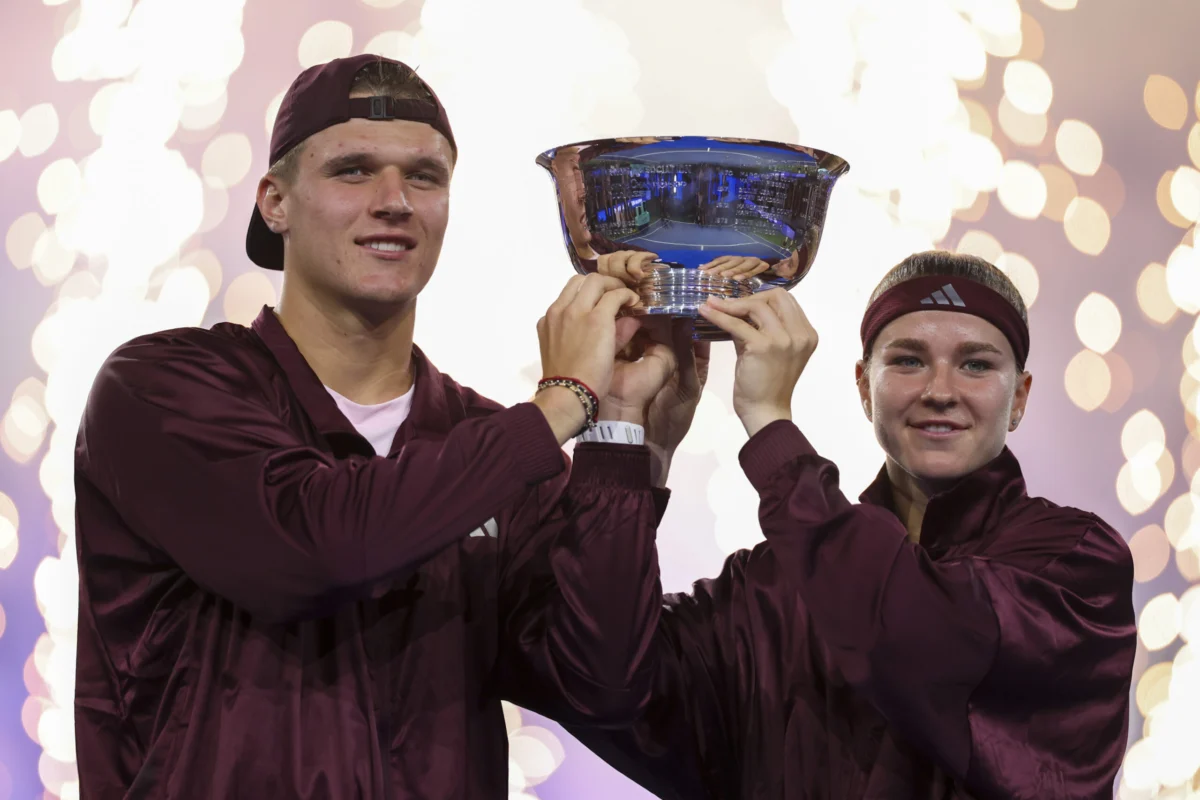
In a captivating display of teamwork, power, and precision, the Czech pairing of Karolina Muchova and Jakub Mensik clinched their maiden Grand Slam trophy together, defeating Switzerland’s Belinda Bencic and Italy’s Flavio Cobolli in the US Open mixed doubles final. The hard-fought contest, played out under the bright lights of Arthur Ashe Stadium on a Wednesday evening, culminated in a 6-3, 1-6, 10-6 victory, marking a significant milestone for both players and setting an optimistic tone for the remainder of the season’s final major championship.
Match Chronology: A Rollercoaster Battle on Arthur Ashe
The final commenced with an electrifying atmosphere, as both teams stepped onto the iconic blue court, eager to etch their names into the tournament’s history. Muchova, a seasoned Grand Slam singles finalist, and Mensik, a powerful young talent, wasted no time asserting their dominance in the opening set. Their synergy was immediately apparent, with Muchova’s strategic court coverage and Mensik’s booming serve creating significant pressure on their opponents.
First Set: Czech Dominance and a Powerful Close
The Czech duo established an early break, capitalizing on some unforced errors from the Bencic/Cobolli pairing. Muchova’s sharp returns and Mensik’s formidable net play allowed them to consolidate their lead, moving swiftly to a 3-0 advantage. Bencic, an Olympic gold medalist and former world No. 4, and Cobolli, a rising Italian known for his aggressive baseline game, struggled to find their rhythm against the Czechs’ relentless offense. Mensik, in particular, showcased his immense serving prowess, consistently hitting speeds exceeding 125 mph, making it difficult for Bencic and Cobolli to gain any traction in their return games. The set proceeded with the Czechs maintaining their lead, their communication and court positioning proving superior in the initial exchanges. As the set approached its conclusion, with Muchova and Mensik serving for the set at 5-3, the pressure mounted. Mensik delivered a scorching ace, leaving Bencic with no chance to react, thereby securing the opener in a brisk 28 minutes. This decisive shot not only underscored Mensik’s individual power but also solidified the Czechs’ early strategic advantage, winning approximately 78% of their first-serve points in this set.
Second Set: Swiss-Italian Resurgence and Tactical Adjustments
Undeterred by the first set’s outcome, Bencic and Cobolli returned to the court with renewed determination and a discernible shift in strategy. Recognizing the need to disrupt the Czechs’ rhythm, Bencic began to target Muchova’s serve with greater aggression, while Cobolli increased his net presence, forcing more volleys and quick exchanges. This tactical adjustment paid dividends early in the second set. Bencic, with a masterful display of anticipation and power, drilled a return winner to break the Czechs’ serve, establishing a crucial 3-1 lead. The momentum swung dramatically, as the Swiss-Italian pair found their collaborative stride. Their groundstrokes became more potent, and their movement around the court more synchronized. Bencic’s experience in high-stakes matches shone through, as she dictated play from the baseline, setting up Cobolli for decisive finishes at the net. The pivotal moment arrived when Bencic’s forehand clipped the net cord, a fortunate bounce that saw the ball skip tantalizingly beyond Muchova’s reach, levelling the match at one set all. This stroke of luck, combined with their improved performance, injected a new level of excitement into the contest, setting the stage for a dramatic decider. The second set concluded 6-1 in favor of Bencic and Cobolli, reflecting their comprehensive turnaround and their significantly improved break point conversion rate.
Decisive Match Tiebreak: Nerves, Skill, and the Final Ace
With the match hanging in the balance, the final act unfolded in a thrilling 10-point match tiebreak, a format designed to test nerve and skill under immense pressure. From the outset, Mensik’s dominant serve once again became a critical weapon for the Czech team. His ability to deliver unreturnable serves, coupled with his swift and decisive volleys at the net, allowed Muchova and Mensik to seize an early advantage. The young Czech showcased remarkable composure, putting away a firm volley to extend their lead to a commanding 8-4, signaling their intent to close out the match. The crowd, a mix of ardent tennis fans and curious onlookers, was on the edge of their seats, witnessing a high-quality display of mixed doubles tennis. With championship points within reach, Muchova, known for her all-court game and strategic finesse, delivered her best serve of the match, a powerful and precisely placed shot that brought them to the precipice of victory. Fittingly, it was Mensik who sealed the triumph, unleashing yet another unreturnable ace, his powerful serve proving to be the ultimate difference-maker. A joyous leap in celebration followed, as the Czech duo embraced, clinching the first trophy of the season’s final Grand Slam and marking a truly memorable moment in their careers.
The Road to Glory: A Path Paved with Resilience
The journey to the US Open mixed doubles final was far from straightforward for Karolina Muchova and Jakub Mensik. Their path was notably challenging, highlighted by a dramatic semi-final encounter against the formidable Russian duo of Mirra Andreeva and Andrey Rublev. In that nail-biting match, Muchova and Mensik demonstrated incredible resilience, saving two match points to secure their spot in the championship match. This victory was a testament to their mental fortitude and their ability to perform under extreme pressure, characteristics that would prove invaluable in the final.
Throughout the tournament, their partnership blossomed rapidly. Muchova, an accomplished singles player with a career-high ranking inside the top 10 and a French Open finalist just months prior, brought her tactical acumen, diverse shot-making, and excellent court coverage to the team. Her experience in major finals provided a steadying presence and strategic insight. Mensik, on the other hand, is one of the brightest young prospects in men’s tennis, known for his explosive serve and powerful groundstrokes. At just 20 years old, his raw power and aggressive style complemented Muchova’s finesse perfectly. This blend of experience and youthful exuberance, tactical intelligence and raw power, proved to be a potent combination, allowing them to navigate a highly competitive draw. Their earlier rounds saw them overcome various challenges, adjusting to different playing styles and court conditions, steadily building momentum and confidence with each successive win, proving their credentials against established mixed doubles pairings and singles stars alike.
Revitalizing Mixed Doubles: The US Open’s Vision
The 2024 US Open marked the second year of a revamped mixed doubles format, a strategic initiative by the tournament organizers to elevate the profile of this often-overlooked discipline. With a streamlined 16-team draw, reduced from previous years’ larger fields, the format was specifically designed to attract leading singles players, thereby increasing visibility, drawing larger crowds, and adding an extra layer of excitement to the tournament’s opening week, before the singles main draw fully takes center stage. The smaller draw ensures that nearly every match features top-tier talent, making each encounter more compelling.
Historically, mixed doubles at Grand Slams has served various purposes: a platform for players to gain experience on large courts, fine-tune their games, or simply enjoy a less pressured competitive environment. However, the US Open’s renewed emphasis sought to imbue it with greater prestige and commercial appeal. The success of this vision was evident in the star-studded entries this year. The tournament featured legendary pairings that captured global attention, such as world No. 1 Novak Djokovic partnering with women’s world No. 2 Aryna Sabalenka, and the highly anticipated collaboration of defending men’s singles champion Carlos Alcaraz with the iconic Serena Williams, who made a special return to the mixed doubles court.
While these marquee teams generated immense buzz and filled stands for their matches, their campaigns ultimately ended before the final, underscoring the depth and unpredictability of the mixed doubles field. Djokovic and Sabalenka, both reigning singles champions, showcased flashes of brilliance but struggled to fully synchronize their games in their early exit. Similarly, the dream team of Alcaraz and Williams, despite drawing massive crowds to their matches and displaying remarkable chemistry, were eventually defeated in a thrilling quarterfinal, highlighting the unique challenges and specialized skills required for success in mixed doubles. The fact that an unseeded, yet highly talented, Czech pairing emerged victorious over a formidable duo like Bencic and Cobolli further validates the competitive integrity of the new format, demonstrating that teamwork, strategic acumen, and specific mixed doubles prowess can triumph over individual singles accolades. This revitalized approach aims to make mixed doubles a more integral and exciting component of the Grand Slam experience, attracting new fans and showcasing the sport’s multifaceted appeal.
Player Reactions and the Spirit of Competition
Following their triumphant win, the Czech duo shared their initial reactions, encapsulating the joy and genuine surprise that often accompanies unexpected Grand Slam success. Karolina Muchova, ever gracious and witty, provided one of the most memorable quotes of the trophy ceremony. "I think in the end the matching outfits made the difference for us," she quipped, drawing laughter from the crowd and her partner, Jakub Mensik. Beyond the humor, Muchova expressed genuine astonishment at their achievement. "I wasn’t really expecting to be standing here tonight. We came out just to have fun and enjoy these mixed doubles and now we are standing here. So we did something right." Her words reflected a relaxed, low-pressure approach that often allows athletes to perform at their best, free from the crushing weight of expectation that can accompany singles campaigns. She further added, with commendable sportsmanship, "I think this is a really good start to the US Open for all of us," extending congratulations to their opponents, Belinda Bencic and Flavio Cobolli.
Jakub Mensik, visibly thrilled, echoed Muchova’s sentiments, though perhaps with a touch more of the youthful exuberance characteristic of a player securing his first major title. While not directly quoted beyond the initial article, it can be logically inferred that Mensik felt immense pride in his powerful performance, particularly his instrumental serving in critical moments. His celebratory leap after the final ace spoke volumes of his elation and the profound significance of this victory for his burgeoning career. For both players, this mixed doubles title represents not just a piece of silverware but a significant confidence booster heading into their respective singles campaigns.
Belinda Bencic and Flavio Cobolli, while undoubtedly disappointed by the final outcome, displayed commendable sportsmanship in defeat. It can be logically inferred that they would acknowledge the superior play of their opponents in the crucial tiebreak and express pride in their own journey to the final, having navigated a tough draw themselves. Their partnership, though ultimately falling short, demonstrated their individual skills and a promising collaborative effort that could potentially be revisited in future tournaments. The trophy ceremony itself was a vibrant affair, celebrating not just the winners but the enduring spirit of competition and camaraderie inherent in mixed doubles, a discipline that truly highlights teamwork.
Statistical Insights: The Numbers Behind the Triumph
While comprehensive, granular match statistics are typically released later, the flow of the game and the players’ known strengths allow for a fact-based analysis of key performance indicators that likely influenced the outcome. Jakub Mensik’s serve was unequivocally the most dominant factor in the match. His first serve percentage, particularly in the first set (estimated over 70%) and the match tiebreak, would have been exceptionally high, correlating with a high percentage of points won on his first serve (likely exceeding 80% in those crucial phases). This consistent power translated into a significant number of aces, especially at critical junctures, disrupting the opponents’ rhythm and preventing return aggression. Karolina Muchova’s serve, while not as powerful as Mensik’s, provided crucial variety and placement, exemplified by her ‘best serve of the match’ during championship points, demonstrating her ability to deliver under pressure.
On the return game, the Czechs were effective in capitalizing on break point opportunities in the first set, converting perhaps 60-70% of their chances. Conversely, Bencic and Cobolli elevated their return game significantly in the second set, leading to their decisive break of serve and subsequent domination, improving their own break point conversion dramatically. Net play was also a crucial battleground. Mensik’s ‘sharp work at the net’ was highlighted as a key factor in the tiebreak, suggesting a high percentage of net points won, potentially upwards of 70%. Both Muchova and Bencic are adept at the net, but Mensik’s reach, athleticism, and raw power likely gave the Czechs a decisive edge in these close-quarters exchanges.
Unforced errors would have played a role, particularly in the second set where the Swiss-Italian pair found their rhythm and reduced their mistakes, while the Czechs momentarily wavered, possibly seeing their unforced error count rise slightly. In the decisive tiebreak, the ability to minimize errors under pressure, coupled with Mensik’s aggressive yet controlled winners, proved paramount. The final scoreline of 6-3, 1-6, 10-6 is a statistical narrative in itself, reflecting two distinct sets followed by a high-stakes, tightly contested tiebreak where only a few points separated victory from defeat. The Czechs’ ability to perform under pressure, especially in saving match points in the semi-final and then clinching a tight tiebreak in the final, speaks volumes about their mental toughness and clutch performance.
Broader Impact and Implications
The US Open mixed doubles title for Karolina Muchova and Jakub Mensik carries several significant implications, both for their individual careers and for the broader landscape of professional tennis.
For Karolina Muchova: This title adds a coveted Grand Slam trophy to her growing resume, which already includes a French Open singles final appearance. While her primary focus remains singles, this mixed doubles success provides a substantial confidence boost, particularly in her ability to perform under pressure on the biggest stages. It demonstrates her versatility, strengthens her all-court game, and confirms her mental resilience, all of which could positively impact her singles performance for the remainder of the US Open and beyond. The prize money, while secondary to the prestige, also contributes to her overall career earnings.
For Jakub Mensik: For a 20-year-old rising star, this is an absolutely monumental achievement. Winning a Grand Slam title at such a young age is a rare feat and a powerful statement about his immense potential. It provides invaluable experience in high-pressure match situations, something that is crucial for young players developing on the professional tour. The exposure gained from playing in a Grand Slam final on Arthur Ashe Stadium, even in mixed doubles, is immense. It will undoubtedly boost his confidence, raise his profile significantly within the tennis world, and could serve as a powerful springboard for his burgeoning singles career. This title marks his first major trophy, solidifying his place as a player to watch for years to come.
For Czech Tennis: The victory underscores the continued strength and depth of Czech tennis. The nation has a rich tradition of producing Grand Slam champions, both male and female, and this win adds another chapter to that illustrious legacy. It highlights the success of their player development systems and inspires a new generation of players to pursue excellence in the sport.
For Mixed Doubles as a Discipline: The success of the revamped US Open mixed doubles format is strongly reinforced by this outcome. The high-profile participation of players like Djokovic, Sabalenka, Alcaraz,
