

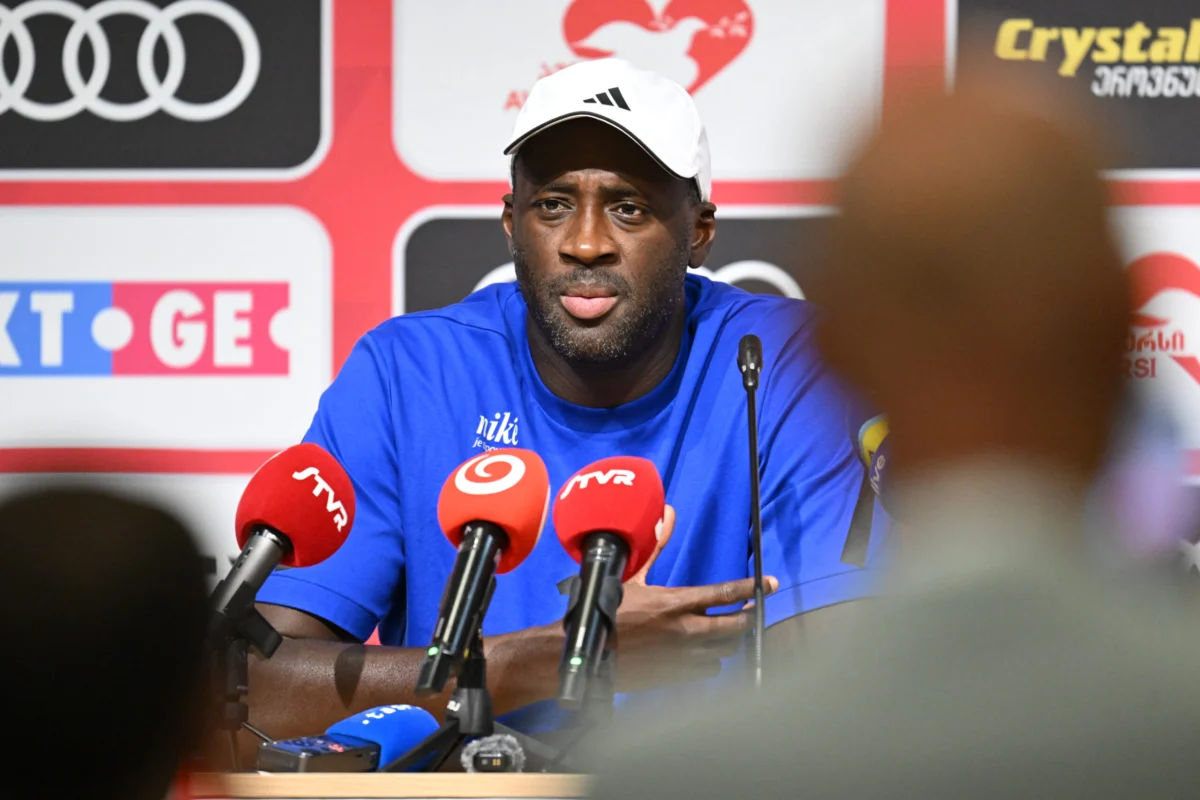
In a monumental achievement that reverberates across European football and holds particular significance for the African continent, legendary former Ivory Coast midfielder Yaya Toure has propelled Slovan Bratislava into the main round of the UEFA Champions League. This historic feat, secured just two months after Toure assumed the head coach position, establishes him as the first African coach to lead a team into the competition’s prestigious group phase. The Slovakian champions navigated a rigorous qualifying gauntlet, culminating in a hard-fought 3-2 aggregate victory over Slovenian side NK Celje, sealing their place among Europe’s elite clubs.
The qualification not only marks a significant milestone in Toure’s nascent managerial career but also delivers a substantial financial and reputational boost to Slovan Bratislava and Slovakian football as a whole. Toure’s immediate impact since his appointment in June has been nothing short of remarkable, with the team demonstrating tactical discipline and a winning mentality that saw them secure four victories in their domestic league alongside their European triumphs.
A Gruelling Path to European Glory: Slovan Bratislava’s Qualification Journey
Slovan Bratislava’s journey to the Champions League group stage was a testament to their resilience and Toure’s astute management, spanning several challenging qualifying rounds. Their campaign commenced in July, facing Georgian champions Saburtalo in the first qualifying round. Slovan secured a comfortable 2-0 victory in the first leg, establishing a crucial advantage. The second leg saw them hold firm, drawing 1-1, which was enough to progress with a 3-1 aggregate score. This initial success set the tone for their European aspirations.
The second qualifying round presented a challenge from Sweden’s Mjallby. Demonstrating their growing confidence and tactical prowess under Toure, Slovan Bratislava overcame their Swedish counterparts in both legs. A narrow but vital win in the first leg was followed by another disciplined performance, ensuring their passage to the playoffs. These consecutive victories underscored the team’s ability to perform consistently against diverse European opposition.
The decisive play-off round pitted them against NK Celje, a formidable Slovenian club determined to make their own mark on European football. The two-legged tie was a tense affair, a true test of nerve and strategy. Slovan Bratislava, under Toure’s guidance, ultimately prevailed with a 3-2 aggregate score. The final whistle confirming their progression sparked jubilant celebrations among the players, staff, and travelling fans, who serenaded Toure with the iconic "Yaya Toure" chant, a nostalgic echo of his playing days at Manchester City.
This arduous path through multiple qualifying rounds highlights the sheer difficulty for clubs from smaller leagues to reach the Champions League group stage. They must overcome several domestic champions or high-ranking teams from other European leagues, often with significantly larger budgets and more established European pedigrees. Toure’s ability to galvanize his squad and navigate these treacherous waters in such a short period speaks volumes about his leadership qualities and coaching potential.
The Financial Windfall and Club Profile Enhancement
Reaching the UEFA Champions League group stage is a transformative event for clubs like Slovan Bratislava. The financial implications are immense, providing a significant injection of capital that can reshape the club’s future. Participation fees alone run into many millions of euros, providing a substantial boost to the club’s operating budget, player salaries, and infrastructure development. For the 2026/27 season, the base participation fee for reaching the group stage is projected to be around €15.64 million. On top of this, clubs earn additional revenue from performance bonuses (e.g., €2.8 million for a win, €930,000 for a draw), TV market pool revenue, and gate receipts from three lucrative home matches against some of Europe’s biggest clubs.
For Slovan Bratislava, this financial windfall could easily exceed €20-25 million, a sum that dwarfs their typical annual revenue. This capital can be strategically invested in strengthening the squad, attracting higher-calibre players, improving training facilities, and enhancing youth academies, thereby securing the club’s long-term competitiveness both domestically and in Europe.
Beyond the monetary benefits, the Champions League group stage offers unparalleled global exposure. Players will compete on the biggest club stage, watched by millions worldwide, potentially increasing their market value and attracting scout attention. The club’s brand will be elevated, drawing new fans, sponsors, and media interest, which in turn can lead to further commercial opportunities. For a club from the Slovakian Fortuna Liga, this level of visibility is invaluable, placing them firmly on the European football map.
Yaya Toure: A Legend’s Transition to the Touchline
Yaya Toure’s playing career was nothing short of legendary, cementing his status as one of the greatest African footballers of all time. Born in Bouaké, Ivory Coast, Toure’s journey through European football saw him grace the pitches of some of the continent’s most illustrious clubs. His trophy cabinet is brimming with silverware, reflecting a career defined by dominance and success.

His stint at Spanish giants Barcelona from 2007 to 2010 saw him win the coveted UEFA Champions League in the 2008-09 season, two La Liga titles (2008-09, 2009-10), the Spanish Super Cup (2008-09), the UEFA Super Cup (2009-10), and the FIFA Club World Cup (2010). Operating primarily as a defensive midfielder, his powerful physique, elegant ball control, and tactical intelligence were crucial to Pep Guardiola’s iconic Barcelona side.
It was at Manchester City, however, where Toure truly blossomed into a global superstar and a goal-scoring midfielder of immense influence. Joining the club in 2010, he became a central figure in their transformation into a Premier League powerhouse. Over eight seasons, he won three Premier League titles, one FA Cup, and three English League Cups. His remarkable ability to drive forward from midfield, score crucial goals (often from long range or free-kicks), and dictate the tempo of matches made him a fan favourite and a nightmare for opposition defences. His prolific goal-scoring season in 2013-14, where he netted 20 Premier League goals from midfield, remains an incredible statistical anomaly for his position.
Individually, Toure’s dominance was recognized with an unprecedented four consecutive African Footballer of the Year awards from 2011 to 2014, a record he shares with Samuel Eto’o. On the international stage, he finally achieved his long-held ambition of winning the Africa Cup of Nations with The Elephants of Ivory Coast in 2015, a crowning moment for his national team career. He retired as a player in 2019, leaving behind an indelible legacy of power, skill, and leadership.
His transition to coaching began with assistant roles across various European clubs, including Leyton Orient in the United Kingdom, and subsequent stints in Belgium, meticulously gathering experience and honing his tactical philosophy. This period saw him work under different managerial styles, absorbing knowledge and preparing for the demands of a head coach role. Most recently, he served as an assistant coach for the Saudi Arabian national team in 2023, working alongside his former Manchester City manager, Roberto Mancini, an experience that undoubtedly broadened his perspective on international football management and strategy. These foundational experiences laid the groundwork for his swift success at Slovan Bratislava, demonstrating a methodical approach to his post-playing career.
Implications for African Coaching and Global Football
Yaya Toure’s achievement is particularly resonant for African football. Despite the continent producing some of the world’s most talented players, African coaches have historically faced significant barriers to breaking into elite European management roles. Representation at the highest levels of European club football has been sparse, making Toure’s breakthrough a landmark moment. It challenges existing perceptions and stereotypes, proving that African coaches possess the tactical acumen, leadership skills, and strategic insight required to succeed at the highest echelons of the sport.
His success could serve as a powerful inspiration and a trailblazing example for aspiring African coaches, opening doors and fostering greater diversity in European dugouts. It sends a clear message that talent and capability, regardless of origin, can lead to success in the fiercely competitive world of football management. This could encourage clubs to look beyond traditional recruitment pools and consider a wider array of coaching talent.
For Slovakian football, Toure’s success brings immense pride and exposure. Slovan Bratislava’s presence in the Champions League group stage elevates the profile of the Fortuna Liga, potentially attracting more investment, better players, and greater media attention to the domestic league. It showcases the quality within Slovakian football and demonstrates that their clubs can compete on the European stage. This can have a ripple effect, inspiring other Slovakian clubs to invest further in their development and strive for similar European adventures.
Statements and Reactions: A Sense of Triumph and Anticipation
While specific direct quotes from Yaya Toure following the qualification were not immediately available, the mood surrounding Slovan Bratislava was undoubtedly one of elation and immense satisfaction. It can be logically inferred that Toure would express profound pride in his players’ dedication and hard work, acknowledging the collective effort that led to this historic achievement. His focus would likely shift quickly to the challenges ahead, emphasizing the need for continued growth and improvement as they prepare to face Europe’s giants.
The club’s management and president would likely issue statements praising Toure’s immediate impact and vision, celebrating the financial and reputational dividends this qualification brings. The fans, having witnessed their club’s arduous journey, would be ecstatic, their celebratory chants echoing the deep connection they feel with their team and their new manager.
The broader football community, especially in Africa and Toure’s former clubs like Manchester City and Barcelona, would certainly acknowledge and celebrate this milestone. It would be seen as a significant step for a respected figure in the game, further solidifying his legacy. Pundits and analysts would likely commend his quick adaptation to management and his ability to translate his playing intelligence into effective coaching strategies.
The Road Ahead: Champions League Group Stage Draw
Slovan Bratislava will learn their Champions League group stage opponents late on Thursday when the draw is held in Madrid. The draw will place them into one of eight groups, where they will face three other clubs, including some of Europe’s most decorated teams. This presents a unique opportunity for Slovan Bratislava to test their mettle against footballing titans, offering invaluable experience for their players and further enhancing the club’s profile. Regardless of the opponents, their participation alone is a triumph, a testament to Yaya Toure’s impactful leadership and the club’s unwavering determination. The journey from relative obscurity to the brightest stage in club football, orchestrated in just two months by a rising managerial talent, is a narrative that will captivate football enthusiasts worldwide.
