

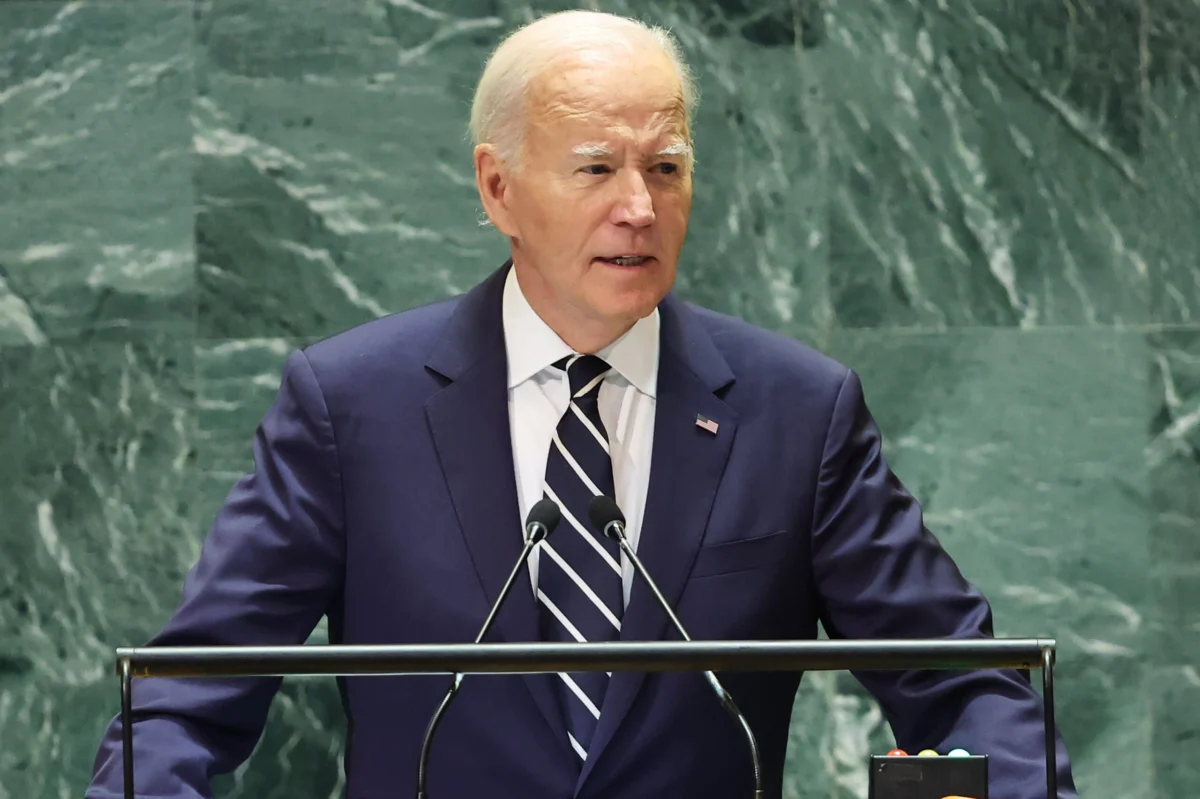
President Joe Biden took the rostrum at the 79th session of the United Nations General Assembly in New York City on Tuesday, delivering a high-stakes address that served as both a summation of his half-century in public service and a call to action for a world fractured by escalating violence. Speaking to a hall filled with heads of state and global dignitaries, Biden sought to reconcile the optimistic multilateralism of his administration with the grim realities of the wars currently ravaging the Middle East, Eastern Europe, and East Africa. As the final General Assembly address of his presidency, the speech was meticulously crafted to frame his foreign policy legacy as one defined by the restoration of American alliances and a steadfast commitment to democratic institutionalism.
The President opened his remarks by acknowledging the pervasive sense of "despair" that many global citizens feel when surveying the current geopolitical landscape. However, he countered this sentiment with a personal reflection on his long career, which began during the height of the Cold War. Biden emphasized that despite the "uncertainty and crisis" that greeted his arrival to the presidency in 2021, the collective action of the international community has historically overcome seemingly insurmountable odds. This theme of resilience formed the backbone of his 25-minute address, as he urged world leaders to maintain their resolve in the face of aggression and humanitarian catastrophe.
A Legacy Framed by Global Conflict and Alliance Building
Since taking office, the Biden administration has navigated a series of seismic shifts in the international order. The President used his platform on Tuesday to enumerate what the White House considers its most significant foreign policy achievements. Chief among these was the revitalization of the North Atlantic Treaty Organization (NATO) and the swift coordination of a global coalition to support Ukraine following Russia’s full-scale invasion in February 2022. Biden highlighted that the expansion of NATO—which recently welcomed Finland and Sweden as its 31st and 32nd members—stands as a testament to the failure of President Vladimir Putin’s strategic objectives.
Beyond Europe, Biden pointed to his administration’s efforts to manage the complex competition with China, asserting that the United States seeks to "responsibly manage" the relationship to avoid conflict while standing firm on economic and security interests. He also touched upon the development of global principles for artificial intelligence, a burgeoning field of diplomacy where the U.S. has sought to lead in establishing ethical guardrails. However, the President’s focus remained largely on the "hot" conflicts that have defined the latter half of his term: the wars in Gaza, Ukraine, and Sudan.
The Middle East Crisis: A Region on the Brink
The geopolitical backdrop of Biden’s speech was particularly somber regarding the Middle East. Since his last address to the General Assembly in September 2023, the region has been transformed by the October 7 attacks by Hamas and the subsequent, ongoing military operations by Israel in Gaza. The conflict has reached a critical juncture, with recent escalations between Israel and Hezbollah in Lebanon threatening to ignite a broader regional war.
Biden used his address to reiterate the urgent need for a ceasefire and hostage deal. He spoke directly to the suffering of both Israeli and Palestinian civilians, noting that tens of thousands of Gazans have been killed or wounded, while many Israeli families continue to wait for the return of loved ones held in captivity. "Now is the time for the parties to finalize its terms," Biden declared, referring to the ceasefire proposal currently on the table. He further emphasized that a lasting peace must include a two-state solution, where Israel enjoys full recognition and normalized relations with its neighbors, and Palestinians live in a state of their own with "security, dignity, and self-determination."
Crucially, Biden also addressed the rising tide of violence in the West Bank, calling for an end to attacks against innocent Palestinians. This inclusion was seen by analysts as a signal to the Israeli government that the U.S. remains concerned about regional stability beyond the immediate borders of the Gaza Strip.
Ukraine and the Defense of the International Order
The war in Ukraine, now entering its third year, remains a cornerstone of Biden’s foreign policy. The President’s address came at a time of increasing political friction in Washington, where some members of the Republican Party have voiced opposition to continued military and financial aid for Kyiv. Biden addressed this domestic and international fatigue head-on, warning the General Assembly that the world cannot afford to "grow weary" or "look away."
Biden framed the defense of Ukraine as an essential defense of the United Nations Charter itself. He argued that allowing Russia’s aggression to go unchecked would signal the end of the post-World War II international order, which is predicated on the sovereignty and territorial integrity of nations. "We will not let up on our support for Ukraine, not until Ukraine wins a just and durable peace," Biden stated, reinforcing his commitment to President Volodymyr Zelenskyy, who is scheduled to meet with Biden and Vice President Kamala Harris in Washington later this week.

The Humanitarian Crisis in Sudan and Forgotten Conflicts
While Ukraine and Gaza have dominated the headlines, Biden made a point to highlight the devastating civil war in Sudan. The conflict between the Sudanese Armed Forces (SAF) and the Rapid Support Forces (RSF) has created one of the world’s worst humanitarian disasters, with millions displaced and facing famine. Biden’s mention of Sudan was an attempt to bring international attention back to a conflict that many diplomats feel has been sidelined by Northern Hemisphere interests. He called for an immediate cessation of hostilities and a return to the transition toward civilian-led democracy, emphasizing that the U.N. must not ignore the suffering in Africa while focusing on crises elsewhere.
Domestic Transitions and the Future of American Leadership
In a rare move for a U.N. address, Biden spoke candidly about his decision to withdraw from the 2024 U.S. presidential election. This moment of the speech was designed to project a message of democratic humility and the importance of institutional stability over personal power. "As much as I love the job, I love my country more," Biden said, explaining his decision to make way for a "new generation of leadership."
This statement was aimed at both the domestic audience and the world leaders in the room, many of whom are watching the upcoming U.S. election with intense scrutiny. By highlighting his voluntary departure from the race, Biden sought to contrast the American democratic process with the authoritarian tendencies of leaders who cling to power indefinitely. He urged his fellow heads of state to remember that "some things are more important than staying in power."
A Packed Diplomatic Schedule: The Quad and Beyond
Biden’s appearance at the UNGA is part of a final, intensive diplomatic push. Just days prior, he hosted the "Quad" summit in Wilmington, Delaware, bringing together the leaders of Australia, India, and Japan to discuss maritime security and technological cooperation in the Indo-Pacific. This was followed by a historic meeting on Monday with United Arab Emirates President Mohamed bin Zayed Al Nahyan in Washington—the first ever official visit by a UAE president to the U.S. capital.
The President’s schedule for the remainder of the week includes a summit focused on the global fight against synthetic drug trafficking, particularly the fentanyl crisis, and a meeting with Vietnamese President Tô Lâm. These engagements underscore the administration’s "integrated deterrence" strategy, which seeks to weave together economic, technological, and military partnerships to maintain global stability.
Analysis: Hedging Bets in a Transition Year
As Biden prepares to exit the world stage, foreign leaders are already looking toward the future. The presence of both Vice President Kamala Harris and former President Donald Trump in the peripheral conversations of the UNGA highlights the uncertainty of future U.S. foreign policy. While Harris met with the UAE president and is set to meet with Zelenskyy, Trump’s campaign has indicated that he also expects to meet with Zelenskyy, as well as Indian Prime Minister Narendra Modi and Polish President Andrzej Duda.
This "dual-track" diplomacy reflects a world that is hedging its bets. For allies, the prospect of a second Trump term brings concerns about a return to "America First" isolationism and potential shifts in NATO commitments. For adversaries, the transition period represents a window of potential vulnerability or opportunity. Biden’s speech was a concerted effort to reassure the world that the foundations of American leadership remain solid, regardless of the electoral outcome in November.
Conclusion: The Path Forward
President Biden concluded his address by returning to the theme of hope, grounded in the historical progress he has witnessed over eight decades. He argued that the challenges of the 21st century—from climate change and pandemics to the rise of AI—require a level of cooperation that transcends traditional borders.
While the speech did not offer new policy breakthroughs for the conflicts in Gaza or Ukraine, it served as a definitive statement of the "Biden Doctrine": a belief that American strength is derived from its alliances and its adherence to a rules-based international order. As he departs New York, Biden leaves behind a world that is arguably more united in its formal alliances but more deeply divided by active conflict than when he took office four years ago. The success of his legacy will ultimately be judged by whether the "hope" he expressed can be translated into the "just and durable peace" he called for on the world’s most prominent diplomatic stage.
