

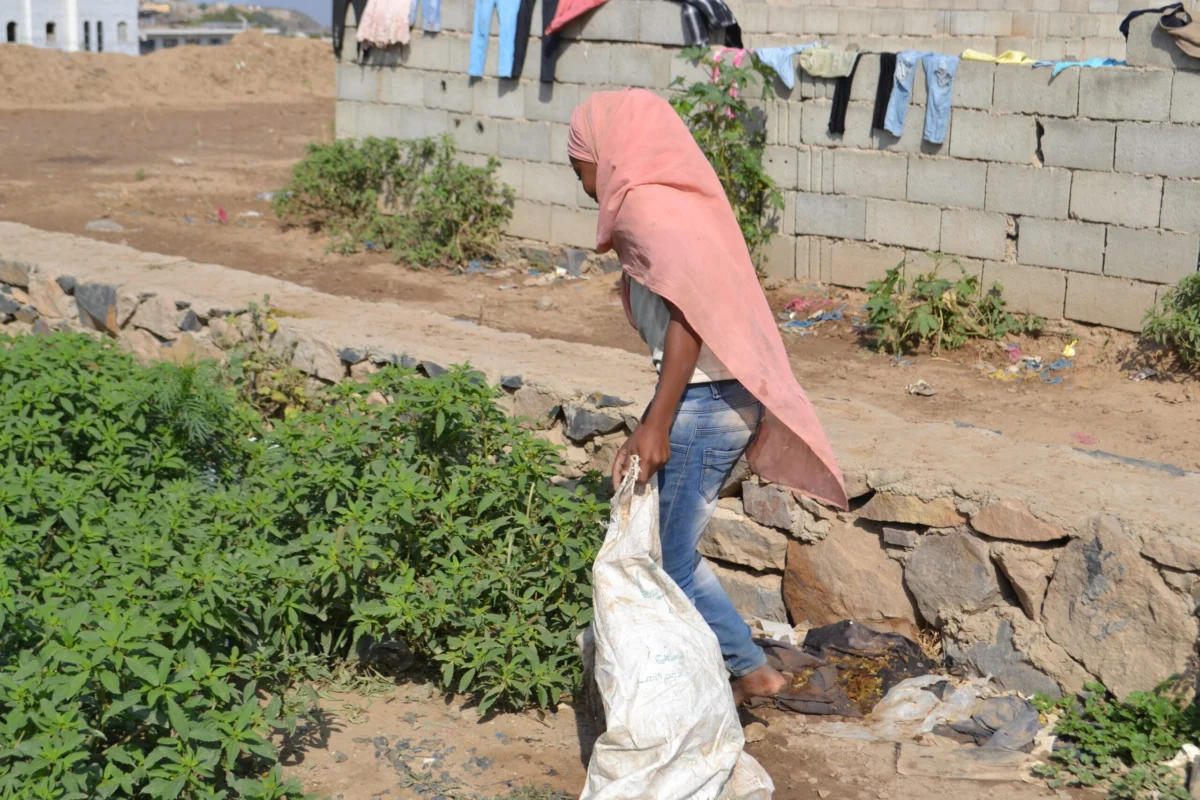
The middle of a morning in Taiz, Yemen, should have echoed with the sounds of children preparing for break time at school. Instead, 11-year-old Hasnaa Jaber was traversing desolate farmlands on the city’s outskirts, her small frame bent collecting discarded plastic bottles. Hasnaa’s life is a stark representation of the profound humanitarian catastrophe engulfing Yemen, where a decade-long war has systematically eroded the very foundations of childhood, forcing millions to abandon education in a desperate bid for survival. She lives with her impoverished family in an informal settlement, one of countless displaced by a conflict that has reshaped the nation’s demographics and future. Rather than attending school, a right many take for granted, Hasnaa works tirelessly alongside her family, contributing to the meagre income needed to keep them from starvation.
"My dream is to become a teacher. I studied up to the third grade, but then I dropped out of school along with my two older brothers to help my father," Hasnaa confided, her words carrying a weight far beyond her years. While the new academic year commenced on August 30 in government-controlled areas of Yemen, Hasnaa and an estimated 3.2 million other children in similar dire financial straits remain absent from classrooms. This figure, provided by the United Nations Children’s Fund (UNICEF), marks a harrowing increase from the 1.8 million children UNICEF reported out of school in 2015, the war’s inaugural year. The escalating numbers underscore a crisis of monumental proportions, threatening to condemn an entire generation to illiteracy and perpetual poverty.
Of Hasnaa’s four siblings, only the youngest currently attends school, spared from the harsh realities of collecting plastic bottles or washing cars – the arduous tasks her family undertakes daily. "My two brothers and I asked my father if we could resume our studies this year," she recounted, a glimmer of hope in her voice. "He was happy that we wanted to go back to school, but providing basic food for the family remains a major struggle. He promised us that we will go back next year." This promise, while cherished, hangs precariously in the balance of a conflict that shows little sign of abating. Hasnaa finds solace not with her school-going friends, but with those who share her predicament, bound by the shared hardship of a childhood stolen too soon. "I don’t enjoy spending time with the children who go to school because they look down on us," she explained, revealing the social stigma attached to their circumstances. "But next year, I will return to my studies and fulfil my dream of becoming a teacher." Her resolve, though inspiring, is a testament to the immense pressure placed on children in Yemen.
The Economic Battlefield: Food as Priority
Hasnaa’s daily earnings from selling plastic bottles to scrap traders amount to approximately 1,500 Yemeni rials, roughly $1 USD. This seemingly small sum is a crucial lifeline for her family, headed by her 35-year-old father, Jaber Ali. Eight years ago, fighting forced Jaber to flee his hometown near Taiz, displacing his family and plunging them into an unending cycle of precarity. Jaber, who himself never received an education, harbors deep aspirations for his children’s schooling, but the harsh realities of survival have dictated otherwise.
"I used to work and keep my children in school, but the situation has worsened over the past two years. What I earn from washing cars is no longer enough to provide them with basic food, let alone cover other necessities," Jaber told Al Jazeera, his voice laden with the weariness of constant struggle. The relentless rise in living costs, coupled with an acute scarcity of work opportunities, has tightened its grip on the family. Jaber enumerated the hidden costs of education: books, stationery, and other daily expenses that have become an unattainable luxury.
"I was left with two choices: either send my children to school and watch them starve, or ask them to help me earn a living," Jaber articulated, outlining the agonizing dilemma faced by countless Yemeni parents. "I had to choose the latter because food is the top priority right now, not education." Despite the grim reality, Jaber strives to maintain his children’s spirits. "We must encourage our children to study, and I do my best to keep their spirits up," he added. "I don’t tell them they will never return to school – I tell them this is just a temporary phase, and I hope conditions will improve so they can resume their education soon." This fragile hope is all that sustains many families caught in the vortex of Yemen’s humanitarian crisis.

A Byproduct of War: Systemic Educational Collapse
The current education crisis is not an isolated phenomenon but a direct consequence of the protracted conflict that began in late 2014 when Houthi rebels seized the capital Sanaa, prompting a Saudi-led coalition to intervene in March 2015 to support the internationally recognized government. This intervention plunged Yemen into a devastating war, characterized by intense fighting, aerial bombardments, and a suffocating blockade. The conflict has destroyed infrastructure, crippled the economy, and triggered what the United Nations has repeatedly called the world’s worst humanitarian crisis.
According to the Yemen Humanitarian Needs and Response Plan (HNRP), published by the United Nations Office for the Coordination of Humanitarian Affairs (OCHA), nearly 6.6 million Yemeni children require education assistance in 2026. This staggering figure encompasses not only those entirely out of school but also those enrolled yet facing formidable barriers to learning, including active conflict, pervasive poverty, and the wholesale collapse of essential public services. Schools have been damaged or destroyed, teachers’ salaries often go unpaid, and educational materials are scarce, making sustained learning an insurmountable challenge for many.
Ammar al-Sharjabi, an education expert who has worked with the Ministries of Education in both Sanaa and Aden, unequivocally states that the education crisis is among the most severe repercussions of the war, particularly in its capacity to force children out of the classroom. "Dropping out of school deprives children of their right to education and weakens their chances of securing stable employment in the future, potentially forcing them into hard labour at an early age," he explained, highlighting the vicious cycle of poverty and lack of opportunity. "At the societal level, persistent dropout rates lead to increased illiteracy, poverty, and unemployment, adversely impacting development and the community’s overall future." The long-term implications for Yemen’s societal fabric and its potential for post-conflict recovery are dire, threatening to create a lost generation with limited prospects.
A source within the Ministry of Education in Aden, speaking anonymously due to not being authorized to comment publicly, conveyed the profound challenges faced by educational authorities. "The ministry is deeply concerned about students dropping out, but this is the direct result of dire economic conditions – not an educational issue that can be solved within the classroom alone," the source elaborated. The ongoing war, which has seen dramatic escalations in recent weeks after years of relative calm, renders any purely educational intervention largely ineffective without addressing the root economic causes. The ministry coordinates with humanitarian organizations to support vulnerable children, but intervention is difficult when parents are compelled to make their children work to survive. "This surge in dropouts is a byproduct of the ongoing war and its economic fallout," he added. "As soon as parents secure a stable source of income, we will see children return to school immediately. No parent wants to see their child deprived of an education." This sentiment underscores the desperate choices families are forced to make.
Child Breadwinners: The Ultimate Sacrifice
The grim reality of Yemen’s economic collapse is further illuminated by recent assessments. A Save the Children report, covering approximately 2,000 households in southern and southwestern Yemen, revealed that a shocking 92 percent of those surveyed live with the constant uncertainty of not knowing where their next meal will come from. Furthermore, 95 percent of families rely on precarious, daily informal labor for their income, a testament to the complete breakdown of formal employment structures. Consequently, 84 percent of families reported being unable to afford basic educational expenses, such as uniforms and textbooks, even if schools were accessible and free. The assessment also found that nearly one in five school dropout cases identified was directly linked to child labor, highlighting the pervasive nature of this tragic phenomenon.
Thirteen-year-old Ahmed Abdulelah, though not displaced, embodies this harrowing statistic. He left school two years ago following the death of his father from cancer. The family’s meager savings were entirely depleted by medical treatment, leaving Ahmed, the eldest of four siblings, to assume the role of primary breadwinner. He now works at a grocery store, a responsibility typically reserved for adults, not adolescents.

"My father provided us with everything we needed," Ahmed recalled, the memory tinged with sorrow. "But since he passed away, there has been no one else to help us, and I cannot bear to see my mother suffer." Unlike Hasnaa, who clings to the hope of returning to her studies, Ahmed has made a more profound, and perhaps more heartbreaking, sacrifice. He does not dwell on the grief of dropping out, finding solace in the knowledge that his labor allows his younger siblings to remain in school. He has no plans to resume his education, believing his window of opportunity has passed. Instead, he has set his sights on becoming a shopkeeper one day, a testament to his pragmatic adaptation to a harsh reality.
"I work here so my siblings can finish their education," he asserted, a quiet dignity in his voice. "They will make up for what I lost, and I am proud that our family doesn’t have to beg or rely on anyone else." Ahmed’s story is a stark reminder of the immense resilience and sacrifice displayed by Yemeni children, who are forced into adult roles far too early, bearing the weight of family survival on their young shoulders.
Broader Implications and the Call for Action
The systematic erosion of education in Yemen carries profound and far-reaching implications, extending beyond individual lives to the very future of the nation. An entire generation is at risk of being deprived of the skills and knowledge necessary for personal development and national reconstruction. This crisis exacerbates cycles of poverty, fuels social instability, and undermines any prospects for sustainable peace and development. Without education, children are more vulnerable to exploitation, early marriage, child trafficking, and even recruitment by armed groups, further entrenching the humanitarian disaster.
International organizations, while providing crucial aid, face immense challenges in addressing the root causes of the educational collapse. UNICEF, OCHA, and other humanitarian actors consistently call for increased funding, unimpeded humanitarian access, and a lasting political solution to the conflict. The international community’s response, though substantial, often struggles to keep pace with the escalating needs. The sustained lack of funding for education in emergencies means that programs to support teachers, rebuild schools, and provide learning materials are chronically under-resourced.
The stories of Hasnaa and Ahmed are not isolated incidents but represent the daily struggles of millions of Yemeni children. Their dreams, aspirations, and fundamental right to education are being sacrificed on the altar of war and economic devastation. As Yemen enters its second decade of conflict, the imperative to protect and invest in its children’s education becomes ever more critical. Failing to do so would not only deepen the humanitarian catastrophe but also mortgage the future of a nation already ravaged by war, creating a generation scarred by lost opportunities and unfulfilled potential. A concerted global effort, encompassing sustained humanitarian aid, robust peace efforts, and long-term investment in education, is urgently needed to prevent an irreversible loss of human capital and to offer Yemen’s children a pathway out of despair.
