

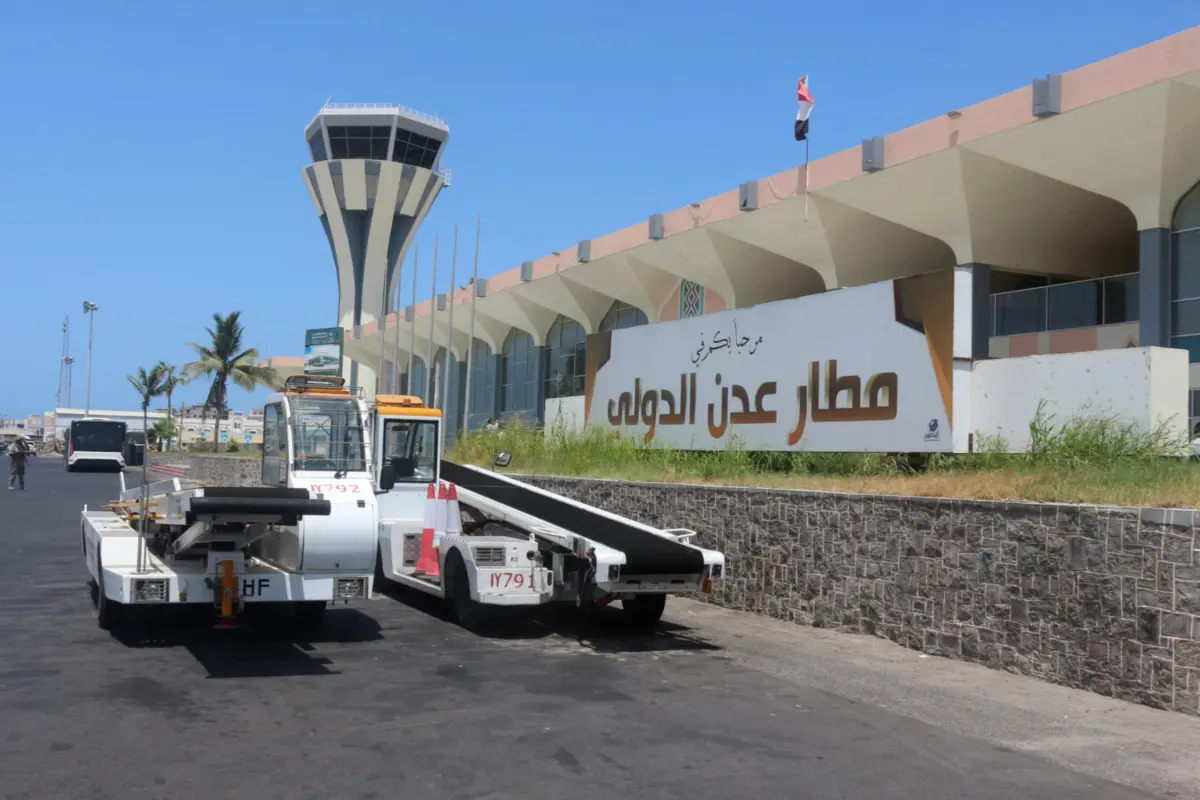
The internationally recognized government of Yemen has reported a significant escalation in hostilities as Houthi rebel forces launched multiple missile strikes targeting the Aden International Airport on Friday. This latest assault follows a deadly attack on the presidential palace in the southern port city just twenty-four hours prior, signaling a dangerous intensification of the conflict that has plagued the nation for over a decade. According to Yemeni Information Minister Moammar al-Eryani, two missiles landed in close proximity to the airport’s runway, striking approximately 500 meters (1,640 feet) from a civilian aircraft that was in the final stages of preparation for takeoff.
The Information Minister confirmed that all passengers and crew members aboard the aircraft were unharmed, attributing the lack of casualties to "divine providence" while warning that the strike narrowly avoided a "horrific humanitarian catastrophe." In a statement released on social media platform X, al-Eryani condemned the bombardment as a "grave violation of international laws and norms," highlighting the vulnerability of civilian infrastructure in the contested seat of the Yemeni government.
The Strategic Assault on Aden
The Houthi movement, also known as Ansar Allah, issued a statement through a military source claiming responsibility for the strikes in Aden. However, the group’s narrative differed from the government’s account, asserting that their operation specifically targeted the command headquarters of "Saudi forces" located at the Badr camp within the Aden province. The Houthis further claimed to have successfully struck a weapons depot in the vicinity. This discrepancy in targeting—between civilian transport hubs and military installations—has become a recurring theme in the information war between the warring factions.
Aden has served as the temporary capital for the internationally recognized government since the Houthis seized the traditional capital, Sanaa, in 2014. The city’s airport is a vital lifeline for humanitarian aid, diplomatic travel, and the movement of Yemeni citizens. An attack of this nature not only threatens the safety of non-combatants but also risks further isolating the government and disrupting the already fragile supply chains that sustain the southern provinces.
Heavy Losses Reported in the Marib Offensive
While the eyes of the international community were fixed on the explosions in Aden, a brutal ground war continued to rage in the northern and central highlands. Yemeni government forces claimed to have made significant territorial gains in Marib province, a region of immense strategic and economic importance due to its vast oil and gas reserves. Military spokesman Majed al-Nazili reported that government troops, bolstered by intensive air support from the Saudi-led coalition, had secured "key positions" in the eastern sector of the province.
The human cost of the latest 24-hour cycle of violence in Marib has been staggering. Al-Nazili stated that government forces had "neutralized" more than 430 Houthi fighters in a single day. While these figures are difficult to verify independently, they point to the high-intensity nature of the current combat phase. In addition to the loss of personnel, the government claimed to have destroyed or disabled over 100 Houthi military vehicles and assets, including technicals and armored units.
Marib remains the last major northern stronghold of the internationally recognized government. For the Houthis, capturing the province would provide a decisive economic boost and effectively end the government’s presence in the north. For the government, holding Marib is essential for its continued political legitimacy and its ability to negotiate from a position of relative strength.
The Siege of Taiz and the Capture of Specialized Units
To the southwest, the governorate of Taiz has re-emerged as a pivotal battlefront. Government forces in the region reported fending off several "large-scale" Houthi offensives aimed at breaking government lines. Taiz, Yemen’s third-largest city, has been under a partial Houthi siege for years, but recent weeks have seen the situation deteriorate sharply.
A significant development in the Taiz theater was the reported capture of a specialized Houthi drone team. The use of Unmanned Aerial Vehicles (UAVs) has become a hallmark of Houthi military strategy, allowing the group to conduct surveillance and precision strikes far behind enemy lines. The capture of such a team represents a tactical blow to the Houthis’ reconnaissance capabilities in the area.
The humanitarian situation in Taiz is reaching a breaking point. Houthi forces have recently succeeded in encircling the city more tightly by cutting the main road leading south to Aden. This maneuver has not only trapped thousands of civilians but has also caused widespread displacement and a sharp spike in the prices of essential goods, including food, clean water, and medical supplies.
Regional Escalation: Missiles Over Riyadh
The conflict in Yemen continues to spill across international borders. On Friday, the Saudi-led coalition announced that its air defense systems had intercepted and downed several missiles and drones launched by Houthi forces toward Riyadh and other regions of Saudi Arabia. These cross-border attacks are a frequent occurrence, often timed to coincide with major ground offensives within Yemen.
Saudi Arabia has consistently accused Iran of providing the Houthis with advanced weaponry, including long-range ballistic missiles and sophisticated drone technology. Riyadh maintains that the Houthi insurgency is a proxy for Iranian regional ambitions. However, Tehran’s Ministry of Foreign Affairs issued a firm rejection of these claims on Friday. An Iranian spokesperson stated that the Islamic Republic played no role in the Houthi operations and instead reiterated a long-standing proposal to mediate between the warring parties.
A Timeline of Reignition: From Truce to Blockade
The current surge in violence follows a period of relative calm. To understand the gravity of the present situation, it is necessary to examine the chronology of the conflict’s recent reignition:
- 2014–2015: The Houthis seize Sanaa, forcing President Abdrabbuh Mansur Hadi to flee. A Saudi-led coalition intervenes in March 2015 to restore the government.
- 2022: A UN-backed truce brings a significant reduction in violence, though a permanent political settlement remains elusive.
- July 2026: Tensions escalate dramatically as the Houthis declare a naval blockade of Saudi Arabian ports and shipping lanes passing through the strategic Bab al-Mandeb Strait.
- September 2026: Houthi forces launch a lightning ground offensive on the Red Sea port of Mocha, successfully pushing back government loyalists.
- Late September 2026: Houthi units seize Mayyun Island, a strategic landmass in the Bab al-Mandeb Strait, granting them control over one of the world’s most vital maritime chokepoints.
- October 15–16, 2026: Sequential attacks on the presidential palace and Aden International Airport signal a new phase of high-profile targeting in the temporary capital.
Analysis of Implications and the Global Impact
The targeting of Aden International Airport and the ongoing blockade of the Bab al-Mandeb Strait have implications that extend far beyond the borders of Yemen. The strait is a transit point for an estimated 4 to 5 million barrels of oil per day and a significant portion of global trade between Asia and Europe. The Houthi naval blockade and their ability to strike key infrastructure like airports suggest a strategy aimed at crippling the Yemeni economy and exerting pressure on the international community to recognize their authority.
Furthermore, the scale of casualties reported in Marib—if even partially accurate—indicates a shift toward a "war of attrition" that neither side is currently winning. The government’s claims of neutralizing 430 fighters in 24 hours suggest a desperate and bloody struggle for every inch of territory.
For the civilian population, the reignition of the war is a catastrophe. Yemen was already facing what the United Nations described as the world’s worst humanitarian crisis. With the blockade affecting imports and the fighting causing new waves of displacement in Taiz and Marib, the risk of widespread famine and the collapse of the healthcare system has returned to the forefront.
The international community now faces a difficult dilemma. Diplomatic efforts to reinstate the truce have stalled, and the Houthis’ recent territorial gains and successful strikes on Aden have emboldened their leadership. Meanwhile, the Saudi-led coalition remains committed to defending the recognized government, leading to a stalemate where the primary victims are the millions of Yemenis caught in the crossfire. As missiles continue to fall on airports and palaces, the path toward a sustainable peace in Yemen appears more obstructed than ever.
