

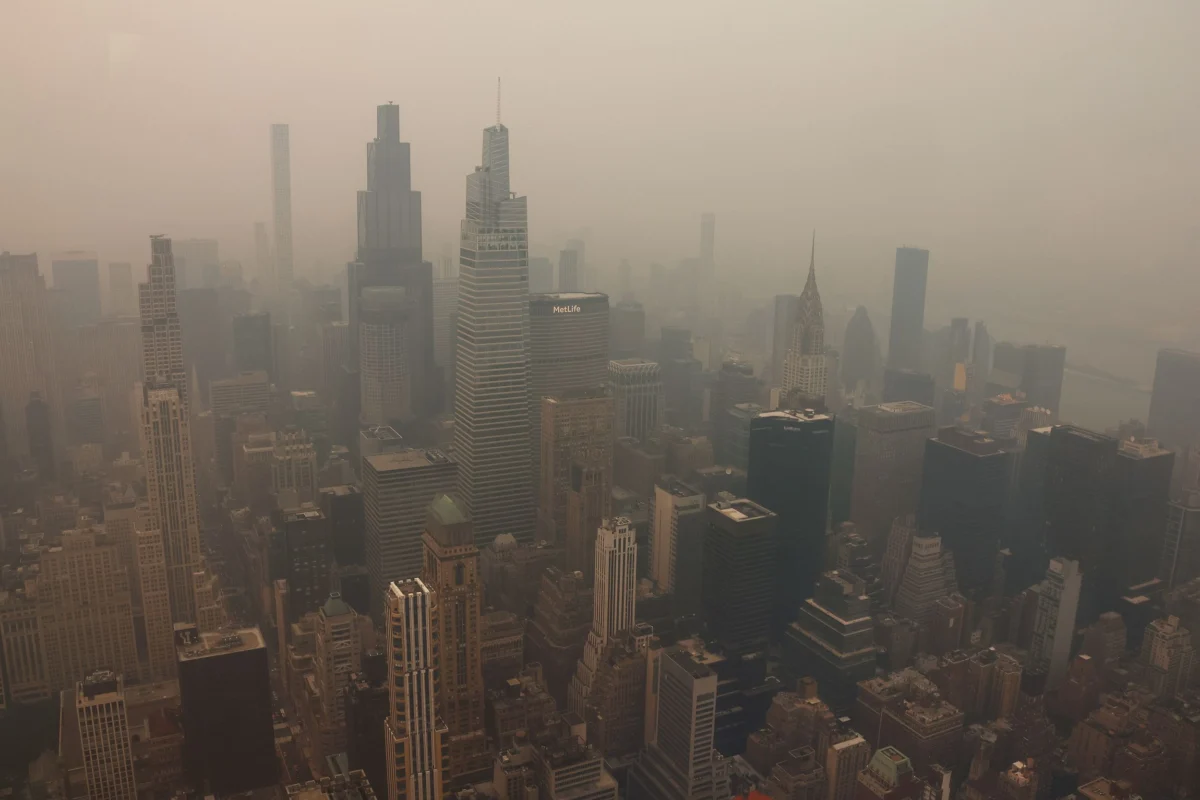
The most anticipated event in global sports is scheduled to take place this Sunday as Argentina and Spain prepare to face off in the World Cup final just outside New York City. However, the historic clash between the reigning world champions and the rising European powerhouse is being overshadowed by an environmental crisis. Thick plumes of wildfire smoke, originating from massive blazes in Canada, have descended upon the tristate area, triggering hazardous air quality alerts and raising urgent questions about the safety of players and spectators alike. Despite the escalating health risks, FIFA, the international governing body for soccer, appears to have no formal contingency plan to address air pollution, leaving the final’s status in a state of atmospheric uncertainty.
For several days, wildfire smoke has been drifting south, blanketing the Midwest and the East Coast in a persistent, acrid haze. The impact has been felt across more than a dozen states, with major metropolitan centers experiencing some of the worst air quality recorded in decades. In New York and New Jersey, residents have watched the sky transform into an eerie shade of orange. On Thursday, New York state officials issued a comprehensive health advisory as the Air Quality Index (AQI) surged into the "unhealthy" and "very unhealthy" categories. Public health officials have been blunt in their assessments, urging the public to avoid outdoor activities and remain indoors with filtration systems running whenever possible.
As of Friday morning, the air quality in the immediate vicinity of MetLife Stadium in East Rutherford, New Jersey—the venue for the final—remained firmly in the unhealthy range. While meteorological forecasts suggest a potential shift in wind patterns that could improve conditions to "moderate" by Sunday’s kickoff, the volatility of wildfire smoke makes such predictions precarious. Because the stadium is an open-air facility with no retractable roof, there is no physical barrier to protect the tens of thousands of fans or the athletes from inhaling fine particulate matter. The match is set to feature some of the world’s most recognizable stars, including the legendary Lionel Messi and the teenage sensation Lamine Yamal, both of whom would be forced to perform under grueling environmental conditions if the smoke persists.
The Physiological Toll on Elite Athletes
The health implications of playing a 90-minute high-intensity match in poor air quality are significant. Wildfire smoke contains PM2.5, fine particulate matter that is small enough to enter the bloodstream and settle deep within the lungs. For professional soccer players, the risks are amplified by the nature of the sport. During a match, an elite midfielder or forward can run upward of seven miles, breathing at a rate significantly higher than a person at rest.
Dr. Courtney Howard, an emergency room physician and official with the Global Climate and Health Alliance, expressed grave concerns regarding the lack of protective measures. Speaking to the Associated Press, Howard noted that high-level athletes move a massive volume of air through their respiratory systems during competition. When that air is saturated with wildfire pollutants, it can lead to immediate symptoms such as throat irritation, persistent coughing, chest tightness, and severe headaches. More critically, for athletes or fans with underlying conditions like asthma or cardiovascular issues, the exposure can trigger life-threatening episodes.
The Spanish national team has already felt the impact of the drifting smoke, conducting a scheduled practice session on Thursday in New Jersey under hazy skies. Medical experts argue that such exposure during the "tapering" phase of tournament preparation can diminish lung function and recovery times, potentially affecting the quality of play in the final.
A Lack of Regulatory Framework
The primary criticism leveled against FIFA in the lead-up to Sunday is the organization’s perceived lack of a standardized air quality protocol. While FIFA has developed sophisticated "Cooling Break" mandates to protect players during extreme heat—triggered when the Wet Bulb Globe Temperature (WBGT) hits specific thresholds—it has yet to implement a similar trigger for air pollution.
In a statement previously provided to environmental news outlet Grist, FIFA emphasized that "climate-related risks are assessed as part of overall tournament planning" and managed in coordination with local host cities and national agencies. However, the organization did not provide specifics on what AQI level would necessitate a delay or cancellation. This lack of transparency stands in stark contrast to other professional sports leagues that have faced similar challenges during this North American summer.
The National Women’s Soccer League (NWSL), for example, has established clear, data-driven policies. During a match at Citi Field in New York this week, the NWSL implemented mandatory hydration and oxygen breaks because the AQI exceeded 101. Their policy further dictates that if the AQI surpasses 200—the "very unhealthy" threshold—matches must be postponed or moved. Similarly, Major League Baseball (MLB) rescheduled a game in Philadelphia this week, and Major League Soccer (MLS) canceled a fixture in Chicago as smoke levels reached dangerous heights.
Chronology of a Growing Crisis
The current crisis is the culmination of a five-week period where the World Cup has been played against a backdrop of increasing environmental instability.
- Week 1-2: The tournament opened with matches across various North American venues. While heat was the primary concern in Southern host cities, air quality remained stable.
- Week 3: Wildfires in Quebec and Alberta intensified due to a prolonged period of drought and record-breaking temperatures. Smoke began moving into the American Great Lakes region.
- Week 4: As the quarter-finals and semi-finals commenced, several host cities reported "moderate" air quality. FIFA officials maintained that schedules would remain unchanged.
- The Final Week: A massive shift in high-pressure systems pushed a dense plume of smoke directly into the Northeast corridor. By Wednesday, the AQI in New York City hit its highest level since the 1960s, turning the sun into a dim red disc and forcing the cancellation of outdoor community events and youth sports leagues across the region.
Despite these developments, FIFA has remained committed to the Sunday schedule. Nicholas Watanabe, a professor of sport and entertainment management at the University of South Carolina, suggests that FIFA is essentially "gambling" on the weather. While current models show the smoke dissipating just in time for the final, Watanabe argues that "dodging a bullet" is not a substitute for a comprehensive safety policy.
Financial and Logistical Pressures
The reluctance to postpone the World Cup final is likely tied to the immense logistical and financial weight of the event. With billions of viewers expected to tune in globally and hundreds of millions of dollars in sponsorship and broadcasting revenue at stake, the pressure to proceed is enormous. A postponement would involve rescheduling international flights for tens of thousands of fans, coordinating with security and stadium staff, and navigating complex broadcasting windows.
However, players are beginning to speak out about the necessity of prioritizing health over schedules. Trinity Rodman, a star for the U.S. Women’s National Team who recently played in smoke-affected conditions in the NWSL, voiced her frustration: "If we have to have a hydration break every 15 minutes, then we shouldn’t be playing the game." Her sentiment reflects a growing consensus among athletes that the traditional sports calendar is increasingly at odds with the realities of a changing climate.
The Broader Impact: A New Normal for Global Sports
The situation in New Jersey is not an isolated incident but part of a broader trend affecting global athletics. Earlier this month, professional cyclists at the Tour de France raised similar alarms. Yellow jersey holder Tadej Pogačar suggested that the entire cycling calendar might need to be overhauled as extreme heat and wildfire smoke become summer staples in Europe. "I would change the whole calendar," Pogačar stated, acknowledging that while he lacks the power to do so, the current conditions are becoming untenable for peak performance.
As the World Cup final approaches, the sporting world is watching to see how FIFA handles the final 48 hours of preparation. If the match proceeds under a haze of PM2.5, it may set a controversial precedent for how international bodies weigh commercial interests against the physical well-being of their participants.
The potential for a "wake-up call" is evident. Whether the air clears by Sunday or not, the 2024 World Cup final will likely be remembered as the moment the "beautiful game" was forced to confront the harsh reality of a warming planet. For FIFA, the challenge moving forward will be to transition from a reactive stance to a proactive one, developing the same level of rigor for air quality as they have for match-fixing or stadium safety. As Professor Watanabe noted, "This should serve as a warning to all sport leagues. Climate risk is no longer a theoretical problem for the future; it is a direct threat to the integrity of the game today."
