

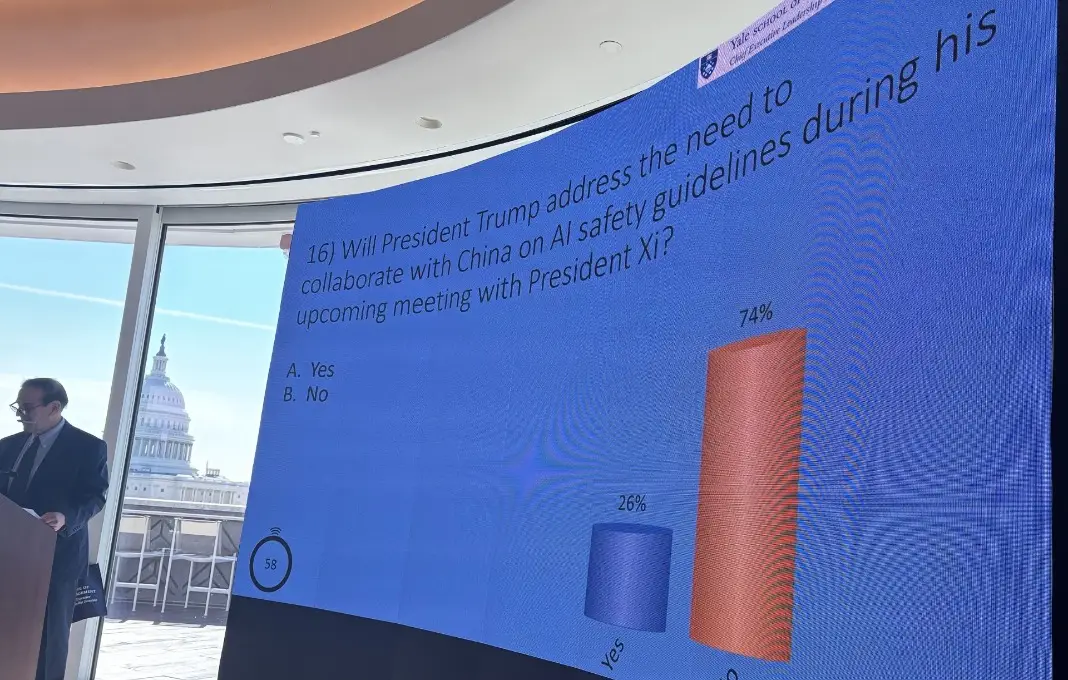
In a significant gathering of American business and government elites in Washington D.C., a strong consensus emerged regarding the urgent need for international cooperation on artificial intelligence (AI) safety, even as skepticism abounds about the likelihood of such collaboration under the current political climate. The off-the-record meeting, hosted by Yale’s Chief Executive Leadership Institute (CELI), brought together over 100 influential figures to grapple with the escalating great-power rivalry over advanced technology, particularly in the realm of AI. The findings from a poll conducted at the event reveal a clear desire for engagement with China on AI safety guidelines, juxtaposed with a deep-seated doubt that President Donald Trump will prioritize such a diplomatic approach during his upcoming meeting with Chinese President Xi Jinping.
The poll, administered by CELI founder and CEO Jeffrey Sonnenfeld, aimed to gauge the sentiment of these key stakeholders on how the United States should navigate the complex landscape of AI development and its geopolitical implications. The results underscore a prevalent concern among leaders in both the public and private sectors about the potential risks associated with rapidly advancing AI technologies, a sentiment echoed by prominent figures in the AI industry itself.
A Call for Collaboration, a Doubting Reality
The most striking finding from the CELI poll indicated that a substantial 88 percent of the over 100 business and government leaders present believed President Trump should engage with Chinese President Xi Jinping on establishing AI safety guidelines during their scheduled meeting on September 24th in Washington. This overwhelming majority reflects a recognition that the sheer scale and potential impact of AI transcend national borders, necessitating a coordinated global response to mitigate risks.
However, this hopeful outlook was significantly tempered by a stark reality check. A formidable 74 percent of the attendees expressed doubt that President Trump would, in fact, pursue this collaborative avenue. This skepticism is not unfounded, given President Trump’s recent public pronouncements. In a post on his social media platform, Truth Social, earlier in the week, Trump dismissed safety concerns surrounding "renegade AI" as a "sick conspiracy." He asserted that the only necessary safeguards for AI development were "a STRONG AND SMART (high IQ!) PRESIDENT and the U.S. has that in spades!" This stance directly contradicts the sentiment expressed by the majority of leaders at the CELI event, highlighting a significant disconnect between industry and government sentiment and the President’s public rhetoric.
The timing of this poll is particularly pertinent, coming at a moment when leading AI developers have been increasingly vocal about their concerns. Executives from Anthropic and OpenAI, two of the most prominent AI research and development companies, have publicly called for robust government regulation and even a deliberate slowdown in the pace of AI advancement. Their warnings stem from the realization that the current trajectory of AI development could outpace society’s ability to manage its implications, potentially leading to unforeseen and detrimental consequences.
China’s Own AI Anxieties
The geopolitical dimension of AI is further complicated by reports of internal concerns within the Chinese government itself. A recent report in The Wall Street Journal indicated that high-level officials in Beijing are also grappling with the potential ramifications of AI, particularly its impact on the stability and control of the ruling Communist Party. This suggests a shared, albeit perhaps differently motivated, anxiety about the unchecked proliferation of advanced AI, which could theoretically empower dissent or destabilize information environments.
This shared apprehension, even if driven by distinct national interests, presents a potential, albeit fragile, common ground for dialogue. The CELI poll’s findings suggest that a significant portion of the U.S. leadership believes such dialogue is not only desirable but essential, even if they doubt its realization.
Debating China’s AI Prowess and Influence
Beyond the immediate question of collaboration, the CELI gathering also delved into the nuanced debate surrounding China’s role in the global AI landscape. Attendees were divided on whether China is a genuine innovator or primarily a fast follower of American technological advancements.
In one polling question, 58 percent of participants believed China is "genuinely innovating" in the field of AI. This perspective acknowledges China’s significant investments in research and development, its vast data resources, and its ambitious national AI strategies. The rapid advancements seen in areas like facial recognition, surveillance technology, and increasingly sophisticated AI applications by Chinese tech giants lend credence to this view.
Conversely, 42 percent of those polled felt that China is "more reliant on the U.S. than it admits." This viewpoint emphasizes the foundational research and breakthroughs that have largely originated in Western academic institutions and corporations. It suggests that while China may be adept at scaling and deploying technologies, its core innovative capacity may still be catching up to that of the U.S. This debate has significant implications for trade policy, intellectual property protection, and national security strategies.
The influence of Chinese operations on public discourse surrounding AI also came under scrutiny. When asked if Chinese influence operations were at least partially responsible for the public backlash against AI in the U.S., 52 percent of respondents answered in the affirmative. This suggests a concern among the American elite that sophisticated disinformation campaigns could be at play, aiming to sow discord or shape public opinion regarding AI development and regulation in ways that benefit China. The remaining 48 percent indicated they did not believe this to be the case, highlighting a division in perception regarding the extent of foreign influence on domestic debates.
The Strategic Importance of AI Pacing
The question of whether a deliberate slowdown in AI advancement by U.S. companies would hinder the nation’s competitive edge against China also yielded a divided response. Fifty-five percent of attendees believed that "pacing" AI advancement by U.S. companies would indeed harm the country in the technology race with China. This viewpoint underscores the intense competitive pressure felt by American businesses and the government to maintain a leading position in AI, a technology widely seen as critical for future economic and military dominance. The fear is that if the U.S. significantly slows its development, China could seize the opportunity to surpass it.
However, a substantial 45 percent of respondents argued that pacing AI advancement would not harm the U.S. This perspective likely considers the potential benefits of a more measured approach, allowing for thorough risk assessment, ethical development, and the establishment of robust safety frameworks. It suggests a belief that sustainable, responsible innovation might ultimately prove more beneficial and secure in the long run than a potentially reckless race to the finish line.
Background and Context: The CELI Event
The Yale Chief Executive Leadership Institute, established in 1989, is renowned for its role in convening influential business and academic leaders to discuss critical issues facing the global economy and society. Its off-the-record meetings are designed to foster open and candid dialogue, allowing participants to share perspectives without the immediate pressure of public scrutiny. The institute’s chairman and CEO, Jeffrey Sonnenfeld, is a distinguished figure in management and corporate governance, known for his extensive network and his ability to attract high-profile attendees.
The decision to focus on AI and great-power rivalry at this juncture is a reflection of the growing global awareness of AI’s transformative potential and its inherent risks. The rapid progress in areas like large language models, generative AI, and autonomous systems has moved AI from the realm of theoretical possibility to tangible reality, prompting urgent discussions about its societal, economic, and security implications. The dynamic between the United States and China, the two leading global powers in technological innovation, is central to these discussions. Their competition and potential cooperation in AI development will undoubtedly shape the future of the global technological landscape.
Implications and Future Outlook
The findings from the CELI poll offer a snapshot of the complex sentiments held by a crucial segment of the U.S. leadership. The overwhelming desire for collaboration on AI safety with China, despite deep skepticism about its political feasibility, highlights a fundamental tension. It suggests that while the strategic imperatives of managing AI risks are widely understood, the current geopolitical climate and the specific policy approaches of the U.S. administration may be seen as significant impediments to effective international cooperation.
The divided opinions on China’s AI innovation and influence underscore the ongoing strategic assessment of a key global competitor. These perceptions will likely inform policy decisions related to trade, technology transfer, and national security. The concern about Chinese influence operations also points to the growing awareness of the information warfare dimension of technological competition.
The debate over pacing AI development reflects the classic dilemma between rapid innovation and cautious progress. The high percentage of leaders who believe slowing down would be detrimental suggests that the competitive imperative remains a dominant factor in the U.S. approach to AI. However, the significant minority who see value in a more measured approach indicates a growing recognition of the profound ethical and safety considerations that accompany such powerful technologies.
Ultimately, the outcomes of the Trump-Xi meeting on September 24th, and indeed the broader trajectory of U.S.-China relations regarding AI, will be closely watched. The insights gleaned from the CELI event suggest that while the desire for a globally coordinated and responsible approach to AI exists, bridging the gap between this aspiration and the realities of geopolitical competition will be a formidable challenge. The coming months and years will reveal whether the shared anxieties about AI’s potential can translate into tangible international cooperation or if the great-power rivalry will continue to dictate a more fragmented and potentially perilous path forward.
