

Israeli settlements are Jewish-only communities constructed in clear violation of international law on Palestinian land within the occupied West Bank and East Jerusalem. These sprawling enclaves often mimic ordinary suburbs, characterized by uniform townhouses, distinctive red-tiled roofs, and meticulously maintained lawns, frequently perched atop strategic hills. From these elevated positions, they command sweeping views of the Palestinian towns and villages that have been fragmented and encroached upon to facilitate their expansion. This comprehensive analysis maps the persistent spread of these illegal Israeli settlements and outposts, detailing the accompanying settler violence, which has now reached unprecedented levels.
The Historical Trajectory and Legal Framework of Settlement Expansion
The phenomenon of Jewish communities in historic Palestine predates the establishment of Israel in 1948. However, the scale and scope of what are now defined as illegal settlements dramatically accelerated following Israel’s occupation of the West Bank, East Jerusalem, and the Gaza Strip (from which it disengaged in 2005) in the aftermath of the 1967 Six-Day War. This military occupation marked a critical turning point, leading to a systematic policy of establishing civilian populations in the newly acquired territories.

Over the past six decades, what began as scattered hilltop outposts has evolved into an extensive network of settlements, interconnected by a dedicated system of roads and highways. These infrastructure projects not only link the settlements to each other but also integrate them seamlessly with Israel proper, further solidifying their presence and control over the occupied land. This expansion is widely considered by the international community to be a deliberate strategy aimed at creating facts on the ground, thereby making the establishment of a viable, contiguous Palestinian state increasingly difficult.
Under international law, these settlements are unequivocally illegal. They contravene the Fourth Geneva Convention, which explicitly prohibits an occupying power from transferring parts of its own civilian population into the territory it occupies. This position has been consistently affirmed by numerous international bodies, including the United Nations Security Council, the International Court of Justice (ICJ), and the International Committee of the Red Cross. Most recently, the ICJ reiterated this stance in its July 2024 advisory opinion, which underscored the illegality of Israel’s settlement policies and their breach of international law. The Security Council has also passed multiple resolutions condemning the settlements, notably Resolution 2334 in 2016, which reaffirmed that the establishment of settlements has "no legal validity" and constitutes a "flagrant violation under international law."
Conversely, under Israeli domestic law, these settlements are legally sanctioned. They are meticulously planned, generously funded, and constructed with direct governmental approval. They range in size from small rural communities to expansive urban centers, such as Ariel and Maale Adumim. This fundamental divergence between international and Israeli law lies at the heart of the ongoing dispute and the persistent international condemnation of settlement activity.

The Mechanics of Growth: Settlements and Outposts Delineated
A crucial distinction exists between "settlements" and "outposts" within the Israeli lexicon, though both are deemed illegal under international law. Settlements, as defined by Israeli law, are communities that have received formal authorization, planning, and funding from the Israeli government. They are fully recognized and supported by the state apparatus.
Outposts, on the other hand, are smaller, often nascent communities established without formal authorization from the Israeli government. Despite their unofficial status, many outposts are later retroactively legalized or absorbed into existing, officially recognized settlements. This process often involves the provision of infrastructure, security, and municipal services, effectively transforming an initially unauthorized presence into a de facto, and eventually de jure, part of the larger settlement enterprise. The proliferation of outposts serves as a vanguard for further expansion, testing the boundaries of Palestinian land and often preceding more formalized settlement growth.
According to Peace Now, a prominent Israeli anti-settlement watchdog, there are at least 148 illegal settlements in the occupied West Bank and 15 in occupied East Jerusalem, totaling 163 recognized entities. These settlements are now home to approximately 750,000 Israelis, representing roughly 10 percent of the country’s Jewish population. The pace of expansion remains relentless. In 2025 alone, nearly 28,000 housing units were advanced within existing settlements in the occupied West Bank. This figure represents a significantly greater volume of growth than the number of new settlements or outposts added independently, highlighting an intensification of construction within established areas.

By 2024, the settler population in these 163 illegal settlements had reached 744,700 individuals: 511,100 in the West Bank and 233,600 in East Jerusalem. This growth is compounded by a record number of illegal outposts, now exceeding 400. These outposts, while not officially counted in government statistics, are frequently absorbed into recognized settlements over time, making a precise and accurate tally of the full extent of the Israeli presence challenging to ascertain. The continuous establishment and expansion of these outposts demonstrate an organic, ground-up component to the settlement enterprise, often driven by ideological settlers seeking to claim more Palestinian land.
Geographic Fragmentation: How Settlements Carve Up Palestinian Land
The physical manifestation of settlement expansion has profound geographical and demographic consequences, fundamentally altering the landscape of the West Bank and East Jerusalem. Many Israeli settlements have evolved into substantial urban communities, equipped with their own municipal structures, mayors, educational institutions, shopping centers, medical facilities, and even universities.
Modi’in Illit stands as the largest settlement, boasting a population of 89,301 residents. It is closely followed by Beitar Illit, with 70,251 inhabitants, and Pisgat Ze’ev, home to 48,419. These large urban centers operate almost entirely independently of the surrounding Palestinian areas, creating self-sufficient enclaves within occupied territory.

Crucially, these settlements are interconnected by a dense network of roads, many of which are designated exclusively for settlers. These bypass roads frequently cut through Palestinian agricultural land and residential areas, severing communities and disrupting the daily lives of Palestinians. Backed by a pervasive system of checkpoints and roadblocks, these roads severely restrict the movement of Palestinians, isolating villages and towns and impeding their access to land, resources, and essential services. The result is a fragmented Palestinian territory, akin to an archipelago of disconnected enclaves, making free movement and economic development exceptionally difficult.
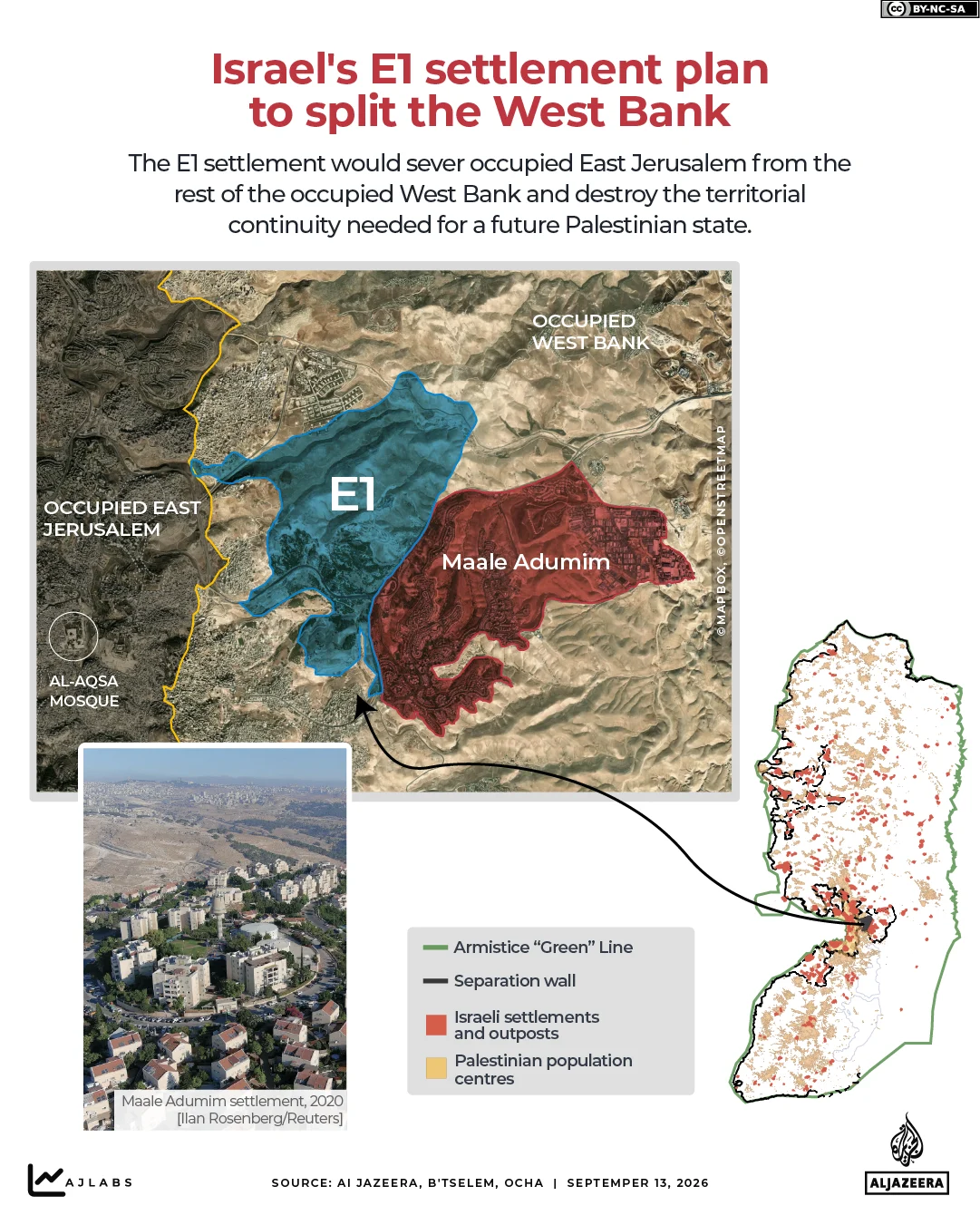
Nowhere is this fragmentation more acutely demonstrated than in the E1 area, located east of Jerusalem. This strategic zone is earmarked for the expansion of Maale Adumim, a major settlement. If fully implemented, the E1 plan would effectively sever East Jerusalem from the rest of the West Bank, creating a contiguous bloc of Israeli territory that would stretch from Jerusalem deep into the Jordan Valley. This would deal a critical blow to the principle of Palestinian territorial continuity and further undermine the viability of a future Palestinian state with East Jerusalem as its capital.
In August 2025, Israeli Finance Minister Bezalel Smotrich approved plans for over 3,000 new homes in the E1 settlement project. This plan had been frozen for decades due to intense international pressure. Smotrich’s declaration that this move would "bury the idea of a Palestinian state" underscored the political motivations behind the expansion. The decision triggered widespread global condemnation, with nearly 30 governments and the European Commission unequivocally labeling it as "unacceptable and a violation of international law," highlighting the deep international concern over the E1 project’s implications for peace.

The Driving Forces: Demographics and Motivations of Settlers
The Israeli settler population is broadly composed of two distinct groups, each driven by different motivations.
The first group is largely influenced by economic incentives. Settlers are often drawn to the West Bank and East Jerusalem by significantly cheaper rents, subsidized mortgages, discounted land prices, and various government incentives. These economic benefits make housing in illegal settlements far more affordable compared to living within Israel proper, appealing to those seeking a lower cost of living or more spacious homes. For many in this group, the primary motivation is pragmatic and financial, rather than ideological.
The second group comprises religious-nationalists, for whom the settlement enterprise is deeply rooted in ideological and theological convictions. These settlers believe the land, which they refer to as Judea and Samaria, was divinely promised to the Jewish people. This group includes the "hilltop youth," a younger, often more radical element known for aggressively establishing new outposts and frequently engaging in attacks against Palestinian communities. Their actions are often carried out with the tacit or overt support of the Israeli military, which in many instances stands by or actively backs these settler incursions. A notable example is the weeks-long siege of Qusra, which began in August and continues under military enforcement, illustrating the deeply intertwined nature of settler activity and state security forces.

Escalating Violence: The Rise of Settler Attacks and the Term "Pogroms"
The period following October 7, 2023, has witnessed a dramatic and alarming escalation in settler violence against Palestinians. Experts and UN officials are increasingly using the term "pogroms" to describe these attacks. A pogrom refers to organized, often state-backed violence perpetrated against a targeted minority group. This terminology reflects the systematic and often coordinated nature of these attacks, as well as the observed complicity or inaction of Israeli security forces. Israeli military officers themselves have reportedly used this term after past incidents, such as the destructive 2023 attack on Huwara.
According to data from the UN Office for the Coordination of Humanitarian Affairs (OCHA), settler attacks resulting in casualties and/or property damage have surged significantly. In 2025, a staggering 1,836 such attacks were recorded, more than double the 852 incidents documented in 2022. This translates to an average of approximately five attacks every single day. The period since October 7, 2023, has been particularly brutal, with a total of 5,131 attacks recorded. The upward trend has continued into 2026, with 1,418 attacks documented between January and July alone, indicating that the year is on track to surpass previous records for settler violence.
This escalating violence, coupled with the relentless creation of new outposts, illustrates a dual-pronged approach to illegal settlement expansion. On one hand, the government facilitates growth through established communities and official planning. On the other, new activity on the ground, often spearheaded by ideological settlers and accompanied by violence, aggressively claims and occupies additional Palestinian land. These two aspects of settlement activity are deeply intertwined, each reinforcing the other and contributing to the overall dispossession and subjugation of Palestinians.

International Condemnation and Broader Implications
The consistent expansion of Israeli settlements and the rising tide of settler violence have drawn widespread and unequivocal condemnation from the international community. The United Nations, through its various bodies, including the Security Council and the Human Rights Council, has repeatedly called for an end to settlement construction and for Israel to adhere to its obligations under international law. The European Union has also consistently voiced its strong opposition, often issuing joint statements with member states condemning new settlement approvals and expressing concern over their impact on the prospects for a lasting peace.
The United States, while historically a key ally of Israel, has also, at times, expressed concern over settlement expansion, particularly during administrations that have actively pursued a two-state solution. However, US policy on settlements has varied, with some administrations adopting a more critical stance than others. Nevertheless, the broad international consensus remains that settlements are illegal, an obstacle to peace, and undermine the viability of a Palestinian state.
The implications of this unabated settlement expansion are profound and far-reaching. Firstly, it poses an existential threat to the two-state solution, which envisions an independent Palestinian state alongside Israel. By fragmenting Palestinian territory, confiscating land, and creating irreversible facts on the ground, settlements make the establishment of a contiguous, sovereign, and economically viable Palestinian state increasingly unattainable.

Secondly, the settlements perpetuate and intensify the humanitarian crisis in the occupied Palestinian territories. They restrict Palestinian movement, hinder economic development, displace communities, and deny Palestinians access to their land and natural resources. The accompanying settler violence further exacerbates this situation, creating an environment of fear, instability, and insecurity for Palestinian civilians.
Thirdly, the continued construction of settlements fuels regional instability and undermines efforts to achieve a just and lasting peace in the Middle East. It erodes trust between Israelis and Palestinians, strengthens extremist narratives on both sides, and makes diplomatic solutions increasingly difficult to achieve. The international community’s persistent focus on this issue underscores its critical role in the broader Israeli-Palestinian conflict and the urgent need for adherence to international law to pave the way for a peaceful resolution.
In conclusion, the expansion of illegal Israeli settlements and the accompanying surge in settler violence represent a critical and escalating challenge to international law, human rights, and the prospects for peace in the Middle East. The systematic nature of this expansion, driven by both economic incentives and ideological convictions, continues to reshape the geopolitical landscape of the occupied territories, with devastating consequences for Palestinians and enduring implications for regional stability.
