

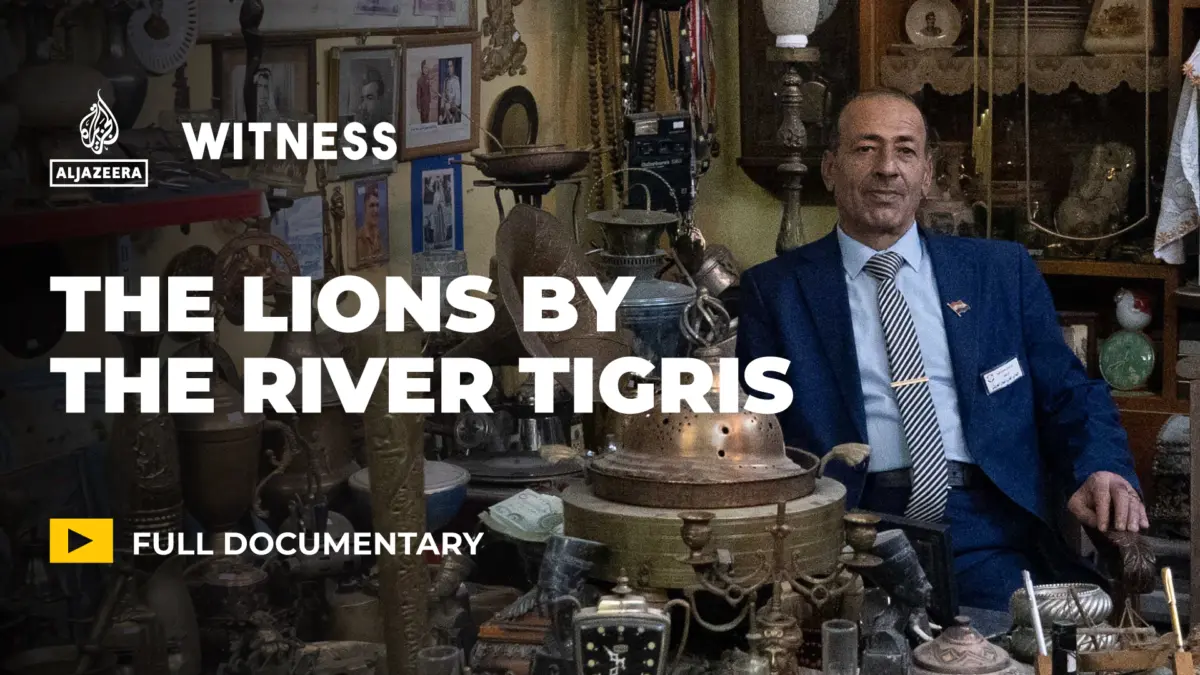
The Lions by the River Tigris: Mosul’s Enduring Spirit Amidst Ruins and Revival chronicles a poignant struggle for identity and restoration in the ancient Iraqi city of Mosul, nearly a decade after its devastating liberation from the Islamic State of Iraq and Syria (ISIL). This documentary by Zaradasht Ahmed focuses on three men whose lives intersect around a singular, potent symbol of Mosul’s shattered yet enduring past: a magnificent marble gate adorned with carved lions. These artifacts, more than mere relics, embody the city’s 8,000 years of history and the fierce determination of its people to reclaim their heritage from the ashes of conflict.
At the heart of war-ravaged Mosul, these two carved lions stand as a fragile yet defiant link to the city’s profoundly damaged heritage. Bashar, a fisherman, bears the deep scars of conflict, having lost his once-grand family home during the brutal battle to liberate Mosul from ISIL nearly 10 years ago. All that physically remains of his ancestral dwelling is this marble gate, crowned with the stoic lion carvings, which he fiercely guards as a testament to his family’s legacy and Mosul’s indelible spirit. His dedication reflects a broader sentiment among Mosul’s residents: a profound attachment to their cultural roots, even when confronted with overwhelming loss.
This deeply personal narrative intertwines with the ambitions of Fakhri, a devoted collector driven by an unwavering determination to salvage and preserve Mosul’s heritage. Fakhri becomes consumed by the desire to acquire Bashar’s lions gate for his unofficial museum, a sanctuary he has painstakingly created to house fragments of the city’s past. His quest, while seemingly focused on an inanimate object, represents the collective yearning to piece back together a fragmented cultural identity. However, Fakhri’s friend, Fadil, a musician whose melodies were once silenced under ISIL’s draconian rule, offers a crucial counterpoint. Fadil challenges Fakhri to look beyond the aesthetic or historical value of each artifact, urging him to recognize the profound human cost and individual stories embedded within every stone and melody. As Mosul slowly rebuilds its infrastructure, a quiet but potent cultural revival is taking root, mirroring the astonishing resilience of a city whose history stretches back millennia.
Mosul’s Fall and the Reign of Terror
To fully appreciate the significance of this struggle, it is crucial to understand the devastating context of Mosul’s recent history. The city, one of the largest in Iraq and a strategic hub, fell to ISIL in June 2014. This takeover marked the beginning of a brutal occupation characterized by extreme violence, systematic oppression, and an ideological war against cultural heritage. ISIL’s extremist doctrine deemed most forms of cultural expression, historical sites, and religious artifacts as idolatrous or heretical.
During their three-year rule, ISIL systematically targeted Mosul’s rich cultural tapestry. The Mosul Museum, a treasure trove of Assyrian and Mesopotamian artifacts, was ransacked and its priceless statues publicly smashed. Ancient sites like Nimrud and Hatra, UNESCO World Heritage sites located near Mosul, were deliberately and extensively destroyed using bulldozers, explosives, and sledgehammers, actions condemned globally as war crimes. The iconic Al-Nuri Mosque, famous for its leaning minaret, Al-Hadba, was a symbol of Mosul’s identity; ISIL forces blew it up in June 2017 as Iraqi forces closed in, a desperate act of defiance and cultural annihilation. Libraries, universities, and religious sites belonging to various faiths were also destroyed or desecrated. The suppression extended to daily life, with music, art, and intellectual discourse strictly forbidden, transforming a vibrant cultural center into a desolate landscape of fear and silence.
The Battle for Liberation and its Aftermath
The battle to liberate Mosul, launched in October 2016 by Iraqi security forces with support from the international coalition, was one of the largest and most destructive urban conflicts of the 21st century. It lasted nine grueling months, inflicting catastrophic damage, particularly on the densely populated Old City and western Mosul. The fighting was fierce, house-to-house, leaving entire neighborhoods in ruins. Estimates suggest that thousands of civilians were killed, and nearly a million people were displaced from their homes, creating an immense humanitarian crisis.
When liberation was finally declared in July 2017, the scale of devastation was staggering. Satellite imagery revealed that vast swathes of the city, especially west Mosul, were reduced to rubble. Infrastructure—including hospitals, schools, bridges, and water networks—was either completely destroyed or severely damaged. The United Nations Development Programme (UNDP) estimated that nearly 140,000 housing units were damaged or destroyed, affecting over a million people. The financial cost of reconstruction was projected to be tens of billions of dollars, a monumental task for a nation already grappling with economic challenges and ongoing security concerns.
A City in Flux: Reconstruction and Renewal
In the years following liberation, Mosul has embarked on a slow, arduous path to recovery. The immediate aftermath was marked by immense challenges: clearing explosive remnants of war, restoring basic services, and facilitating the return of displaced populations. Despite these hurdles, the resilience of Mosul’s inhabitants has been remarkable. Local initiatives, often driven by volunteers and community leaders, began to emerge, focusing on clearing debris, repairing homes, and restarting businesses.
The international community has played a significant role in supporting Mosul’s recovery. UNESCO launched its flagship initiative, "Revive the Spirit of Mosul," in 2018, aiming not just to rebuild the city’s heritage sites but also to restore its cultural life, educational institutions, and urban fabric. This initiative, with substantial funding from various international partners, notably the United Arab Emirates and the European Union, focuses on projects like the reconstruction of the Al-Nuri Mosque and its minaret, the rehabilitation of churches, and the revival of the city’s intellectual and cultural vibrancy. The UNDP, alongside other NGOs, has focused on stabilizing communities, restoring essential services, and creating livelihood opportunities.
The Symbolic Struggle for Heritage
Against this backdrop of immense loss and gradual rebuilding, the personal sagas depicted in "The Lions by the River Tigris" gain profound symbolic weight. Bashar’s steadfast guardianship of the lion gate transcends mere property ownership; it embodies the protective instinct of a people determined not to let their history be erased. The lions, ancient symbols of strength and protection in Mesopotamian mythology, become a powerful emblem of Mosul’s enduring spirit, guarding not just a physical threshold but the very memory of a civilization.
Fakhri’s passionate pursuit of these artifacts for his unofficial museum speaks to a universal human desire to preserve memory and identity. His efforts, mirrored by countless individuals and grassroots organizations, highlight the critical role that cultural heritage plays in post-conflict recovery. For a city like Mosul, with its layered history spanning Assyrian, Babylonian, Roman, and Islamic eras, the physical remnants of the past are not just tourist attractions; they are foundational to the collective psyche and future aspirations of its people.
Fadil, the musician, offers a poignant reminder that cultural artifacts are not isolated objects but are deeply intertwined with human lives and experiences. His perspective underscores that true revival must encompass both the tangible and intangible aspects of culture – the restoration of buildings alongside the return of music, storytelling, and community life. The silencing of music under ISIL was a deliberate attempt to stifle the human spirit; its resurgence, therefore, is a powerful act of defiance and healing. Concerts, art exhibitions, and poetry readings, once forbidden, are now slowly returning to Mosul’s public spaces, symbolizing the reawakening of a city’s soul.
Broader Implications and the Road Ahead
The story of Mosul’s cultural revival carries significant implications beyond its immediate borders. It serves as a stark reminder of the vulnerability of cultural heritage in conflict zones and the critical importance of international cooperation in its protection and restoration. The systematic destruction wrought by ISIL was an attack on universal human heritage, making the rebuilding efforts a global responsibility.
Moreover, the cultural revival is inextricably linked to broader processes of reconciliation and social cohesion. Shared projects, like the restoration of historical sites, can bring together diverse communities that may have been fractured by conflict and sectarian tensions. By working collectively to reclaim their common heritage, Mosul’s residents are actively forging a shared future.
However, the path to complete recovery remains long and fraught with challenges. Security concerns persist, corruption hinders progress, and the psychological trauma of war continues to affect countless individuals. The departure of many skilled professionals and intellectuals during the ISIL occupation represents a "brain drain" that further complicates rebuilding efforts. Sustained international funding and robust governance are essential to ensure that the initial momentum of reconstruction does not wane.
Ultimately, "The Lions by the River Tigris" offers a microcosm of Mosul’s enduring struggle and remarkable resilience. Through the intertwined narratives of Bashar, Fakhri, and Fadil, the documentary illuminates the profound human connection to heritage, the unwavering commitment to remembrance, and the quiet but powerful resurgence of culture in the face of unimaginable devastation. As the city slowly rebuilds, stone by stone and note by note, the spirit of Mosul, rooted in 8,000 years of history and symbolized by those ancient lions, continues to roar, proclaiming a future defined not by destruction, but by an unwavering commitment to beauty, memory, and life.
