

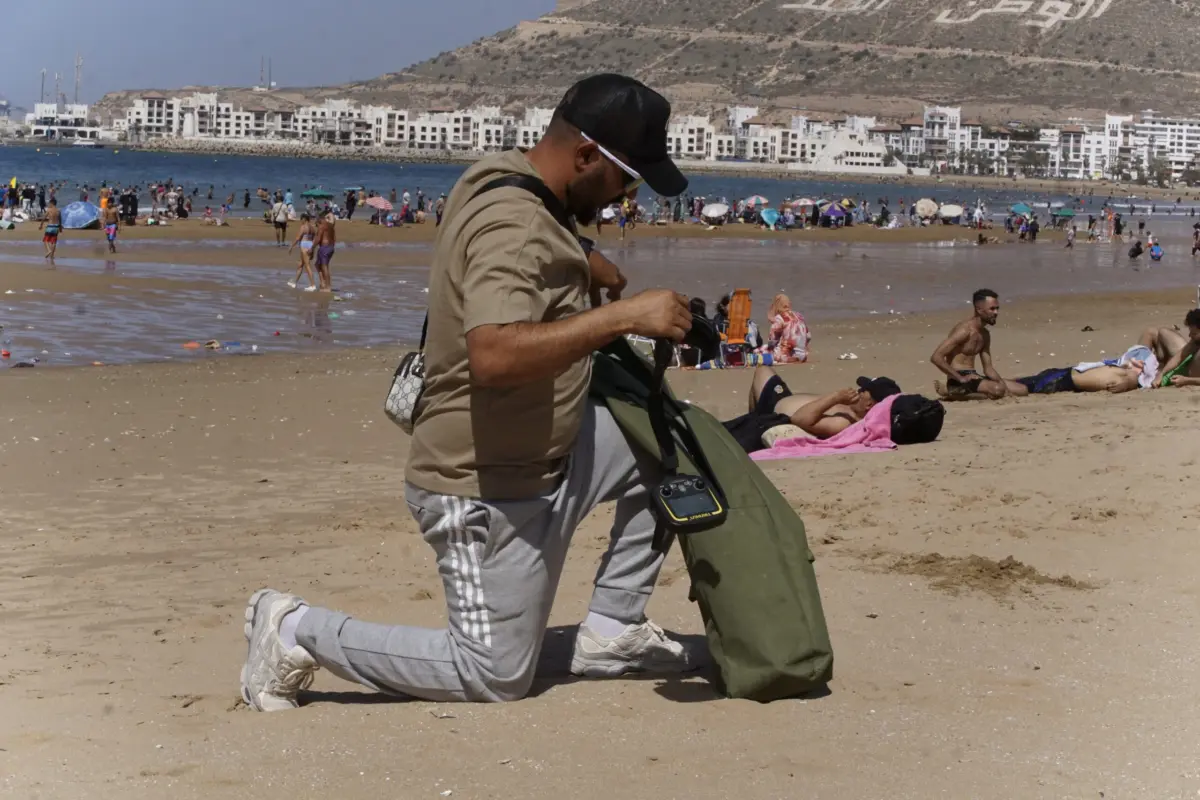
Agadir, Morocco – The rhythmic sweep of a metal detector across the sun-drenched sands of Agadir’s Corniche is a familiar sight to Mustapha Harmouch. Oblivious to the symphony of crashing waves, distant surfer shouts, and the joyful cries of children, the 33-year-old content creator focuses intently on a single, elusive sound: the promising beep that signals a buried secret beneath his coil. This pursuit, a captivating blend of chance and discovery, has transformed a simple hobby into a profound journey into Morocco’s rich past and a burgeoning community endeavor.
For Harmouch, the very essence of metal detecting lies in its inherent uncertainty. His Tianxun TX 850 detector, acquired online approximately four years ago, offers no discernment between a forgotten treasure and a discarded piece of refuse. Whether it signals a valuable coin, a gleaming ring, a fragment of aluminum, or an old piece of fishing gear, the sound remains the same. "The excitement comes partly from not knowing what lies beneath the sand," Harmouch shared with Al Jazeera English, a sentiment that encapsulates the allure drawing enthusiasts to beaches worldwide. What began as a personal pastime has since organically woven itself into the fabric of his popular YouTube channel, Stofishing, a travel and spearfishing platform boasting roughly 123,000 subscribers, further amplifying the appeal of this unique exploration.
The Allure of the Unexpected: A Creator’s Quest
Harmouch’s journey into metal detecting is more than a casual hobby; it’s an extension of his inquisitive spirit. "It’s a nice hobby because it’s the kind of exploration where I find something and learn something new," he explained. "Each outing is a chance to encounter something I would otherwise never have known about." This profound curiosity has led him to a remarkable array of finds, each offering a tangible link to bygone eras. Among his most cherished discoveries are ancient coins, some bearing the imprints of historical regions like Al Haouz and the ancient imperial city of Fez. These small metallic discs, often corroded by time and salt, whisper tales of trade routes, powerful dynasties, and the daily lives of Moroccans centuries ago.
One particularly memorable haul occurred in the coastal town of Sidi Ouassay, approximately 65 kilometers south of Agadir. Here, in a single, fortuitous spot, Harmouch unearthed 14 Moroccan falus – old bronze or copper coins. While some were too severely damaged to reveal their intricate markings, the oldest among them was identified as dating back to 1289 on the Hijri calendar, offering a direct portal to the 13th century. For Harmouch, the true value of these artifacts transcends their monetary worth. "I just collect them as a memory," he stated, a glint of genuine appreciation in his eyes, underscoring the personal connection he forged with these historical fragments.

The path of discovery is not always straightforward, however, and often comes with its own humorous lessons. Harmouch recounted an instance where he believed he had struck scientific gold, discovering what he confidently thought was a meteorite. His excitement, however, was soon tempered by reality when he learned it was merely a common, inexpensive mineral. "Before asking, I thought I had found the best discovery," he recalled, laughing at the memory. This blend of anticipation, occasional disappointment, and continuous learning is what fuels his consistent return to the beaches surrounding Agadir, typically four times a month, often alongside fellow members of the Moroccan Association for Research and Exploration Enthusiasts. He particularly favors the pristine sands of Taghazout and Agadir’s Corniche, areas known for yielding fewer modern refuse items, thus increasing the odds of more significant finds. These coastal stretches have consistently delivered a diverse collection: various pieces of jewelry, both ancient and contemporary Moroccan coins, and even foreign currency, including a notable French 20-franc silver coin, testament to Morocco’s historical connections with Europe. The prospect of uncovering something truly valuable remains a thrilling aspect of the hobby; a small gold ring, for example, was one such precious find in Taghazout. However, Harmouch emphasizes his ethical approach: "I always try to identify and return valuable lost items to their rightful owners," reflecting a commitment to integrity within the detecting community.
The Legal Framework: Navigating Heritage Protection
The burgeoning popularity of metal detecting in Morocco, while exciting for hobbyists, naturally intersects with the nation’s robust legal framework for cultural heritage protection. Morocco, with its millennia of history shaped by various civilizations from Phoenicians and Romans to successive Islamic dynasties, possesses an incredibly rich archaeological landscape, both on land and beneath its extensive coastline. Protecting this irreplaceable heritage is paramount.
The principal legislation governing historical monuments, archaeological sites, works of art, and antiquities is Law 22-80. Enacted decades ago, this law meticulously regulates archaeological prospecting and the proper treatment of historical discoveries. Its core tenet is clear: unauthorized archaeological searches, whether on land or at sea, are strictly prohibited. The Moroccan government has consistently reiterated this stance, emphasizing the need for professional, authorized archaeological endeavors to ensure the scientific integrity of any findings.
Under Law 22-80, any search activity specifically intended to uncover monuments or moveable objects of historic, archaeological, or anthropological importance requires explicit authorization from the relevant government bodies. This requirement is in place to ensure that excavations are conducted by qualified professionals, using methodologies that preserve context and data crucial for historical interpretation. Furthermore, the law stipulates stringent reporting requirements for accidental discoveries. Should any non-archaeological activity – be it construction, farming, or even a casual beach stroll – uncover monuments, ancient coins, works of art, or antiquities, the discovery must be immediately reported to authorities. Crucially, the law dictates that these objects should not be damaged or moved from their original location, except in cases where it is absolutely necessary to protect them from imminent harm.
This legal distinction is vital: finding a modern coin dropped by a holidaymaker is fundamentally different from actively searching for and removing ancient archaeological material. Underwater archaeologist Basma Oumaima eloquently explains the critical importance of context in archaeological finds. "Sometimes something as simple as a fragment of metal, a coin, or a small tool can become important because of where it was found and what was found around it," she stated. The precise location, depth, and association with other artifacts provide invaluable information that professional archaeologists use to reconstruct past human activities, trade networks, and social structures. Removing an object without documenting its context is akin to tearing a page from a history book; the individual word might be present, but its meaning within the larger narrative is lost forever.

However, Oumaima also acknowledges the potential utility of the hobby. "That does not mean curiosity itself should be discouraged. Metal detectors themselves can actually be useful tools in archaeology when they are used as part of a proper archaeological survey, where every find is located, recorded and studied within its context." This highlights a potential avenue for collaboration between hobbyists and professional archaeologists, where the passion and equipment of detectorists could be harnessed for controlled, scientific research under expert guidance. Harmouch and his fellow association members are keenly aware of these regulations. He affirms his respect for the law, stating that members of the Moroccan Association for Research and Exploration Enthusiasts carry identification, meticulously avoid private property and designated heritage sites, and unequivocally treat detecting as a hobby, not a primary source of income. Harmouch himself clarifies that his financial livelihood stems primarily from his content creation and his fishing equipment store, underscoring the recreational nature of his detecting pursuits.
Beyond Treasure: Community, Cleanup, and Shared Passion
The world of metal detecting in Morocco extends beyond the individual quest for historical artifacts; it fosters a vibrant community bound by shared passion, mutual respect, and an unexpected commitment to environmental stewardship. Mohamed Botaib, a former sports coach currently seeking employment, epitomizes the purely recreational aspect of the hobby. For him, searching beaches, forests, and mountains is a cherished pastime, not a means of income. His finds, though modest – ordinary coins, Moroccan dirhams, and rings – are nonetheless satisfying. "Every person has their luck," he remarked, reflecting the philosophy of many hobbyists who value the experience as much as the outcome.
Jalal Zegnoune, another dedicated detectorist, highlights a practical and often overlooked benefit of the hobby: environmental cleanup. While his detector has unearthed exciting finds like coins, jewelry, glasses, and watches, it also frequently picks up less glamorous, yet potentially dangerous, debris. Rusted sardine-can fragments, sharp nails, and discarded fishing gear are common discoveries. "I remove such objects from the beaches because some can be dangerous to beachgoers," Zegnoune explained. This commitment transforms a personal hobby into a tangible public service, making Morocco’s beautiful coastlines safer for everyone. Zegnoune, who works full-time as a maintenance technician in Casablanca, dedicates his free evenings and weekends to detecting, also cherishing the social aspect. "I also enjoy meeting other people who practise the hobby and sharing the objects they find," he added, emphasizing the camaraderie within the community.
This sense of collective responsibility for the environment is echoed by Botaib. "When we look at the beach, it’s not to find treasure," he asserted. "It’s also our way of contributing to keeping our beaches clean. We collect pieces of metal and aluminium that we find and throw them away." This dual motivation – the thrill of discovery coupled with a dedication to preserving natural beauty – paints a fuller picture of the modern metal detecting community in Morocco.
Broader Implications: Heritage, Tourism, and the Future

The activities of metal detecting enthusiasts like Mustapha Harmouch and his colleagues carry broader implications for Morocco. On one hand, their discoveries contribute to a deeper appreciation of the nation’s profound historical layers. Each ancient coin or artifact unearthed, even if found outside a formal archaeological context, sparks public interest and curiosity about Morocco’s past. Harmouch’s YouTube channel, for instance, serves as an educational platform, showcasing these finds and indirectly promoting Morocco’s rich cultural heritage to a global audience. This form of content creation can indirectly boost cultural tourism, drawing visitors interested in history and archaeology to regions like Agadir, Taghazout, and Sidi Ouassay.
On the other hand, the increasing popularity of metal detecting necessitates a continuous dialogue between hobbyists, archaeologists, and governmental bodies to ensure that the excitement of discovery does not come at the expense of irreversible damage to archaeological sites. The careful enforcement of Law 22-80 and ongoing public education are crucial. Initiatives that promote responsible detecting, perhaps even structured volunteer programs where hobbyists can assist professional archaeologists in surveys, could represent a constructive path forward. Such collaborations could leverage the enthusiasm and equipment of detectorists while ensuring that finds are properly documented, preserved, and studied within their historical context.
The environmental aspect, championed by detectorists like Zegnoune and Botaib, offers an undeniable positive impact. The removal of dangerous debris from popular beaches directly contributes to public safety and enhances the tourist experience, aligning with Morocco’s broader efforts to promote sustainable tourism. As the global hobby of metal detecting continues to grow, Morocco finds itself at a unique intersection where ancient history, modern technology, community spirit, and legal frameworks converge. The sand along its Atlantic coast, continually reshaped by the tides, continues to hold untold stories, and for enthusiasts like Mustapha Harmouch, the silent promise of a "beep" will forever beckon, inviting them to unearth not just metal, but fragments of Morocco’s enduring narrative.
