

The landscape of American business leadership is currently marked by a palpable sense of unease, with chief executive officers reporting a significant downturn in their overall assessment of economic conditions. However, a recent survey conducted by Chief Executive reveals a surprising counterpoint to this prevailing pessimism: the outcome of the midterm elections has injected a much-needed dose of optimism for some, offering a potential pathway back to operational normalcy and strategic decision-making. This sentiment, encapsulated by the observation, "Things should start moving again," suggests a desire to transcend political uncertainty and refocus on core business objectives.
The November Chief Executive Officer Confidence Index poll, which gathered responses from 435 U.S. CEOs between November 3rd and 5th, found that while overall confidence has dipped to a 14-month low, the timing of when CEOs responded to the survey revealed a distinct divergence in sentiment. Those who completed the poll after the initial midterm election results began to emerge on the evening of November 3rd exhibited higher confidence levels compared to those who responded prior to this crucial juncture. This suggests that the resolution, or at least the initial clarity, provided by the election outcomes, rather than the specific political affiliation of the victors, played a pivotal role in shifting perspectives.
A Shift in Sentiment: From Uncertainty to Opportunity
For many CEOs, the prospect of moving past the electoral cycle offered a welcome respite from a period of heightened ambiguity. The traditional leanings of the business community toward conservative economic policies might suggest a preference for one party over another. However, the commentary accompanying the survey responses indicates that the primary driver for this incremental optimism is the anticipation of reduced political gridlock and a clearer path forward for policy implementation and business planning.
One CEO participating in the survey articulated this sentiment directly: "I think midterms are weighing on business leaders and their decisions. Once that’s settled, things should start moving again." This viewpoint underscores a common frustration within the corporate world: the impact of prolonged political debates and potential policy shifts on long-term investment and strategic initiatives. The absence of immediate, drastic political upheavals, regardless of the specific party controlling different branches of government, seems to have been interpreted as a positive development by a segment of the CEO community.
Another executive echoed this sentiment, stating, "President’s chaotic initiatives will be balanced by a more functional congress." This implies a belief that a divided government, or a Congress with a more balanced distribution of power, could lead to a more deliberative and less unpredictable legislative environment. The desire for stability, even if it means a period of political negotiation, appears to outweigh the preference for a single party dominating all branches of government. Simpler expressions like, "Election [is] over so hopefully some stability," further reinforce the idea that the resolution of the electoral contest itself was a significant factor.
The Data: A Tale of Two Response Times
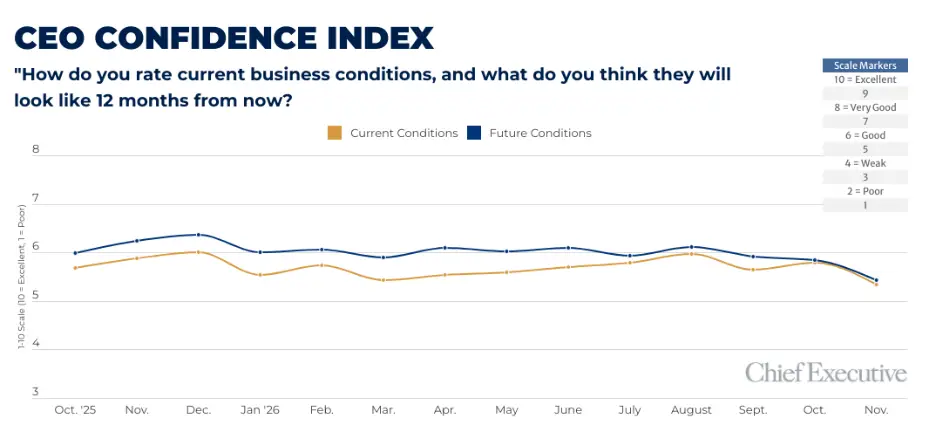
The quantitative data from the survey paints a compelling picture of this nuanced shift. Overall, CEOs rated current business conditions at 5.3 out of 10, an 8 percent decrease from the previous month. Their 12-month outlook also saw a decline, falling 7 percent to 5.4. These figures represent a notable dip in confidence, bringing the overall sentiment to its lowest point since September 2025. During that period, similar concerns regarding tariff uncertainty, fluctuating government policies, and broader economic growth anxieties were prevalent.
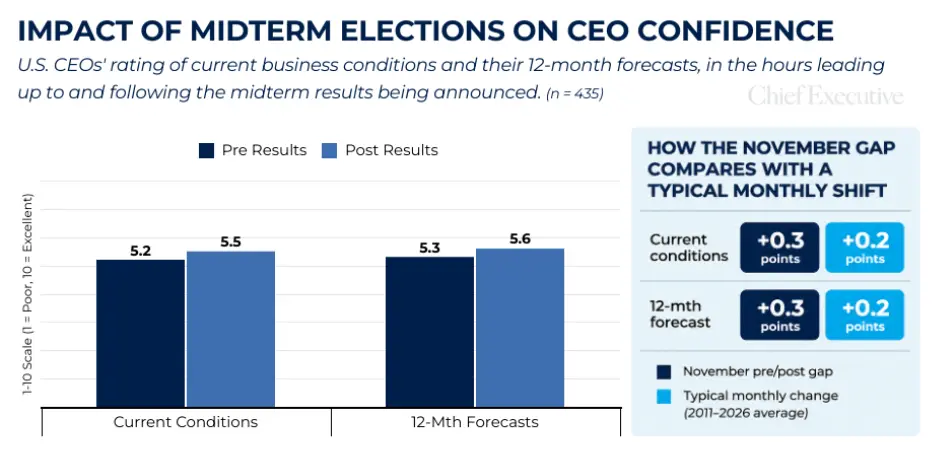
However, the timing of the survey responses reveals a significant correlation between the emergence of election results and improved sentiment. CEOs who completed the survey before November 3rd, when preliminary results began to surface, reported an average rating of 5.2 for current conditions and 5.3 for their 12-month forecast. In contrast, those who responded after the initial results were available saw these figures rise to 5.5 for current conditions and 5.6 for the 12-month outlook. This approximately three-tenths-of-a-point difference, occurring within a matter of hours, is statistically significant, especially considering the historical average monthly fluctuation of the Index, which typically hovers around two-tenths of a point.
The Appeal of Clarity and Stability
The qualitative feedback from CEOs further illuminates the reasons behind this uplift. Many expressed a sense of relief that the period of electoral campaigning and its inherent uncertainties had concluded. The prospect of a defined political landscape, regardless of its perceived direction, was seen as conducive to better business planning.
"The midterm election is over and the balance of power is in place. At least we know what we should probably do," commented the CEO of a family-owned manufacturer. This statement highlights the practical implications of political clarity for operational strategies. Knowing the likely legislative environment allows businesses to allocate resources more effectively and make informed decisions about expansion, investment, and risk mitigation.
Another CEO, while more cautious, acknowledged the value of knowing the country’s trajectory: "The elections will be behind us and will know where the country is headed. May be in the wrong direction, but at least we will know." This pragmatic approach suggests that even if the policy outcomes are not entirely favorable, the certainty itself is a valuable commodity for business leaders who thrive on predictability.
Broader Hopes: Beyond Domestic Policy
The optimism generated by the midterm results extended beyond domestic policy considerations for some CEOs. A segment of respondents expressed hopes that the election outcomes would contribute to easing international trade tensions, improving global diplomatic relations, and potentially accelerating the resolution of geopolitical conflicts, such as the war in Iran.
One CEO, looking ahead to the next 12 months, stated, "The elections will surely change the direction of the country, and we should be out of war by then." This statement reflects a broader hope that a shift in political leadership or a recalibration of foreign policy priorities could lead to a more peaceful and stable international environment, which in turn would benefit global commerce and reduce economic volatility. Another CEO specifically cited "improved global stability based on recent mid-term election results," indicating a belief that the domestic political shift would have positive ripple effects on the world stage.
The Counterpoint: Lingering Pessimism and Uncertainty
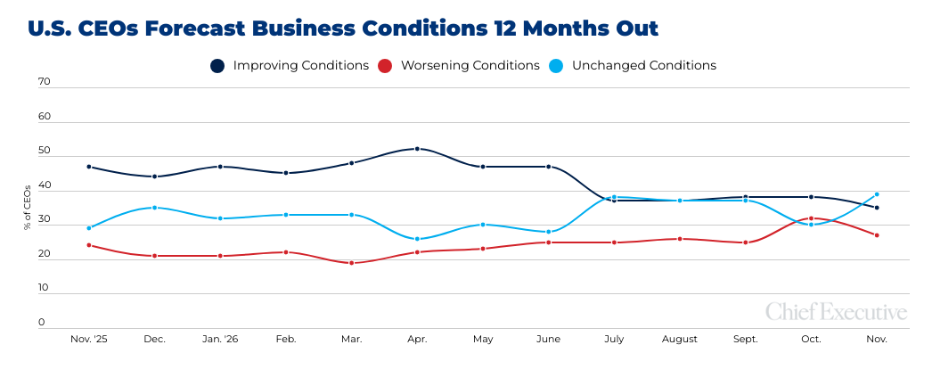
Despite this emerging optimism, it is crucial to acknowledge that the dip in overall confidence was a significant finding, and the midterm results did not uniformly dispel concerns. A substantial portion of CEOs, even among those who responded after the election, continued to forecast a deteriorating business environment. In fact, CEOs responding after the election results were more likely to anticipate a decline in business conditions, with 30 percent expressing this view compared to 25 percent of those who responded earlier.
One CEO attributed this continued pessimism to the potential for "uncertainty and gridlock" stemming from the election outcomes. This suggests that for some, the results may have introduced new political challenges or reinforced existing ones, leading to a more cautious outlook. Another executive expressed concern that the election results would lead to a slowdown due to perceived political polarization: "Business will slow down due to the outcome [of] the November 3 elections due to the democrats going on their witch hunts against republicans throughout the U.S." This sentiment, forecasting a significant drop in business conditions from 3 to 1 out of 10, highlights the deeply held political divisions that continue to influence economic perceptions.
Confidence at a 14-Month Low: A Persistent Economic Chill
The overall decline in confidence is underscored by the fact that the current assessment of business conditions (5.3 out of 10) is comparable to levels not seen since September 2025. That period was characterized by anxieties surrounding trade wars, policy shifts, and concerns about overall economic expansion. More than a year later, many of these underlying challenges persist, contributing to a sustained sense of economic caution among business leaders.
Furthermore, CEOs had anticipated a more robust economic environment by this point. Their forecast from November 2025 projected current conditions to reach 6.2. The current reading of 5.3 represents a significant shortfall, approximately 15 percent below their earlier expectations. The outlook for the next 12 months offers little immediate solace, with the forecast of 5.4 being only marginally better than the current assessment. This pattern of stagnant expectations has been a recurring theme throughout 2026, with only a brief period of heightened optimism during the second quarter offering a temporary reprieve.
A growing number of CEOs are now predicting a period of stasis, with 39 percent anticipating that business conditions will remain largely unchanged over the next year. This represents an increase from the 30 percent who held this view in October, indicating a collective reluctance to project significant growth or decline, opting instead for a wait-and-see approach.
Resilience in Growth Forecasts: A Pocket of Optimism
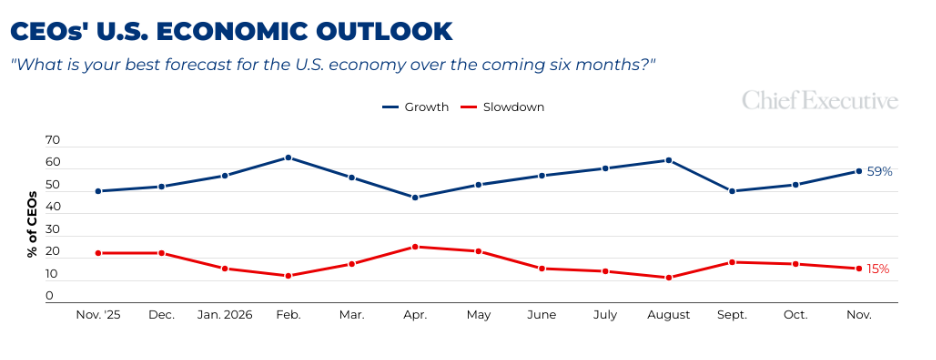
Despite the prevailing caution regarding the broader business environment, chief executive officers have maintained a more optimistic stance when it comes to their own companies’ prospects and the trajectory of the U.S. economy. The survey indicates a notable increase in the expectation of U.S. economic growth over the next six months, with six out of 10 CEOs anticipating expansion, up from 53 percent in October. This shift appears to be driven by a segment of CEOs who previously forecasted a flat economy, while the proportion expecting a slowdown or recession saw a slight decrease.
Interestingly, the post-election survey respondents were more likely to anticipate economic growth, with 63 percent expressing this view compared to 56 percent of those who responded earlier. This suggests that the resolution of the election may have emboldened some leaders to project a more positive economic outlook, even amidst broader concerns.
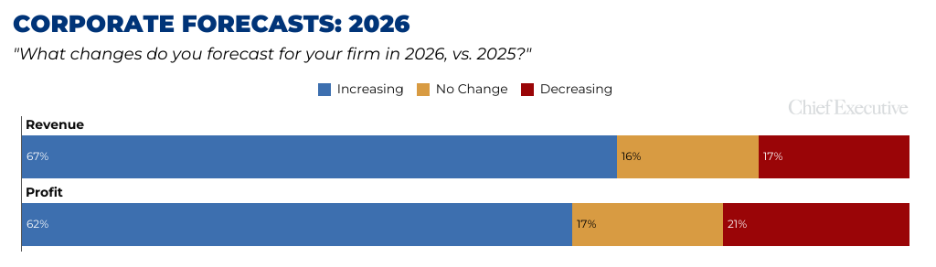
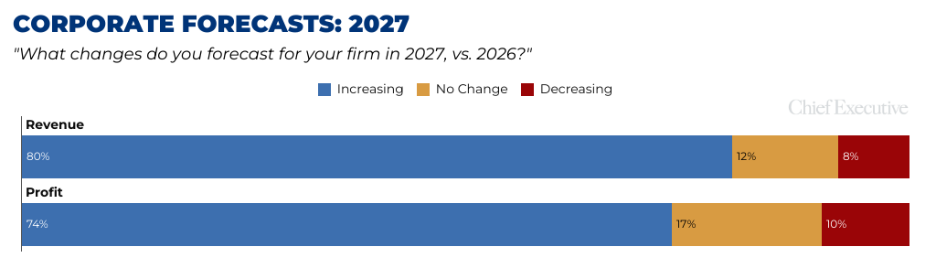
The optimism becomes even more pronounced when CEOs are asked about their own companies. A significant majority anticipate revenue growth in the upcoming year, with 84 percent projecting increases. This optimism extends to profitability, with 78 percent of CEOs expecting higher profits in 2027. These forward-looking projections indicate a strong belief in the resilience and adaptability of their individual businesses, even in the face of macroeconomic headwinds.
These positive expectations are being supported by concrete plans for investment and expansion. A substantial 54 percent of CEOs plan to increase capital spending in the coming year, signaling a commitment to long-term growth and operational improvements. Similarly, 52 percent expect to expand their workforce, indicating a confident outlook on future demand and business activity. While a third of CEOs anticipate holding headcount steady, the overall trend points towards proactive investment and growth strategies.
However, these expansion plans are not without their challenges. Nearly eight in 10 CEOs anticipate higher operating expenses in the coming year, a common concern for businesses operating in fluctuating economic conditions. Nevertheless, the majority of these anticipated increases are expected to be less than 10 percent, suggesting that while costs are rising, they are largely perceived as manageable.
In conclusion, the November CEO Confidence Index reveals a complex and evolving sentiment within the American business leadership. While overall confidence has reached a low point, the resolution of the midterm elections has provided a segment of CEOs with a much-needed sense of clarity and a renewed impetus to "get back to business." This glimmer of hope, however, coexists with persistent concerns about economic uncertainty and political polarization. The ability of businesses to navigate these challenges and capitalize on the anticipated growth in their own sectors will be a key determinant of their success in the coming year. The divergence in sentiment based on the timing of survey responses serves as a powerful reminder of how political events, even those that appear divisive, can paradoxically create opportunities for operational stability and strategic recalibration when their outcomes become clear.
