

The wealth management industry, a complex ecosystem of financial advice and asset management, is often viewed through distinct lenses depending on one’s position within it. Financial advisors and institutional investors, while both stakeholders in the success of wealth management firms, approach their evaluations from fundamentally different, yet interconnected, perspectives. Advisors are primarily concerned with the practicalities of serving clients and growing their own practices, seeking platforms, technology, favorable economics, and robust resources. In contrast, institutional investors, such as private equity firms, hedge funds, and pension funds, delve deeper, scrutinizing the sustainability of a firm’s growth, its underlying costs, the efficiency of capital deployment, and the long-term factors that could reshape its financial trajectory.
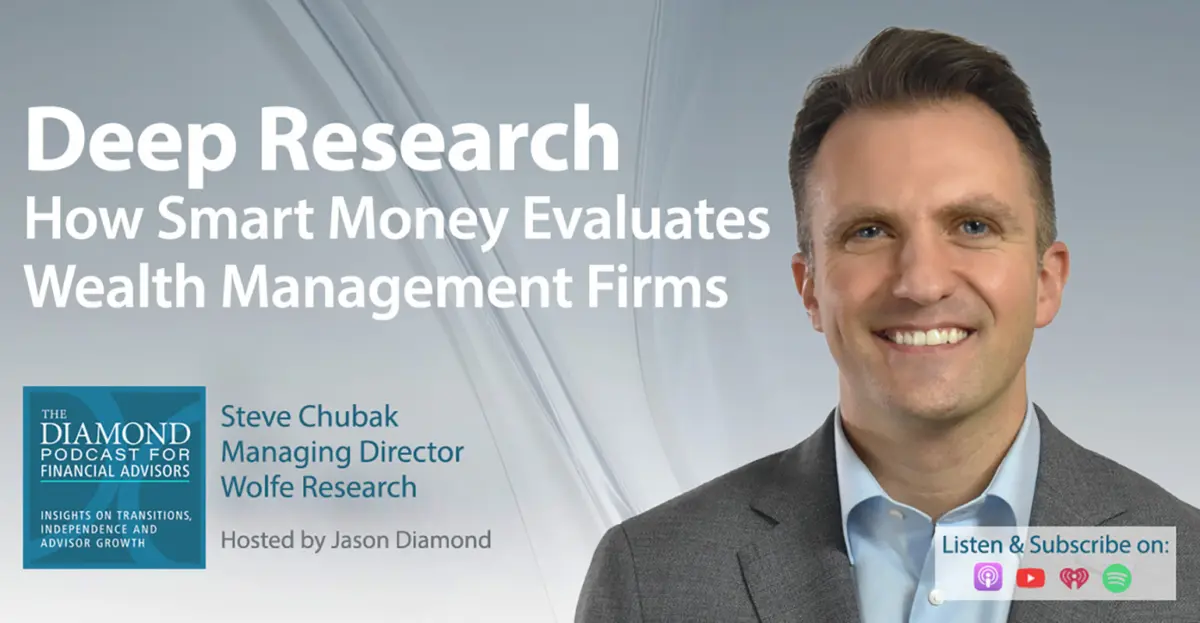
This divergence in perspective is the focus of an insightful discussion with Steve Chubak, Managing Director at Wolfe Research, a firm renowned for its in-depth analysis of the financial services sector. Chubak’s research spans the entire wealth management landscape, encompassing everything from large wirehouses and regional brokerages to custodians, broker-dealers, and alternative asset managers. His unique vantage point, looking at these firms through the eyes of institutional capital, provides a critical yet valuable framework for advisors seeking to understand the deeper health and future prospects of the firms they work for, partner with, or might consider joining.
The conversation, hosted on "The Diamond Podcast for Financial Advisors," delves into several key areas where the institutional perspective offers crucial insights. One significant theme is the distinction between growth achieved through recruiting new advisors and growth generated organically by existing advisors. Institutional investors are increasingly sophisticated in their analysis, understanding that while recruiting can lead to rapid expansion, it often comes with significant costs in the form of transition assistance packages. This has led to a greater emphasis on "same-store" growth – the revenue and asset growth generated by advisors already established on a firm’s platform – as a more reliable indicator of a firm’s underlying strength and client retention capabilities.
Background Context: The Evolving Landscape of Wealth Management
The wealth management industry has undergone significant transformation over the past few decades. From the traditional broker-dealer model to the rise of independent advisory firms and the increasing influence of technology, the competitive landscape has become more dynamic. Institutional capital has played an increasingly prominent role, providing funding for growth, acquisitions, and the development of new technologies. This influx of capital has, in turn, heightened the scrutiny placed on the financial performance and strategic positioning of wealth management firms.
The increasing cost of recruiting top-tier talent has been a significant trend. As firms compete for established advisors with substantial client books, transition packages, which often include upfront cash payments and deferred compensation, have ballooned. While these packages can be effective in attracting talent, they represent a substantial investment for the hiring firm and can impact profitability if not managed effectively. This economic reality is precisely what institutional investors are analyzing, seeking to understand the return on investment for such recruitment efforts.
The Storyline: Unpacking the Institutional Perspective
Steve Chubak’s unique position at Wolfe Research allows him to analyze wealth management firms not as an advisor seeking a new home or a recruiter striving to fill positions, but as an investor evaluating the fundamental health and long-term viability of these businesses. His team meticulously dissects how firms are positioned within the market, identifies the primary drivers of their growth, quantifies the costs associated with generating that growth, and assesses the potential risks that could alter their future outlook.
This institutional lens reveals that while advisors and institutional investors may be asking different questions on the surface, many of the underlying concerns are shared. An institutional investor, for instance, might analyze a firm’s organic growth to determine if it can adequately support its stock price or provide a sustainable dividend. Simultaneously, an advisor considering joining that firm is seeking assurance that the platform’s economics, technology, and overall strategy will enable their business to thrive for years to come. The overlap in these fundamental inquiries creates a richer, more comprehensive understanding of a firm’s true value proposition.
Chubak elaborates on the growing distinction institutional investors make between growth achieved through recruiting new advisors and growth generated by existing advisors. "Investors increasingly distinguish between growth generated by recruiting and growth generated by existing advisors," he notes. This is directly tied to the economics of recruiting. As transition assistance packages have escalated, the market has become more attuned to the difference between "new store" growth, driven by bringing in new advisors, and "same store" growth, which reflects the organic expansion of assets and revenues from advisors already on the platform. For institutional investors, "same store" growth is often seen as a more organic and sustainable indicator of client satisfaction and advisor productivity.
Timeline of Trends in Wealth Management Recruitment and Growth:
- Early 2000s: Transition packages begin to rise, driven by competition for established advisors.
- Mid-2010s: The independent advisor model gains significant traction, leading to increased competition for talent and further escalation of recruitment incentives.
- Late 2010s – Present: Institutional capital becomes more prevalent in the wealth management space, leading to increased focus on profitability and sustainable growth metrics by investors. The cost of transition assistance reaches new heights, prompting a greater emphasis on organic growth by some firms and investors alike.
The Impact of Artificial Intelligence on Wealth Management Economics
Beyond recruitment dynamics, the discussion also turns to the burgeoning influence of Artificial Intelligence (AI) on the wealth management sector. Chubak views AI not merely as a technological advancement but as a potential catalyst for profound economic shifts. "We see significant potential for AI to improve advisor productivity and platform efficiency," he states, highlighting its capacity to automate tasks, enhance client communication, and provide more sophisticated analytical tools.
However, the integration of AI also raises longer-term questions about firm pricing, revenue models, and how firms generate income. This naturally leads to a discussion of the evolving economics of cash sweeps and platform fees. Cash sweeps, where uninvested client cash is automatically invested in money market funds or similar vehicles, have historically been a significant source of revenue for broker-dealers. As interest rates rise, the profitability of these sweeps can increase, but also introduces potential client friction if not managed transparently. Similarly, platform fees, which firms charge for access to their technology, research, and support services, are subject to ongoing scrutiny and competitive pressure.
AI’s potential to streamline operations and enhance advisory capabilities could lead to a re-evaluation of these revenue streams. For instance, if AI significantly boosts advisor productivity, firms might explore fee structures that better reflect the value delivered, potentially leading to adjustments in platform fees or a shift towards more outcome-based pricing. This could also impact how firms are compensated for services, moving towards models that are more directly tied to client outcomes.
The Vanguard-Altruist Transaction and Industry Consolidation
The recent Vanguard-Altruist transaction serves as a prime example of the ongoing consolidation within the wealth management industry. Vanguard, a giant in the asset management space, acquired Altruist, a fintech company focused on serving independent financial advisors. This deal underscores a broader trend of larger players seeking to expand their reach and capabilities within the advisor-centric segment of the market.
For institutional investors, such transactions are analyzed for their strategic implications. Does the acquisition enhance the acquiring firm’s competitive positioning? Does it create synergies that will drive future profitability? What is the cost of integration and the potential for disruption? The Vanguard-Altruist deal, in particular, signals a move by a major asset manager to deepen its engagement with financial advisors, potentially challenging established custodians and technology providers.
Chubak suggests that this consolidation is likely to continue. "We’re seeing significant consolidation across the industry," he observes. This trend is driven by several factors, including the increasing costs of technology and compliance, the desire for scale to compete effectively, and the availability of institutional capital to facilitate mergers and acquisitions. For advisors, this can mean fewer choices of platforms and custodians, but also potentially more robust offerings and greater stability from larger, well-capitalized entities.
The Enduring Value of Human Advice
Amidst the technological advancements and market consolidation, Chubak also offers a perspective on the enduring resilience of human advice. While some predictions suggest that automation and AI could diminish the need for human advisors, Chubak believes otherwise. "Human advice may prove more resilient than some predictions suggest," he posits.
This resilience stems from the inherent value of trust, empathy, and personalized guidance that human advisors provide. In complex financial situations, navigating emotional aspects of wealth management, and providing tailored strategies that go beyond algorithmic recommendations, human connection remains paramount. While AI can augment advisory capabilities, it is unlikely to fully replace the nuanced understanding and relationship-building that defines successful financial advising.
The implications of this resilience are significant. Firms that can effectively integrate technology to enhance the advisor-client relationship, rather than seeking to replace it, are likely to be the long-term winners. This means investing in platforms that empower advisors to deliver more value, freeing them from administrative burdens to focus on high-value client interactions.
A Different Framework for Evaluation
Ultimately, Steve Chubak’s insights offer a valuable recalibration for financial advisors. By understanding how institutional investors scrutinize wealth management firms, advisors can gain a more comprehensive view of the businesses they are part of. The focus shifts from headline growth numbers or attractive recruiting packages to the underlying durability and sustainability of a firm’s business model.
Key takeaways for advisors from this institutional perspective include:
- Focus on Organic Growth: Prioritize firms that demonstrate consistent, organic growth from their existing advisor base. This indicates client satisfaction and advisor engagement.
- Understand Recruiting Economics: Be aware of the costs associated with recruiting and how transition packages impact a firm’s profitability and long-term financial health.
- Assess Technology Integration: Evaluate how firms are leveraging technology, particularly AI, to enhance advisor productivity and client experience, not just to cut costs.
- Analyze Revenue Diversification: Consider how firms generate revenue beyond traditional asset management fees, such as cash sweeps and platform fees, and their potential for future sustainability.
- Evaluate Firm Stability: In an era of consolidation, understand the strategic positioning and financial strength of the firms you partner with.
By adopting this more analytical, institutionally-informed perspective, financial advisors can make more strategic decisions about their career paths, their firm affiliations, and ultimately, the best way to serve their clients in an ever-evolving financial landscape. The insights gleaned from the world of institutional investing provide a critical lens through which to view the health, potential, and enduring value of wealth management firms.
