

The relationship between Carrie Fisher and Debbie Reynolds was one of the most documented and celebrated bonds in Hollywood history, characterized by a unique blend of professional rivalry, deep-seated affection, and a physical proximity that defined their final decades. In their later years, the two lived as neighbors in a sprawling 3.5-acre compound in the Hollywood Hills, a living arrangement that symbolized their inseparable nature. Fisher, the "Star Wars" icon and prolific writer, occupied a charming Spanish-style estate, while her mother, the legendary "Singin’ in the Rain" star, resided in a neighboring cottage at Fisher’s request. This shared sanctuary became the backdrop for their final acts, a place where the lines between family, work, and history blurred into a singular, whimsical domestic life.

Fisher once described her mother as her best friend, a sentiment echoed in the 2016 documentary "Bright Lights: Starring Carrie Fisher and Debbie Reynolds." The film offered a poignant look at their interdependent lives, showing them traversing the short distance between their homes to share meals, stories, and the burdens of aging. Tragically, this bond reached a cinematic conclusion in December 2016. Fisher suffered a cardiac arrest during a flight from London to Los Angeles and passed away at age 60. Just one day later, Reynolds died following a stroke at age 84. Her son, Todd Fisher, noted that his mother simply did not want Carrie to be alone.
The Formative Years in Holmby Hills
The domestic history of the Fisher-Reynolds clan began in the late 1950s, during the height of the Golden Age of Hollywood. In 1958, when Carrie was just 18 months old and her brother Todd was an infant, the family lived in the prestigious Holmby Hills neighborhood of Los Angeles. At the time, Reynolds was married to singer and actor Eddie Fisher. Seeking more space for their growing family, they moved into a white-brick, two-story residence on Conway Avenue.

Reynolds described the home in her memoir, "Debbie: My Life," as a spacious four-bedroom house featuring a large family room and a signature bay window that offered views of a swimming pool and a meticulously maintained rose garden. This period represented the pinnacle of the mid-century Hollywood dream: a successful, beautiful couple raising children in a home that reflected their status. However, the domestic bliss was short-lived. In 1959, the family was thrust into a public scandal when Eddie Fisher left Reynolds for Elizabeth Taylor following the death of Taylor’s husband, Mike Todd.
The Transition to the Karl Estate
Following the divorce, Reynolds moved her children to a Beverly Hills mansion owned by her second husband, Harry Karl, a wealthy businessman. This residence marked a significant shift in the children’s environment. While the Holmby Hills house was a family home, the Karl estate was a monument to opulence. Carrie Fisher later recalled the home as feeling less like a residence and more like a "place where you would get your passport stamped."

The property featured three swimming pools and a five-car garage that housed multiple Rolls-Royces. Internally, the luxury was equally immense; Carrie and Todd each had private bedrooms with marble en suite bathrooms. One of the most notable features was a professional-grade projection room the size of a small commercial theater, allowing the family to screen films in total privacy. Despite the grandeur, Fisher’s descriptions of the era often suggested a sense of detachment, a theme she would later explore with biting wit in her semi-autobiographical novels.
New York and the Muller Frères Lamp
As Carrie Fisher transitioned into adulthood and found global stardom as Princess Leia, her domestic life moved briefly to the East Coast. In 1983, at the age of 26, she married musician Paul Simon. The wedding was a high-profile affair held at Simon’s apartment on Central Park West, overlooking the iconic New York skyline. The guest list was a "who’s who" of 1980s culture, including George Lucas, Billy Joel, Robin Williams, and Art Garfunkel.

Though the marriage lasted less than a year, it left a permanent mark on Fisher’s domestic style in the form of a Muller Frères lamp. Fisher had purchased the piece for $25,000 during what she described as a "manic" shopping spree. The lamp became a symbol of her connection to Simon; she famously stated that whenever they separated, she would take nothing but the lamp. Decades later, the piece occupied a place of honor on the Steinway piano in her Hollywood Hills home, serving as a luminous reminder of her brief time in New York.
The Independence of the 1980s
By 1984, Fisher was establishing her own identity as both an actress and a burgeoning writer. She purchased a 2,600-square-foot home in Los Angeles from "Starsky & Hutch" star David Soul for $925,000. This three-bedroom property, situated on an acre of land, featured a pool, a sauna, and a dense bamboo forest. It was during her time here that Fisher wrote "Postcards from the Edge," the 1987 bestseller that cemented her reputation as one of Hollywood’s sharpest literary voices.

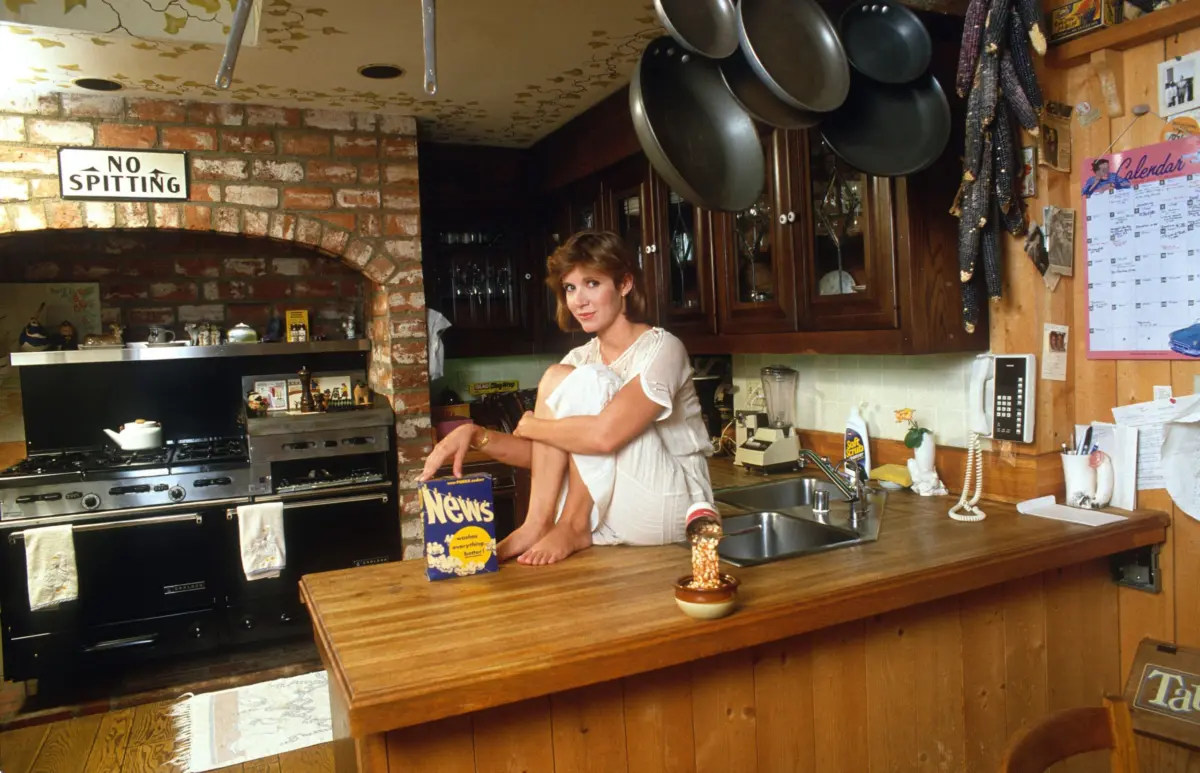
During this era, Fisher began to infuse her homes with the eccentric, whimsical style that would become her trademark. Visitors to the property noted a "whimsically Western motif" that included a driveway gate painted with a rodeo scene and a sign that humorously designated the home as the "Wow! That Was Some Cup of Coffee Institute of Alternative Life-Styles." The yard featured a treehouse with a "Beware of Trains" sign and even a life-sized fake cow. This period represented Fisher’s attempt to create a sanctuary that was intentionally separate from the "fake closeness" she felt defined much of Hollywood.
The Final Compound and Its Storied History
In 1993, Fisher moved into what would be her final home, a Spanish-style hacienda in the Hollywood Hills. The house itself was a piece of cinematic history, having previously been owned by Robert Armstrong (of "King Kong" fame), legendary actress Bette Davis, and renowned costume designer Edith Head. Fisher often joked that she didn’t choose the house; her furniture did. She possessed such a vast collection of oversized 1930s leather club chairs, folk art, and Indian rugs that she needed a structure large enough to accommodate them.

The estate eventually became a family compound when Debbie Reynolds moved into the adjacent cottage. This proximity allowed for a unique intergenerational lifestyle involving Fisher’s daughter, Billie Lourd, and her brother Todd, who lived nearby. The main house was known for its hospitality, hosting a rotating cast of "the famous and near-famous," including those in need of recovery or a place to stay during medical treatments. Singer James Blunt famously recorded his hit "You’re Beautiful" in a bathroom on the property because Fisher felt the acoustics were superior.
Chronology of Major Domestic Milestones
- 1958: Move to the Conway Avenue home in Holmby Hills (Reynolds, Eddie Fisher, Carrie, and Todd).
- 1960: Relocation to Harry Karl’s Beverly Hills mansion following the Fisher-Reynolds divorce.
- 1983: Marriage to Paul Simon and residence at Central Park West, NYC.
- 1984: Purchase of the David Soul house in Los Angeles for $925,000.
- 1993: Acquisition of the final Hollywood Hills estate (formerly owned by Bette Davis and Edith Head).
- Early 2000s: Debbie Reynolds moves into the neighboring cottage on the compound.
- 2016: Deaths of Carrie Fisher (Dec 27) and Debbie Reynolds (Dec 28).
- 2017: The combined estate is listed for $18 million.
Legacy and Real Estate Impact
The deaths of Fisher and Reynolds in 2016 marked the end of an era for Hollywood real estate. In June 2017, the combined 3.5-acre estate was listed for $18 million. The listing was significant not only for its price but for the history it contained. However, the property’s future took a personal turn when Billie Lourd, Fisher’s daughter, decided to keep her mother’s portion of the estate.

Lourd expressed that the "magical" nature of the property made it impossible to let go. In a move that mirrored her mother’s communal spirit, Lourd invited friends to move in with her, creating what she described as an "old-style commune." By maintaining the residence, Lourd preserved a physical link to the legacy of two women who defined different eras of the American film industry.
Fact-Based Analysis of Their Domestic Influence
The living arrangements of Fisher and Reynolds were more than just a matter of convenience; they were a rejection of the traditional Hollywood "dynasty" model that often saw children distancing themselves from famous parents. Their decision to live side-by-side reflected a modern approach to elder care and family support, one that was captured with raw honesty in their public appearances and documentaries.

Architecturally, Fisher’s homes were a departure from the sleek, minimalist trends of modern Los Angeles. She favored "playful" modernism and rustic, eclectic comfort. Her influence can be seen in the way she utilized historical properties to create personal narratives, rather than simply maintaining them as museum pieces. The Hollywood Hills compound stands as a testament to a specific type of creative domesticity—one that prioritized storytelling, hospitality, and a touch of the absurd over conventional luxury. Through their homes, Fisher and Reynolds created a world that was entirely their own, a sanctuary that remained intact until their very last moments.
