

The cultural landscape of early 20th-century France was shaped by a handful of visionary individuals whose influence spanned the realms of fine art, interior design, and haute couture. Among these figures, few were as prolific or as quietly consequential as Gustave Fayet. Despite a legacy that includes the curation of one of the world’s most significant private collections of Post-Impressionist masterpieces and the early promotion of Pablo Picasso, Fayet has remained a secondary figure in the annals of art history. This autumn, however, the Fondation Louis Vuitton seeks to rectify this historical oversight with its latest exhibition, Gustave Fayet, Collector–Designer. Part of the institution’s acclaimed Icons of Modern Art series, the exhibition will occupy the entirety of the Frank Gehry-designed building in Paris from October 9 through March 8, offering an exhaustive exploration of Fayet’s multifaceted career as a patron, entrepreneur, and artist.
The Architect of an Avant-Garde Legacy
Gustave Fayet’s impact on the art world was rooted in an uncanny ability to identify genius long before it achieved institutional validation. At one point, Fayet’s Parisian residence served as a de facto museum dedicated to Paul Gauguin, housing enough of the artist’s work to rival national collections. His eye for talent was not limited to established masters; Fayet was instrumental in organizing one of the first French exhibitions of the work of a teenage Pablo Picasso, providing a platform for the young Spaniard at a time when his radical style was still largely misunderstood by the Parisian establishment.

The upcoming exhibition at the Fondation Louis Vuitton highlights how Fayet’s influence extended beyond the gallery walls and into the domestic spheres of France’s elite. His creative reach was such that the legendary couturier Jeanne Lanvin commissioned him to design bespoke rugs for her private apartment, while the "King of Fashion," Paul Poiret, looked to Fayet’s aesthetic circle when designing the wedding dress for Fayet’s daughter. By bridging the gap between fine art and functional design, Fayet embodied the "total work of art" philosophy that would come to define the modernist era.
From Béziers to the Vanguard: A Chronology of Influence
Born in 1865 into a prosperous family of landowners and wine merchants in the South of France, Fayet’s artistic sensibilities were nurtured from a young age. He learned the technical aspects of painting from his father and uncle, both of whom were accomplished amateur artists. However, Fayet’s ambitions were more expansive than the provincial life of a merchant.
In the late 1890s, he accepted a position as a curator at the Musée de Béziers. It was here that he began his professional journey into the avant-garde, collaborating with the sculptor Louis Paul, a former student of Auguste Rodin. Together, they produced a series of ceramics heavily influenced by Japonisme—the French obsession with Japanese art and aesthetics. These works, characterized by their bold glazes and organic forms, eventually found their way into some of the most prestigious galleries in Paris, marking Fayet’s first successful foray into the commercial art world.

The year 1899 served as a definitive turning point. Following the death of his father, Fayet inherited the substantial family estate, providing him with the financial liquidity to begin collecting on a monumental scale. He moved rapidly, acquiring seminal works by Pierre-Auguste Renoir and Gauguin. Over the following decade, Fayet’s collection became a revolving door for masterpieces that are now cornerstones of global museum collections, including Vincent van Gogh’s Self-Portrait With Bandaged Ear, Paul Cézanne’s The Great Pine, and Gauguin’s Three Tahitians.
The Abbaye de Fontfroide: A Sanctuary for the "Fontfroideans"
By 1908, Fayet’s focus shifted toward a singular, monumental project. Alongside his wife, Madeleine, he purchased the Abbaye de Fontfroide, a dilapidated Cistercian monastery near Narbonne. Fayet envisioned the abbey not merely as a residence, but as a living laboratory for artistic collaboration—a "total work of art" (Gesamtkunstwerk) where architecture, painting, and nature could coexist in harmony.
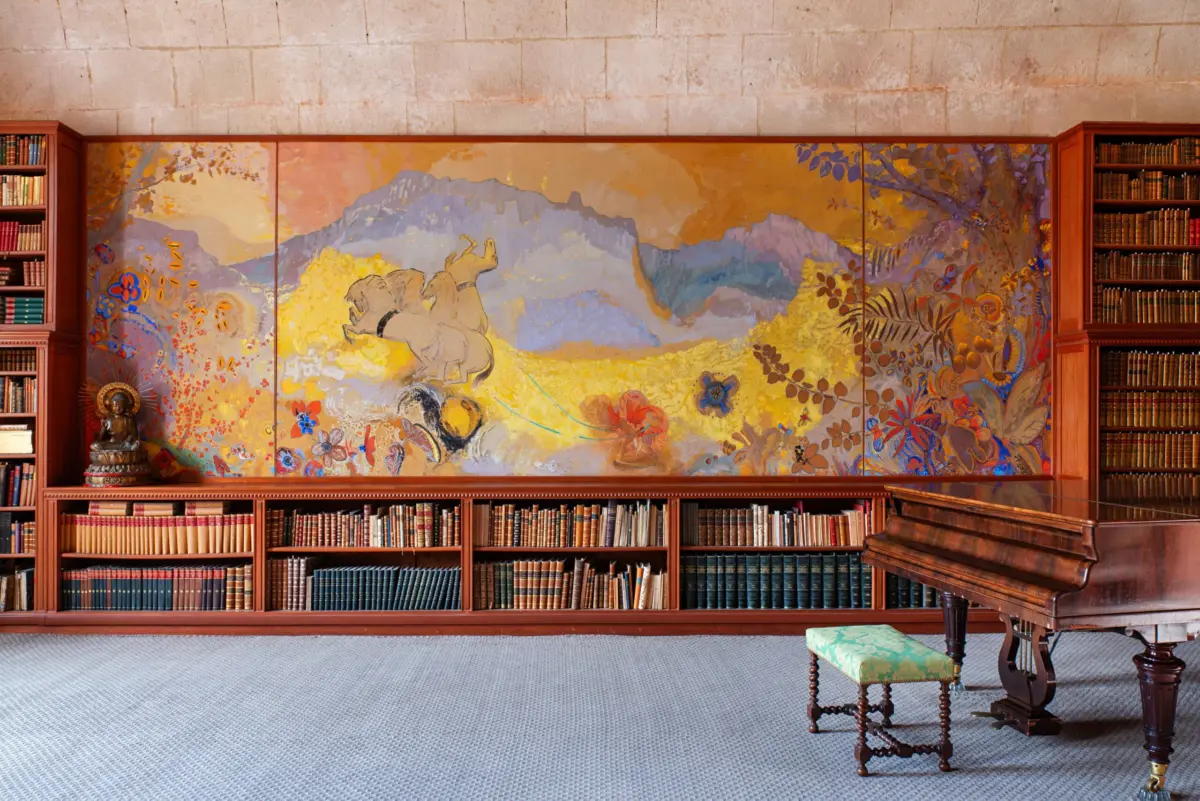
To realize this vision, Fayet assembled a collective of creative minds he affectionately dubbed the "Fontfroideans." The most notable among these was the Symbolist painter Odilon Redon. For the abbey’s library, Redon created a series of three monumental murals titled Day, Night, and Silence. These panels, which represent the pinnacle of Redon’s late-career output, have long been shielded from public view. One of the primary draws of the Fondation Louis Vuitton exhibition is the rare opportunity for the public to view these panels outside the confines of the abbey for the first time.

The restoration of Fontfroide acted as a catalyst for Fayet’s own artistic rebirth. After years of focusing on the works of others, he returned to his own practice with a newfound, idiosyncratic style. Around 1911, he began experimenting with watercolor on blotting paper, a technique that allowed for a bleeding, ethereal quality in his compositions. These floral works, characterized by what exhibition director Robert Carsen describes as "childlike spontaneity," revealed a mature artist who had finally found his own voice.
The Industrialist of Aesthetics: Atelier de la Dauphine
Fayet’s genius lay in his ability to translate high-art concepts into reproducible luxury goods. His blotting-paper watercolors caught the eye of the decorator Paul Dumas, who saw their potential as textile and wallpaper patterns. This partnership led to the founding of the Atelier de la Dauphine, a manufacturing venture dedicated to producing rugs and wall coverings based on Fayet’s designs.
The Fondation Louis Vuitton show will feature several of these original rugs, many of which have undergone extensive restoration specifically for this event. These pieces demonstrate how Fayet’s aesthetic—often a blend of Mediterranean light, Symbolist mystery, and the structured patterns of the Arts and Crafts movement—was disseminated into the homes of early 20th-century collectors. In his later years, Fayet’s creative output expanded even further into the world of literature and illustration, as he produced illuminated editions of poetry and even a whimsical book for his grandchildren, proving that his imaginative drive remained undiminished until his death.

Data and Analysis: The Scale of the "Icons of Modern Art" Series
The Gustave Fayet, Collector–Designer exhibition is the latest installment in the Fondation Louis Vuitton’s Icons of Modern Art series, which has previously featured the collections of Sergei Shchukin and the Morozov brothers. These exhibitions have been record-breaking in terms of attendance and historical significance, often reuniting collections that were dispersed by war, revolution, or economic shifts.
Statistical data from previous exhibitions in this series suggests a high level of public interest:
- The Shchukin Collection (2016-2017): Attracted over 1.2 million visitors.
- The Morozov Collection (2021-2022): Garnered approximately 1.1 million visitors despite post-pandemic travel restrictions.
The decision to focus on Fayet represents a strategic shift for the Foundation. While Shchukin and Morozov were titans of industry who acquired art, Fayet was a "multihyphenate" who participated in the creation of the art itself. By showcasing his work alongside the masterpieces he once owned, the exhibition challenges the traditional boundary between the "passive" collector and the "active" artist.

Broader Implications and Cultural Impact
The rediscovery of Gustave Fayet arrives at a moment when the art world is increasingly interested in the figures who operated "behind the scenes" of the Modernist movement. Art historians are moving away from the "Great Man" theory of history—which focuses solely on the painters themselves—to look at the networks of patronage, design, and commerce that allowed movements like Post-Impressionism and Fauvism to survive their initial rejection by critics.
Robert Carsen, the artistic director for the exhibition, emphasizes that Fayet’s career was defined by a constant "venturing deeper and deeper into new genres." This versatility is what makes Fayet a particularly modern figure. In an era where contemporary artists are expected to be brands, curators, and designers simultaneously, Fayet’s life provides a historical blueprint for the "creative director" model of artistic practice.
Furthermore, the exhibition highlights the importance of regional centers like Béziers and Narbonne in the development of French modernism. While Paris remained the epicenter, the financial and creative resources provided by wealthy provincial figures like Fayet were essential for the survival of artists like Gauguin and Van Gogh, who often lived on the margins of the capital’s economy.

As the doors open at the Frank Gehry building this October, the legacy of Gustave Fayet will finally step out from the shadows of the giants he supported. By presenting his life’s work as a cohesive whole—from the ceramics of his youth to the grand murals of Fontfroide and the innovative rugs of the Atelier de la Dauphine—the Fondation Louis Vuitton ensures that Fayet is no longer remembered just for what he bought, but for what he built. Through this monumental showcase, the "forgotten multihyphenate" is poised to reclaim his rightful place as one of the true architects of modern French culture.
