

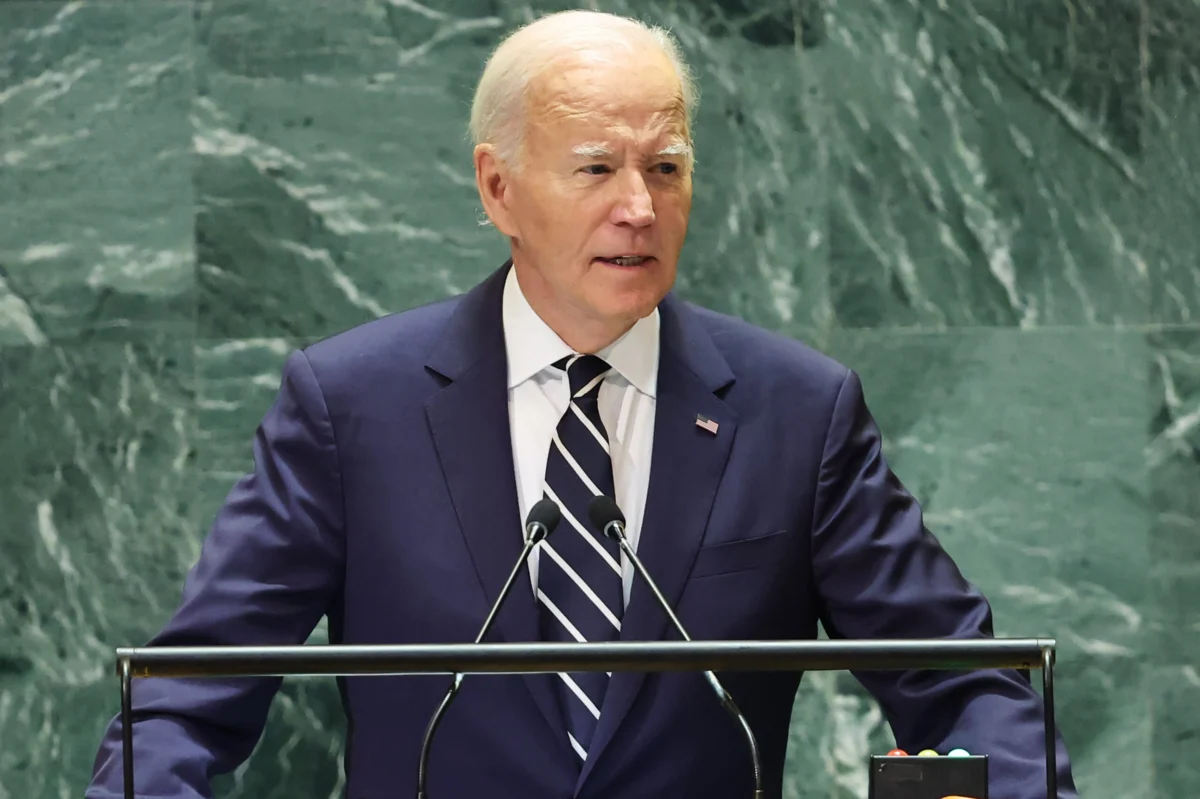
Standing before the green marble backdrop of the United Nations General Assembly for the final time as President of the United States, Joe Biden delivered a poignant address that attempted to reconcile his lifelong commitment to internationalism with a world increasingly fractured by brutal warfare and domestic political shifts. Addressing the 79th session of the General Assembly on Tuesday, Biden used his swan song on the global stage to frame his foreign policy legacy, urging world leaders to choose hope over despair while acknowledging the "grim reality" of current conflicts in the Middle East, Eastern Europe, and East Africa. His speech served as both a defense of the liberal international order and a personal reflection on a half-century of public service, coming just months before he is set to hand over the keys to the Oval Office.
“I know many look at the world today and see difficulties and react with despair,” Biden told the assembled heads of state and diplomats. “But maybe because of all I’ve seen and all we have done together over the decades, I have hope.” This optimism, however, was tested by the immediate geopolitical context: a Middle East on the precipice of regional war, a protracted war of attrition in Ukraine, and a forgotten humanitarian catastrophe in Sudan. As Biden prepares to exit the presidency, his address sought to solidify a doctrine of "diplomatic persistence," even as the effectiveness of the United Nations itself faces growing scrutiny.
A Legacy of Transatlantic Unity and the Defense of Ukraine
A central pillar of Biden’s address was the ongoing defense of Ukraine against Russian aggression. Since the full-scale invasion launched by Vladimir Putin in February 2022, the Biden administration has been the primary architect of a coalition that has provided tens of billions of dollars in military and economic aid to Kyiv. Biden framed the conflict not merely as a regional dispute, but as a fundamental test of the UN Charter and the principle of territorial integrity.
“We could have stood by and merely protested, but Vice President [Kamala] Harris and I understood that that was an assault on everything this institution was supposed to stand for,” Biden said. He highlighted the revitalization and expansion of NATO—which recently welcomed Finland and Sweden into its ranks—as a primary achievement of his tenure. However, the President also issued a stark warning to those within the international community and the U.S. Congress who have grown weary of the cost of the war. “You cannot grow weary,” he cautioned. “You cannot look away. We will not let up on our support for Ukraine, not until Ukraine wins a just and durable peace.”
This call for persistence comes at a critical juncture. In Washington, a segment of the Republican Party remains skeptical of continued funding for Ukraine, arguing that domestic priorities should take precedence. Biden’s speech was aimed as much at these domestic critics as it was at the global audience, emphasizing that a Russian victory would embolden autocrats globally and destabilize the international security architecture that has existed since the end of World War II.
The Middle East: A Region on the Brink
While the war in Ukraine represents a clear-cut struggle for sovereignty in Biden’s view, the situation in the Middle East presented a more complex and fraught challenge for his final UNGA address. Since his last speech to the General Assembly in September 2023, the region has been transformed by the October 7 Hamas attacks and Israel’s subsequent military campaign in Gaza. Biden’s address occurred as the conflict threatened to expand into a full-scale regional war involving Hezbollah in Lebanon and their backers in Tehran.
Biden reiterated his administration’s commitment to a ceasefire and hostage deal, an objective that has remained elusive despite months of high-level negotiations involving Egypt and Qatar. “Now is the time for the parties to finalize its terms, bring the hostages home, to secure security for Israel and Gaza free from Hamas’ grip, ease the suffering in Gaza, and end this war,” Biden declared. He also took a firmer stance on the escalating violence in the West Bank, calling for an end to attacks on innocent Palestinians and reiterating the necessity of a two-state solution.
The President’s vision for the region—one where Israel enjoys full normalization with its neighbors and Palestinians live in a state of their own with dignity and self-determination—remains the official goal of U.S. policy, yet critics argue that the current reality on the ground has moved further from this ideal during his presidency. The humanitarian crisis in Gaza, characterized by widespread displacement and a lack of essential resources, continues to be a point of significant friction between the U.S. and its allies in the Global South.
Addressing the Global Humanitarian Crisis in Sudan
Beyond the headlines of Ukraine and Gaza, Biden drew the world’s attention to the devastating civil war in Sudan. Often referred to as a "forgotten war," the conflict between the Sudanese Armed Forces (SAF) and the Rapid Support Forces (RSF) has created the world’s largest displacement crisis. Biden urged the international community to stop arming the rival generals and to increase humanitarian aid to the millions facing famine.
The inclusion of Sudan in his address was a strategic move to demonstrate that U.S. foreign policy is not solely focused on European and Middle Eastern interests. By highlighting the suffering in Sudan, Biden sought to align the U.S. with the concerns of African nations and reinforce the idea that the UN must be a vehicle for peace in every corner of the globe.

Managing the Rise of China and Technological Frontier
Biden’s foreign policy legacy is also inextricably linked to his approach toward China. Throughout his presidency, he has pursued a strategy of "de-risking" rather than "decoupling," attempting to compete with Beijing economically and technologically while maintaining open lines of communication to prevent conflict. During his address, he noted that managing this competition remains a top priority, alongside the development of global norms for artificial intelligence.
The administration has been proactive in outlining principles for AI, emphasizing that the technology should be used to advance the UN’s Sustainable Development Goals rather than as a tool for surveillance or warfare. This focus on the "technological frontier" reflects Biden’s belief that the 21st century will be defined by how democracies manage emerging technologies in the face of autocratic alternatives.
The Personal Toll of Leadership: A Call to Relinquish Power
Perhaps the most personal moment of the address came when Biden discussed his decision to withdraw from the 2024 presidential race. In July, following a period of intense internal party pressure and concerns over his age, Biden announced he would not seek re-election, effectively passing the torch to Vice President Kamala Harris.
“As much as I love the job, I love my country more. I decided, after 50 years of public service, it’s time for a new generation of leadership to take my nation forward,” he told the General Assembly. In a world where many leaders cling to power for decades, Biden’s message was clear: “My fellow leaders, let us never forget: Some things are more important than staying in power.” This statement was seen as a subtle rebuke to authoritarian leaders globally, as well as a reflection on the democratic process within the United States.
A Timeline of Diplomatic Engagements
Biden’s final UNGA appearance was part of a broader, final surge of diplomatic activity. The week surrounding the General Assembly featured a packed schedule designed to lock in policy gains before the January transition:
- September 21: Biden hosted the "Quad" summit in Wilmington, Delaware, meeting with the leaders of Australia, India, and Japan to discuss maritime security in the Indo-Pacific.
- September 23: A bilateral meeting with United Arab Emirates President Mohamed bin Zayed Al Nahyan in Washington to discuss regional stability and economic cooperation.
- September 24: The UN General Assembly address, followed by a summit on countering the trafficking of synthetic drugs, a key domestic and international priority for the administration.
- September 25: A scheduled meeting with Vietnamese President Tô Lâm to build on the historic upgrade in U.S.-Vietnam relations achieved in 2023.
- September 26: A pivotal meeting with Ukrainian President Volodymyr Zelenskyy at the White House. Zelenskyy is expected to present his "Victory Plan," while the U.S. considers further military support.
The Shadow of the 2024 Election
While Biden occupied the center stage, the looming U.S. election was an inescapable presence in the halls of the United Nations. Foreign leaders are increasingly hedging their bets, meeting not only with the sitting President but also with his potential successors.
Vice President Kamala Harris held her own high-level meetings, including a sit-down with the UAE president, and is scheduled to meet with Zelenskyy on Thursday. Simultaneously, former President Donald Trump, the Republican nominee, has maintained his own line of communication with world leaders. Trump is expected to meet with Zelenskyy, Indian Prime Minister Narendra Modi, and Polish President Andrzej Duda, signaling a potential "America First" return that could radically alter the alliances Biden has spent four years strengthening.
Fact-Based Analysis: The Future of the "Biden Doctrine"
As Joe Biden departs the international stage, the "Biden Doctrine"—defined by a return to multilateralism, the strengthening of traditional alliances, and the framing of global politics as a struggle between democracy and autocracy—faces an uncertain future.
Statistically, the Biden administration can point to a rejuvenated NATO and a robust post-pandemic economic recovery that has outpaced many other G7 nations. However, the persistence of the war in Ukraine and the volatility in the Middle East suggest that diplomatic engagement alone has limits. The United Nations, too, faces questions regarding its efficacy, as the Security Council remains largely paralyzed by the veto powers of its permanent members.
The implications of Biden’s final address are profound. He has set a high bar for the defense of democratic values and international law, yet he leaves behind a world that is arguably more dangerous than when he took office in 2021. The "hope" he spoke of at the rostrum will now be tested by his successors and the evolving realities of a multipolar world. For the international community, the speech was a reminder of a vanishing era of American leadership—one rooted in the post-Cold War consensus—even as the world enters a much more volatile and unpredictable chapter.
