

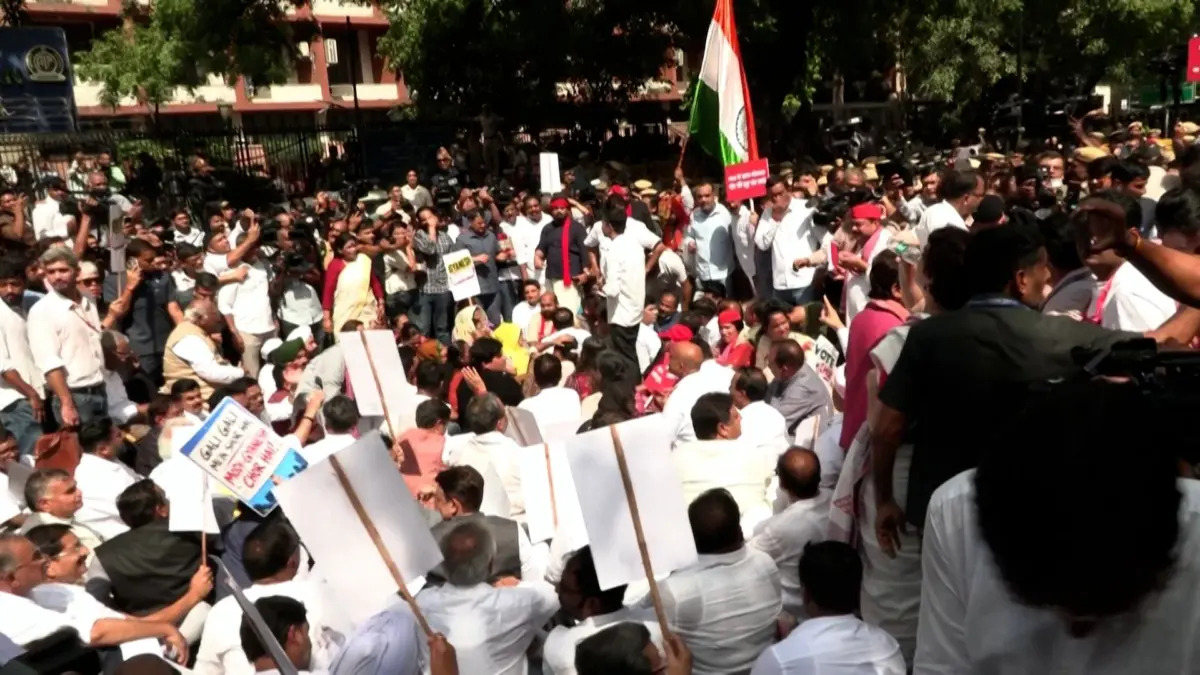
In a dramatic escalation of political tensions, police in New Delhi on October 6, 2026, detained several prominent Indian opposition leaders during a protest outside the Election Commission of India (ECI) headquarters. The protest saw lawmakers and activists converge, demanding the immediate resignation of Chief Election Commissioner (CEC) Gyanesh Kumar, whom they accuse of overseeing a flawed electoral process marked by significant voter-list irregularities. The Election Commission has vehemently denied these allegations, asserting its commitment to maintaining the integrity and fairness of India’s democratic exercises.
The detentions, which included Members of Parliament and senior functionaries from various opposition parties, underscore a deepening crisis of confidence between a significant portion of the political opposition and one of India’s most crucial independent constitutional bodies. The protest commenced mid-morning, with hundreds of supporters gathering near Nirvachan Sadan, the ECI’s central office, despite prohibitory orders in place. Chanting slogans calling for transparency and accountability, and carrying placards highlighting alleged discrepancies in electoral rolls, the demonstration quickly drew a heavy police presence. Authorities cited concerns over public order and the violation of Section 144 of the Criminal Procedure Code, which restricts public assembly, as the basis for the detentions.
Escalating Tensions: The Genesis of the Protest
The current wave of protests is not an isolated incident but rather the culmination of months of simmering discontent and specific accusations leveled by the opposition against the ECI. For over a year, a unified front of opposition parties, often referred to as the ‘INDIA’ bloc, has been vocal about alleged systemic issues impacting the integrity of India’s vast electoral rolls. Their concerns primarily revolve around three major areas: arbitrary deletion of legitimate voters, the presence of duplicate or "bogus" entries, and significant discrepancies between the ECI’s data and ground realities, particularly concerning demographic information.
Opposition leaders contend that these alleged irregularities disproportionately affect marginalized communities and opposition strongholds, raising serious questions about the fairness of upcoming elections. They have repeatedly submitted memorandums, held press conferences, and sought direct audiences with the Election Commission to present their evidence and demand corrective action. The Election Commission, however, has consistently dismissed these allegations as unsubstantiated or based on misinterpretations of its rigorous and multi-stage voter list revision process. The call for CEC Gyanesh Kumar’s resignation signals a critical breakdown in trust, with the opposition arguing that the ECI, under his leadership, has failed to adequately address their concerns or uphold its constitutional mandate impartially.
The Role and Independence of the Election Commission
The Election Commission of India is a permanent and independent constitutional body responsible for administering all election processes in India, including parliamentary, state legislative assembly, and presidential elections. Established under Article 324 of the Constitution, its functions encompass the preparation of electoral rolls, delimitation of constituencies, recognition of political parties, and ensuring the conduct of free and fair elections. Given India’s status as the world’s largest democracy, with an electorate exceeding 950 million citizens, the ECI’s role is monumental and its perceived independence is paramount to the credibility of the democratic process.
The integrity of electoral rolls is fundamental to democratic legitimacy. An accurate and updated voter list ensures that every eligible citizen can exercise their franchise and that no ineligible person can vote. The ECI employs a continuous update mechanism and periodic Special Summary Revisions (SSR) to ensure the accuracy of these rolls. This process involves public notification, invitation for claims and objections, field verification, and final publication. Public trust in the ECI’s ability to manage these processes without political interference is a cornerstone of India’s democratic framework. Challenges to the ECI’s impartiality, especially those involving the electoral rolls, therefore strike at the very heart of the nation’s democratic fabric.
A Chronology of Discontent: From Allegations to Direct Action
The events leading to the October 6th protest represent a gradual but steady escalation of grievances.
Early Warning Signs: Months of Mounting Concerns
The first significant public pronouncements regarding voter list irregularities emerged in early 2025, following the conclusion of several state assembly elections. Opposition parties began compiling anecdotal evidence and data analyses pointing to discrepancies. Specific allegations included:
- Arbitrary Deletions: Numerous reports from various constituencies claimed that names of legitimate voters, particularly those from minority communities or specific socio-economic backgrounds, were found deleted from the rolls without proper notification or due process. Activists cited instances where entire families or even localities found their names missing.
- Duplicate Entries: Conversely, allegations surfaced regarding the presence of thousands of duplicate entries, where a single individual was registered in multiple polling stations or even multiple districts, raising concerns about potential voter fraud.
- Demographic Mismatches: Statistical analyses presented by opposition-affiliated data groups highlighted unusual demographic shifts in certain constituencies, with significant changes in age, gender, or community representation on the voter lists that did not align with natural population growth or migration patterns.
These concerns were initially raised through local party units and subsequently compiled into detailed representations submitted to the ECI by various national opposition parties.
Calls for Accountability Intensify
Throughout late 2025 and early 2026, the opposition intensified its campaign. Multiple petitions were filed with the ECI, outlining specific examples of alleged irregularities across several states. Press conferences became a regular feature, with leaders displaying evidence of deleted voters and duplicate entries. They demanded transparent audits of the electoral rolls, particularly in "sensitive" constituencies, and sought a more robust grievance redressal mechanism that would address complaints promptly and effectively. When these representations failed to yield what the opposition considered satisfactory responses or concrete corrective actions, the rhetoric grew sharper. The ECI, in its defense, stated that its revision processes were transparent, involving booth-level officers and public participation, and that any discrepancies were minor or rectified during routine updates.
The October 6th Standoff
Having exhausted what they termed "official channels" without resolution, the opposition alliance decided on a direct confrontation. The call for a nationwide protest culminating in a demonstration outside the ECI headquarters in New Delhi was issued in late September 2026. The specific demand for CEC Gyanesh Kumar’s resignation emerged as a symbol of their complete loss of faith in the ECI’s current leadership.
On the morning of October 6th, hundreds of activists, party workers, and elected representatives from across the country converged near Nirvachan Sadan. Despite barricades and a significant deployment of Delhi Police personnel, the crowd managed to approach the perimeter of the ECI building. Prominent leaders, including several Members of Parliament and former chief ministers, attempted to breach the police cordon, asserting their right to peaceful protest and to directly convey their demands to the Election Commission.
The atmosphere was charged with slogans such as "Save Democracy," "Resign, CEC," and "Ensure Fair Elections." Police, having issued prior warnings regarding the prohibitory orders, acted swiftly to prevent further advancement. In a matter of minutes, dozens of leaders and key protestors were physically lifted and put into police vans. While the exact number of detentions was not immediately released, sources indicated that over fifty individuals, including at least ten Members of Parliament, were taken into custody. They were reportedly detained under sections related to unlawful assembly and obstructing public servants, and were transported to various police stations across the city, where they were held for several hours before being released later in the evening.
Official Responses and Counter-Narratives
The immediate aftermath of the protest saw swift reactions from all involved parties, each presenting their narrative of the unfolding events.
Election Commission’s Firm Denial
In response to the protest and the renewed allegations, the Election Commission of India issued a press statement reiterating its unwavering commitment to the impartiality and accuracy of its electoral processes. A spokesperson for the ECI stated, "The Election Commission operates with utmost transparency and adherence to constitutional principles. Allegations of widespread voter-list irregularities are baseless and misleading. Our electoral rolls undergo rigorous, multi-stage revision processes that involve extensive public participation and verification by trained officials. Any discrepancies brought to our notice are promptly investigated and addressed." The statement further emphasized that the ECI welcomes constructive criticism and engagement but condemned attempts to "undermine the credibility of a constitutional body through unsubstantiated claims and disruptive protests." The Commission highlighted its established grievance redressal mechanisms, urging political parties to utilize these formal channels rather than resorting to public demonstrations.
Police Action Justified
The Delhi Police defended its actions, stating that the detentions were necessary to maintain law and order and to enforce prohibitory orders in a sensitive zone. A senior police official remarked, "Prohibitory orders under Section 144 CrPC were in force around the Election Commission premises to ensure public safety and smooth functioning of essential services. Despite repeated warnings, protestors attempted to breach the barricades, necessitating intervention. The detentions were carried out as per legal provisions to disperse an unlawful assembly and prevent any untoward incidents." Police officials stressed that the actions were taken without prejudice against any political party, purely based on the need to uphold the law.
Government’s Stance
The ruling party swiftly condemned the opposition’s protest, accusing them of attempting to politicize and discredit independent institutions. A spokesperson for the ruling party stated, "This is a desperate attempt by the opposition to cast doubt on India’s democratic process ahead of crucial elections. When they lose elections, they question the Electronic Voting Machines (EVMs); when they fail to mobilize public support, they attack the Election Commission. The ECI is an independent body, and its integrity must be respected. Such protests are an insult to the constitutional framework and an attempt to create an atmosphere of distrust among the electorate." The government reiterated its full faith in the ECI’s ability to conduct free, fair, and transparent elections.
Reactions Across the Political Spectrum and Civil Society
The detentions and the underlying allegations have sparked a wide range of reactions, both domestically and internationally.
Opposition Vows Continued Resistance
Upon their release, the detained opposition leaders were defiant. Addressing the media, a prominent opposition Member of Parliament declared, "Our voices may be suppressed, but our resolve will not be broken. The police action today only strengthens our belief that the Election Commission, under its current leadership, is acting at the behest of the ruling dispensation. We will not rest until the electoral rolls are fully cleansed and CEC Gyanesh Kumar steps down. This is a fight for the very soul of Indian democracy." Many leaders vowed to intensify their protests and explore legal avenues to challenge the alleged irregularities and the detentions themselves.
Concerns from Watchdog Groups
Civil society organizations and electoral reform advocates expressed concern over the escalating tensions. The ‘Forum for Electoral Accountability,’ a prominent election watchdog, issued a statement calling for an independent audit of the electoral rolls. "While protests must adhere to legal norms, the seriousness of the allegations made by a broad spectrum of opposition parties cannot be ignored," read their statement. "The ECI must go beyond mere denials and proactively engage with all stakeholders to transparently address every concern. Public confidence in the electoral process is non-negotiable for a healthy democracy."
Legal and Constitutional Perspectives
Legal experts offered varied perspectives. Some emphasized the importance of maintaining public order and respecting prohibitory orders, while others highlighted the fundamental right to peaceful protest. Dr. Anjana Sharma, a constitutional law expert, noted, "The ECI holds vast powers and responsibility. While it must be independent, it is also accountable. There are constitutional mechanisms for redressal of grievances. However, when those channels are perceived as unresponsive, protests often become the only recourse for political parties. The challenge lies in balancing the right to protest with the need for maintaining public order and respecting institutional integrity."
Broader Implications for India’s Democratic Fabric
The ongoing dispute surrounding voter-list irregularities and the subsequent protests carry significant implications for the future of India’s democratic landscape.
Erosion of Public Trust?
The most critical implication is the potential erosion of public trust in the Election Commission, and by extension, in the entire democratic process. If a substantial segment of the electorate perceives the electoral rolls as manipulated or unfair, it can lead to widespread cynicism, voter apathy, and even political instability. In a country as diverse and politically charged as India, confidence in the impartiality of electoral bodies is paramount to ensuring peaceful transitions of power and the acceptance of election outcomes.
Political Landscape and Upcoming Elections
The controversy is set to dominate the political narrative leading up to future elections, whether state assembly polls or the next general election cycle. The opposition alliance will likely continue to use this issue as a rallying point, portraying themselves as defenders of democracy against an allegedly compromised system. This could further polarize the electorate and intensify political campaigning. For the ruling party, the challenge will be to defend the ECI’s integrity without appearing to undermine its independence, while simultaneously countering the opposition’s narrative. The dispute could also influence voter turnout and the dynamics of political mobilization.
The Imperative for Electoral Reforms
This high-stakes standoff could reignite long-standing debates about electoral reforms in India. Discussions might focus on:
- Appointment of Election Commissioners: Calls for a more transparent and bipartisan process for appointing the Chief Election Commissioner and other Election Commissioners, moving away from a system where the government of the day holds significant sway.
- Voter List Management Transparency: Demands for greater transparency in the entire voter list revision process, including public access to data, detailed justifications for deletions, and robust independent auditing mechanisms.
- Grievance Redressal: Strengthening the ECI’s grievance redressal system to ensure timely, impartial, and publicly documented resolution of complaints from citizens and political parties.
- Technological Solutions: Exploring advanced technological solutions for voter registration and verification that minimize human error and potential for manipulation.
International Scrutiny
As the world’s largest democracy, India’s electoral processes are often subject to international observation and commentary. The current allegations and the resulting political friction could draw scrutiny from international democratic watchdogs, human rights organizations, and foreign governments, potentially impacting India’s global standing as a beacon of democratic values.
The events of October 6, 2026, mark a significant moment in India’s political trajectory. The clash between the opposition’s demands for electoral integrity and the Election Commission’s assertion of its impartiality has created a volatile situation. The path forward demands not just political maneuvering, but a serious commitment from all stakeholders to uphold the sanctity of India’s democratic institutions and to ensure that every citizen’s right to vote is protected and respected. The resolution of these critical issues will undoubtedly shape the future of India’s vibrant, yet often contentious, democratic landscape.
